
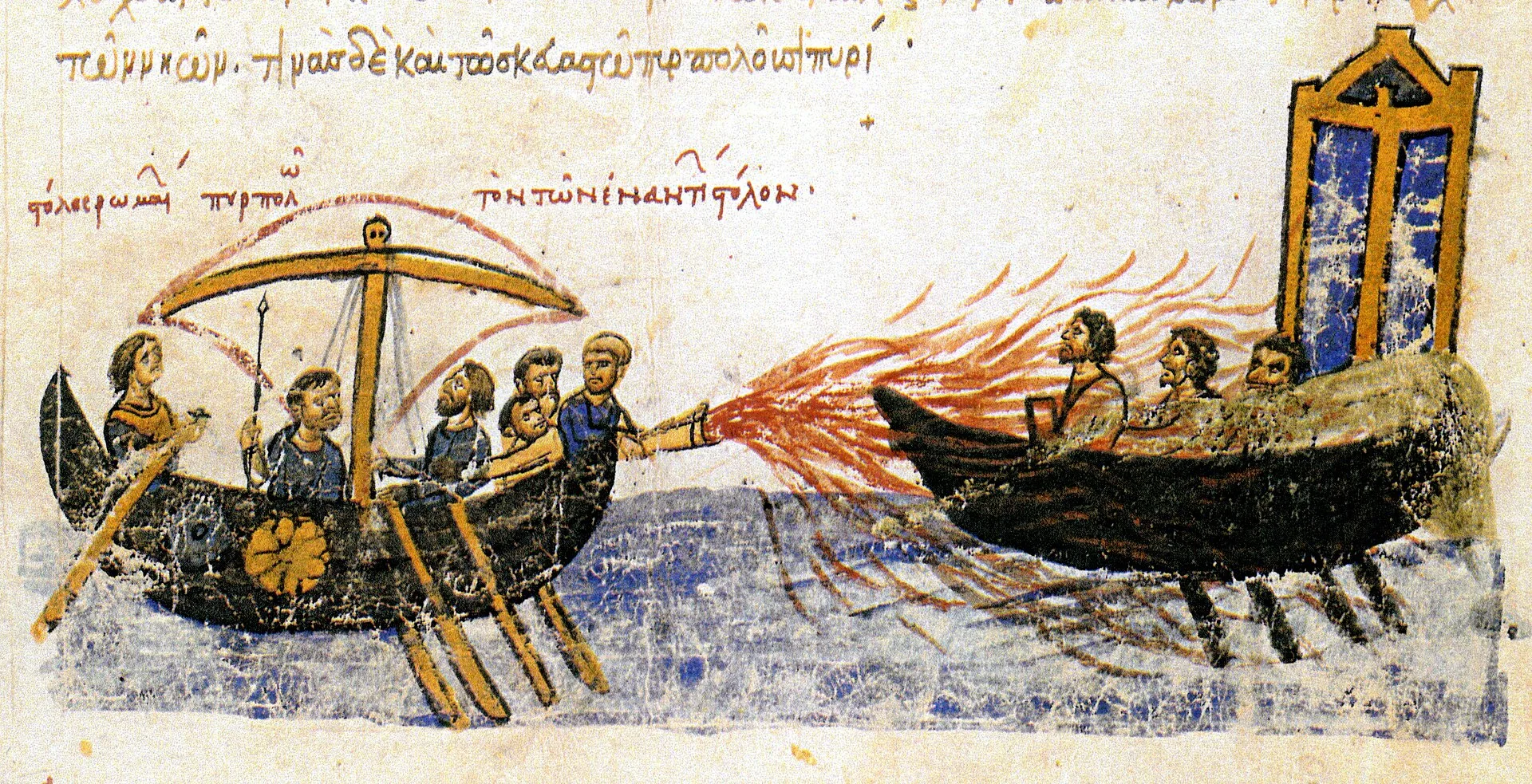
For several centuries the warships of the Byzantine Empire, the Greek-speaking continuation of the Roman Empire ruled from Constantinople, carried a weapon their enemies dreaded: a burning liquid pumped through a nozzle at the bow that clung to whatever it hit and kept burning on the surface of the sea. The Byzantines called it sea fire, liquid fire or prepared fire. Western crusaders later called it Greek fire. How it was made was a state secret, and the secret was kept so well that no one now knows the recipe.
Where it came from
The main early source is the chronicler Theophanes the Confessor, writing in the early ninth century. He credits an architect named Kallinikos, a refugee from Heliopolis in Syria, with devising the sea fire around 672, at a time when Arab fleets were pressing toward Constantinople itself. Ships armed with it burned the Arab vessels, crews and all. Theophanes also mentions Byzantine ships equipped with siphons a year or two before Kallinikos appears, so the refugee may have improved an existing incendiary rather than invented one. As the Skeptoid writer Brian Dunning points out, petroleum and its light fraction, naphtha, had long been used in war, thrown in pots or smeared on arrows. What was new was a liquid that could be projected under pressure from a ship.
How it was used
The weapon was a system rather than a substance. A bronze tube, the siphon, was mounted on a swivel at the prow. Modern reconstructions assume the liquid was heated in a closed vessel and forced out by a pump, with a flame at the mouth to ignite it as it emerged. Range was short, probably no more than about fifteen meters. Later emperors added hand-held siphons for use by single soldiers and grenades of fire packed in clay jars.
Byzantine fleets used it against Arab attackers in the late seventh and early eighth centuries, against the rebel admiral Thomas the Slav in the 820s, and against Rus raiders in the tenth century. The princess and historian Anna Komnene describes Byzantine ships fighting a Pisan fleet in 1099 with siphons cast in the shape of lions’ heads, so that the fire seemed to pour from the beasts’ mouths.
A guarded secret
In the mid-tenth century the emperor Constantine VII wrote a handbook of statecraft for his son, De Administrando Imperio. In it he instructs that foreigners asking for the liquid fire must be refused, explaining that its secret had been revealed by an angel to Constantine the Great on condition that it never be given to another nation, and that an official who once betrayed it had been struck down by fire from heaven as he entered a church. Modern historians think the real protection was more practical. Knowledge seems to have been divided among different specialists, so that no single captured sailor or craftsman could reproduce the whole system. When the Bulgarians captured dozens of siphons and a quantity of the liquid in 814, they apparently could not use them.
Mentions of the weapon fade in the twelfth century, and there is no reliable report of it during the crusader attacks on Constantinople in 1203 and 1204. Whether the knowledge had already been lost, the raw materials had become unobtainable or the system had simply fallen out of use is not known.
What was in it
Early modern scholars proposed saltpetre, which would make Greek fire a kind of gunpowder, or quicklime, which reacts violently with water. Both ideas are now largely rejected: saltpetre does not appear in Middle Eastern or European warfare until the thirteenth century, and a lime mixture could not be pumped through a tube. Most historians now favor a petroleum base, possibly crude oil from wells around the Black Sea, mixed with pine resin or similar substances to make it sticky. In 2002 the Byzantine historian John Haldon tested a reconstructed pressurized siphon firing light crude oil and resin, which produced a roaring jet of flame. The experiment showed such a weapon was possible, not that it matched the Byzantine original.
Where it stands
Greek fire was real, well documented and as frightening as its reputation. Its general nature is no longer much of a mystery; the precise formula and the engineering of the siphons remain unknown, and short of a lost technical manual coming to light, they are likely to stay that way.