
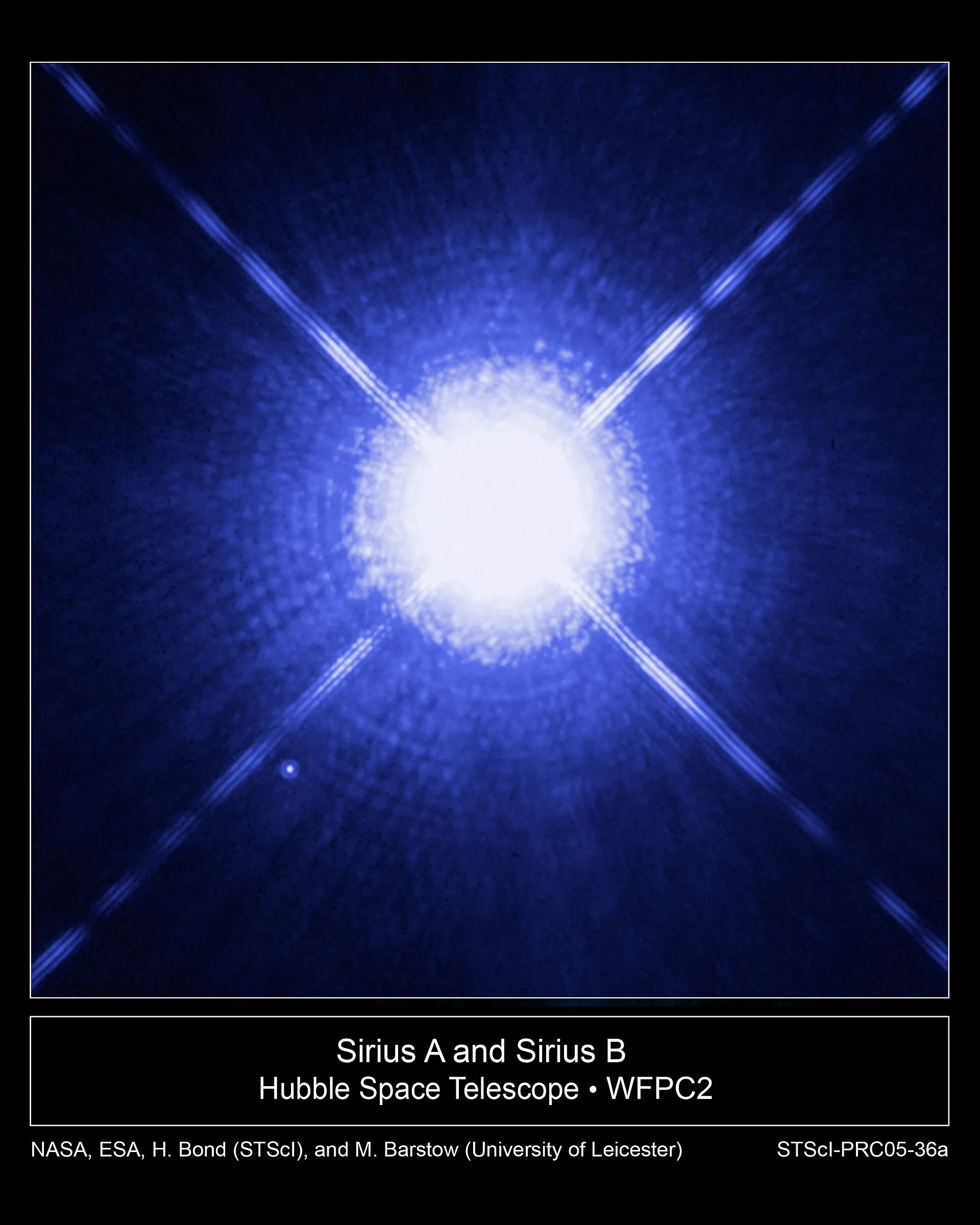
Sirius, the brightest star in the night sky, has a faint partner. Sirius B is a white dwarf, a collapsed stellar core roughly the mass of the Sun packed into a body about the size of Earth, and it circles its brilliant companion every fifty years. Western astronomers worked this out between 1844 and the 1920s. In 1950 two French ethnologists reported that the Dogon of Mali, farmers living along the cliffs of the Bandiagara Escarpment, already knew it. That claim became the foundation of one of the most influential books of the ancient-astronaut movement.
What happened
Marcel Griaule began fieldwork among the Dogon in 1931 and returned repeatedly, from 1946 every year until his death in 1956, often with his colleague Germaine Dieterlen. In 1950 they published “Un système soudanais de Sirius” in the Journal de la Société des Africanistes. It drew mainly on interviews carried out between 1946 and 1950 with four senior Dogon informants from the Sanga area, among them a priestess and a village patriarch. According to the article, the Dogon held that Sirius, which they called sigu tolo, had an invisible companion called po tolo, named after a tiny cultivated grain. It was the smallest and heaviest of all stars, made of a special metal, and it took fifty years to orbit Sirius. A third body, emme ya, was said to accompany them, and the whole system was tied to the Sigui, a ceremony held about once every sixty years. The authors added that they had not tried to explain how people without telescopes could know such things.
Their 1965 book Le Renard pâle expanded the system. In 1976 the American writer Robert Temple published The Sirius Mystery, which argued that the knowledge had been handed down from amphibious beings, the Nommo of Dogon myth, who had visited Earth from the Sirius system thousands of years ago. The book found a wide audience and appeared in an expanded second edition in 1998.
The investigation
Skeptics responded quickly. The astronomer Ian Ridpath wrote in 1978 that the Dogon account, read literally, was full of contradictions and errors, and that its resemblances to modern astronomy could have entered through contact with Europeans long before the ethnologists arrived. Carl Sagan made a similar case in 1979. Others suggested possible channels, from Dogon who had traveled abroad to a French expedition that spent five weeks in West Africa observing the solar eclipse of April 16, 1893.
The most damaging test came from the field. The Dutch anthropologist Walter van Beek worked among the Dogon of Tireli, on the same escarpment, for a decade from 1979, deliberately checking Griaule’s major works against what people told him, and published his findings in Current Anthropology in 1991. They found no evidence that the Dogon regarded Sirius as a double star or that astronomy played the central part in their religion that Griaule had described. People did speak of sigu tolo, but they disagreed about which star it was; some said an unseen star that would rise to announce the Sigui, others pointed to Venus. All of them, van Beek reported, said they had learned about the star from Griaule. He concluded that Griaule’s coherent cosmology was largely his own synthesis of fragmentary myths, shaped by his questioning and by informants’ readiness to please an influential visitor. Griaule’s daughter, the linguist Geneviève Calame-Griaule, and other defenders replied that van Beek had not been admitted to esoteric knowledge, and the debate over Griaule’s methods continues.
The explanations
The astronomy also cuts against the claim. Telescopic measurements show a single white dwarf, close to the Sun’s mass, orbiting Sirius A every 50.1 years. Precise Hubble Space Telescope tracking published in 2017 found no third body and ruled out companions heavier than about 15 to 25 times the mass of Jupiter around either star over the range of orbits it could test, leaving the predicted emme ya unconfirmed. The details that are accurate were all known to European astronomy by the 1920s, and others, as critics including the journalist James Oberg noted, match the astronomy of that time rather than of today, such as the count of Jupiter’s moons and the idea that only Saturn has rings.
Where it stands
The Sirius mystery is no longer a question about what the Dogon knew in antiquity. It is a question about what Griaule and Dieterlen recorded, how they asked, and what their informants had already heard. The one major independent restudy found no Dogon tradition of Sirius B and traced the star lore to Griaule himself. The Dogon have a rich ritual life connected to the Sigui; an ancient knowledge of a white dwarf invisible to the eye is not shown to be part of it.