
In the summer of 1841 the body of a young woman was pulled from the Hudson River off Hoboken, New Jersey, across the water from Manhattan. She was Mary Cecilia Rogers, a clerk well known to New Yorkers as the “beautiful cigar girl.” Her death filled the city’s new penny newspapers for months and became, a year later, the basis for one of the first detective stories ever written. Nobody was ever charged, and how she died is still disputed.
What happened
Rogers had worked behind the counter of John Anderson’s cigar store in Manhattan, where her looks drew a steady stream of customers and admirers. In 1838 she had briefly vanished, leaving what her mother took for a suicide note, and then reappeared, leading some papers to suspect a publicity stunt for the store. By 1841 she was helping her widowed mother, Phoebe, run a boardinghouse and was engaged to one of the boarders, a cork cutter named Daniel Payne. Another lodger, Alfred Crommelin, had courted her and been turned down.
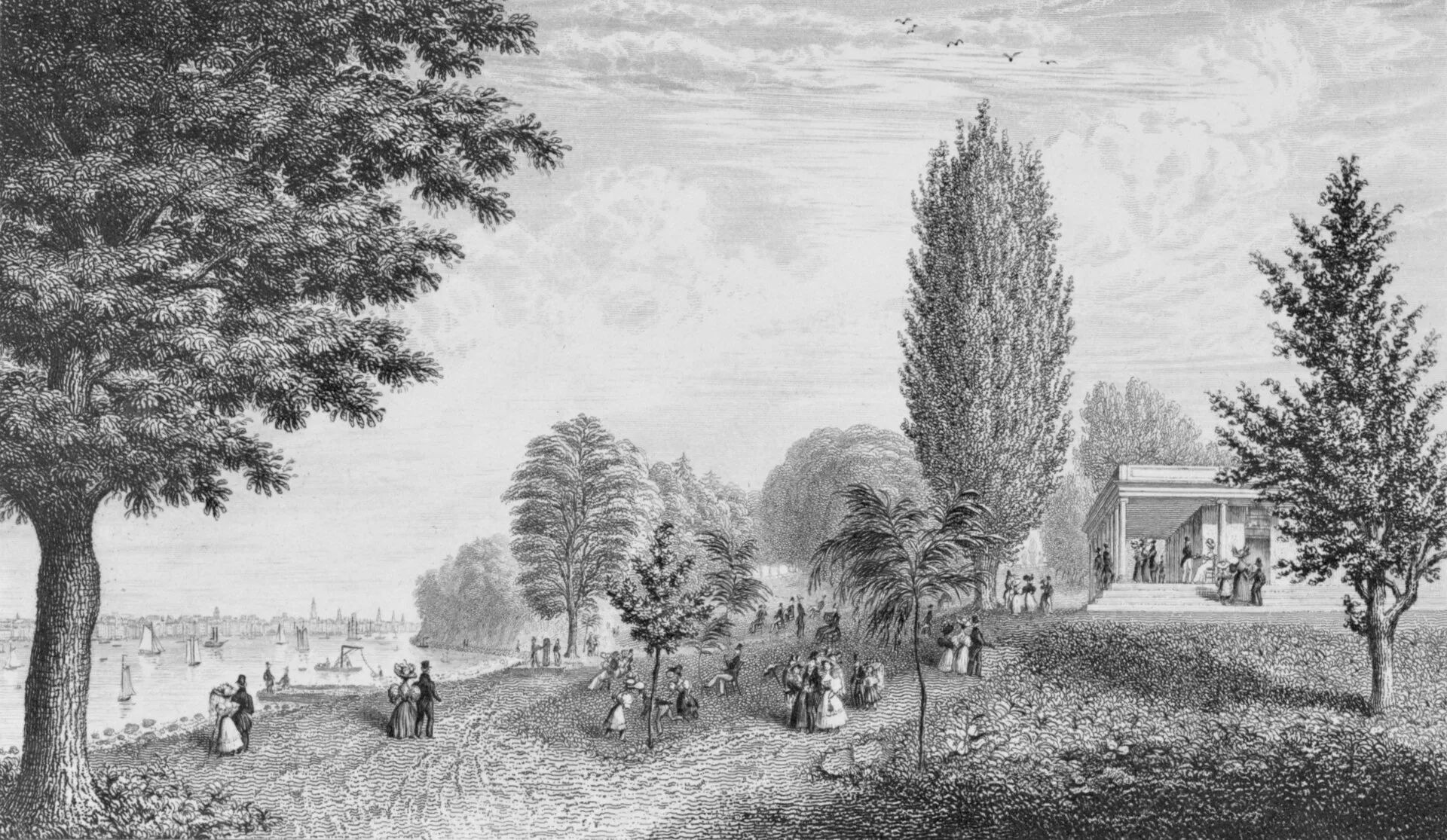
On the morning of Sunday, July 25, 1841, Payne walked her to an omnibus; she said she was going to visit relatives. She did not come back. On July 28 three men in a rowboat found a woman’s body in the river near Sybil’s Cave, a picturesque grotto and spring at the edge of the Elysian Fields, a riverside park popular with New Yorkers on day trips. Crommelin, who had crossed to Hoboken to search, identified her by her clothing and the hair on her arm. The New Jersey coroner’s hasty examination found a cord still tied around her throat and recorded strangulation; days later the New York coroner had the body dug up and brought across the river for a second look. Some reporters doubted it was her at all.
The investigation
New York in 1841 still relied on a night watch and a handful of constables and marshals, and the case became a running indictment of that system in the press. The sons of Frederica Loss, who kept a roadhouse near the river, said she had stopped there that Sunday evening, that a gang of rowdies had been in the house, and that they later heard a woman scream from the woods. A magistrate settled on an unidentified gang of Irish immigrants, and that became the accepted version. About a month after the body was found, two boys reported finding some of her clothing in a thicket nearby, a scene the New York Tribune illustrated. In October Payne went to Hoboken, drank heavily, swallowed laudanum and died near Sybil’s Cave, leaving a remorseful note announcing that he had come to “the very spot.” Police had earlier accepted his alibi: he admitted he had gone drinking instead of meeting her that evening as planned.
In November 1842 Frederica Loss was accidentally shot by one of her sons. Before she died she was reported to have said that Rogers had died at her house during a botched abortion, and that the body had been dumped in the river. The well-known New York abortion provider Madame Restell was blamed in the papers, though she was never seriously treated as a suspect, and the magistrate supposedly given the confession later called it a cruel hoax.
The explanations
Edgar Allan Poe, living in Philadelphia, followed the coverage closely. By June 1842 he had written “The Mystery of Marie Rogêt,” moving the case to Paris and handing it to his detective C. Auguste Dupin, who works entirely from newspaper reports. After magazines in Baltimore and Boston turned it down, it ran in Snowden’s Ladies’ Companion in three installments in November and December 1842 and February 1843. The 1842 text argued for a single killer, probably a naval officer, rather than a gang. According to the Poe scholar Richard Fusco, the Loss story broke between the second and third installments and forced hurried changes. When Poe reprinted the tale in 1845 he cut the passages that named a solution, softened his attacks on the police, added wording that left room for an abortion, and claimed in a footnote that later confessions had confirmed his reasoning. Fusco shows that claim does not survive a check of the dates. Poe reportedly told Sarah Helen Whitman years later that the killer was a naval officer named Spencer.
Other suspects have had their advocates: Payne, Crommelin, an unknown sailor, the Loss family. When the Poe Museum in Richmond asked visitors to its “CSI: Poe” exhibition in 2016 to vote, they picked Payne. Anderson, who became rich selling tobacco to gold prospectors, later took up Spiritualism and believed Mary’s ghost followed him and offered advice.
Where it stands
The cause of death was never settled, and the evidence for a gang, a lover and a failed abortion all came from witnesses whose stories shifted. The case is remembered today mainly through Poe, whose story did not solve it.