
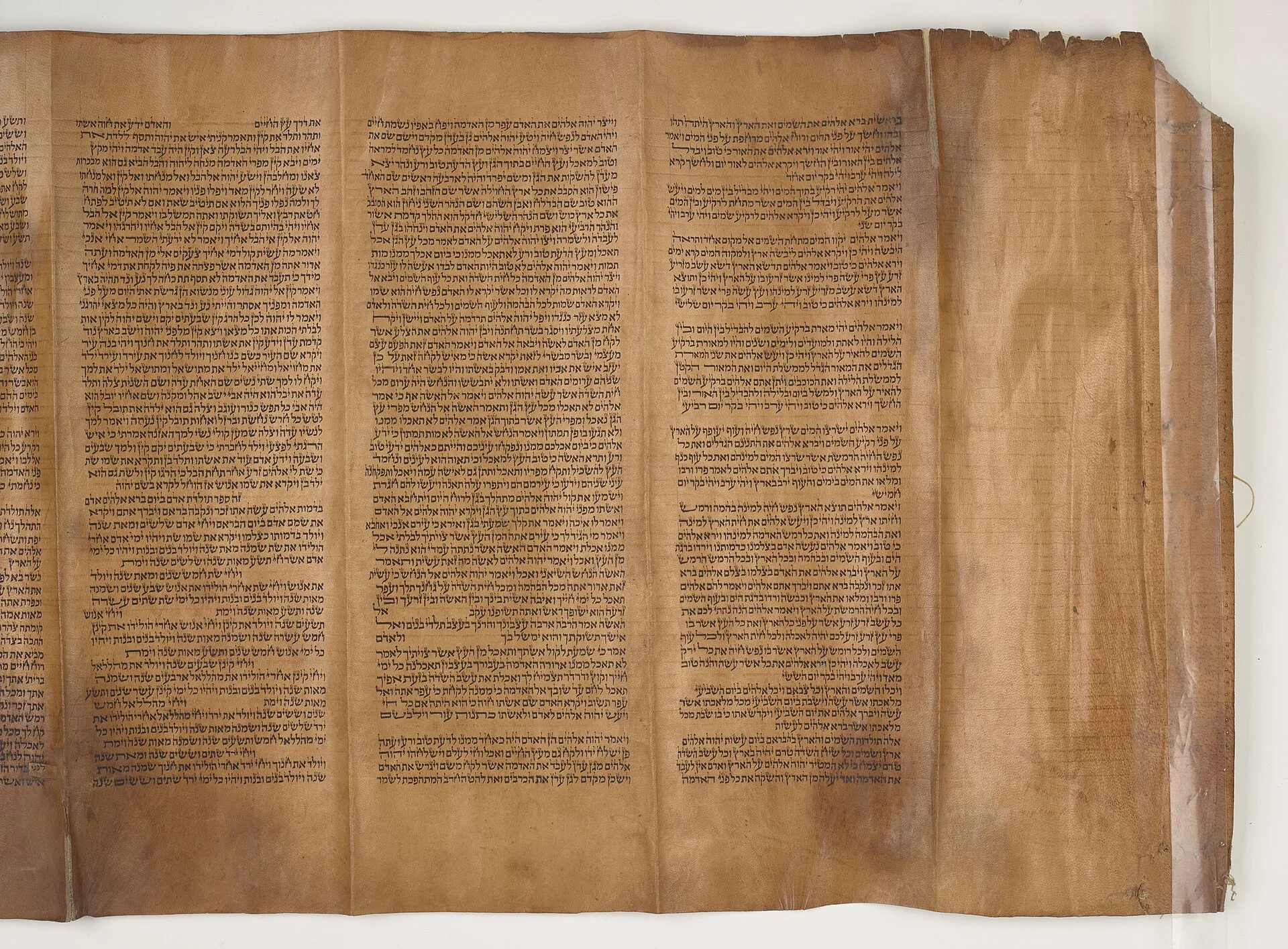
The idea behind the Bible code is simple to state. Take the Hebrew text of the Torah, strip out the spaces so that it becomes one continuous string of about 304,800 letters, and read every fifth letter, or every fiftieth, or every three-thousandth, starting from any point. Somewhere in those skips, believers say, are names, dates and warnings that the authors of Genesis could not have known. In the 1990s the claim moved from Jerusalem study halls to a statistics journal and then to the bestseller lists.
What happened
Hunting for letters at regular intervals in scripture had a long history among a few Jewish scholars, including an Orthodox rabbi in New York who worked at it by hand in the 1950s. Computers made it fast. In August 1994 the journal Statistical Science published a paper by three Israeli researchers, Doron Witztum, Eliyahu Rips of the Hebrew University and Yoav Rosenberg, on what they called equidistant letter sequences in Genesis. They had taken the names of 32 rabbinic sages who lived between the ninth and eighteenth centuries, together with the dates on which they were born or died, and measured how close each name lay to its matching date when both were hunted as skip sequences in Genesis. The pairs fell closer together than they did in scrambled versions of Genesis or in Tolstoy’s War and Peace rendered into Hebrew, and the authors reported odds against chance of roughly 62,500 to one. The journal’s editor, Robert Kass, presented the paper to readers as a challenging puzzle, not as an endorsement; its referees could not find the flaw but doubted the result.
In 1997 the journalist Michael Drosnin, who had reported for both The Wall Street Journal and The Washington Post, published The Bible Code with Simon and Schuster. Drosnin used looser methods to search the whole Torah for modern events. His centerpiece was the assassination of the Israeli prime minister Yitzhak Rabin: Drosnin said he had found Rabin’s name crossed by a phrase he translated as “assassin that will assassinate,” and that in 1994 he had flown to Israel to deliver a warning letter. Rabin was shot in November 1995. The book also forecast an atomic world war beginning in Jerusalem within about a decade. It became a bestseller and put the codes on daytime television.
The investigation
Rips moved quickly to separate himself from the book. On the day it reached stores he issued a handwritten statement disowning both Drosnin’s methods and the conclusions he drew from them, and saying that, in his view, the codes could not be used to predict the future. Mathematicians were less patient with both. Drosnin had told Newsweek that he would take his critics seriously when they found a prime minister’s assassination encoded in Moby Dick. The Australian mathematician Brendan McKay ran the same kind of search on Melville’s novel and posted grids showing Indira Gandhi, Martin Luther King, John F. Kennedy and Rabin himself, each surrounded by apt words, and explained that no rules beyond a little programming were needed to produce them.
The original 1994 paper required a harder answer, because its test had been designed in advance. In 1999 Statistical Science published “Solving the Bible Code Puzzle” by McKay, Dror Bar-Natan, Maya Bar-Hillel and Gil Kalai, after review by four senior statisticians. They showed that Hebrew names and dates can be spelled in many legitimate ways, and that the particular spellings and appellations chosen for the rabbis were the ones that happened to make Genesis look exceptional. Minor, equally defensible changes to the word list made the effect much weaker. Using the same latitude, they assembled a list that produced an equally striking result in War and Peace. Kass, introducing their paper, agreed that the puzzle had been solved: the choices behind the data had in effect tuned the method to Genesis.
The explanations
The general lesson is one statisticians call data mining. A text of hundreds of thousands of letters, searched at every possible skip and in every direction, will throw up an enormous number of short words, and anyone free to choose which words to look for, how to spell them and what counts as close will find meaningful clusters anywhere. The Harvard mathematician Shlomo Sternberg noted that Drosnin’s Rabin phrase could equally be read as calling Rabin himself a killer, and Newsweek reported that Drosnin spotted the gunman’s surname, Amir, near Rabin’s name only after the police had arrested him.
Where it stands
Witztum has continued to publish rebuttals defending the original experiment, and the McKay team has replied to the main ones. No warning drawn from the codes is known to have foretold a specific event in advance, and Drosnin’s predicted atomic war did not occur. Within mainstream statistics the matter is regarded as closed: the 1994 paper was the only refereed study claiming to support the codes, and the journal that printed it has published the explanation of why it worked.