
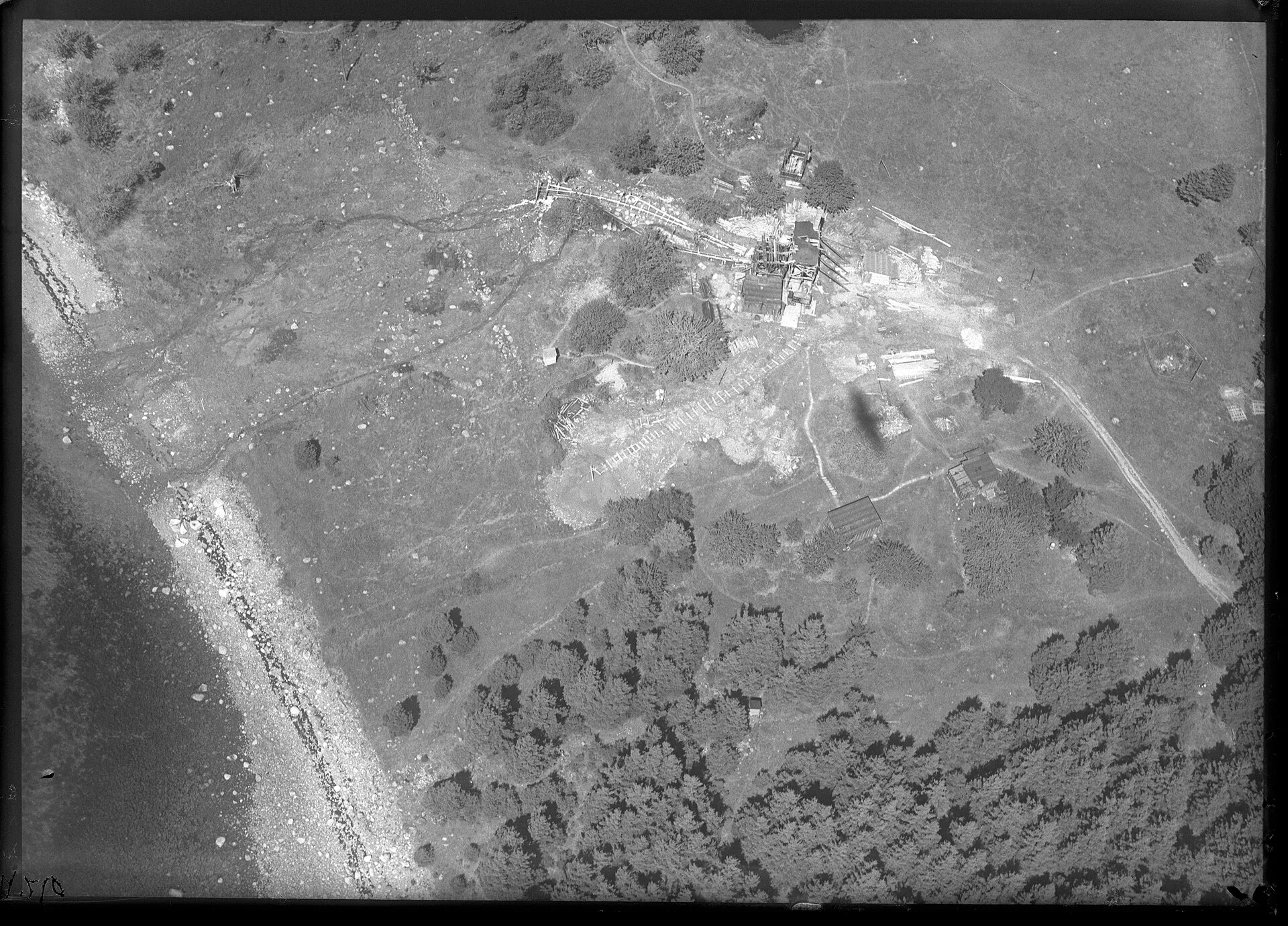
Oak Island is a wooded drumlin of about 57 hectares in Mahone Bay, on the south shore of Nova Scotia, joined to the mainland near Western Shore by a causeway. Its fame rests on a single spot near the eastern end, the Money Pit, where people have been digging for buried treasure, on and off, for more than two hundred years. In that time the hunt has consumed several fortunes, cost six lives and turned up no treasure.
What happened
The founding story is that in 1795 a young man named Daniel McGinnis noticed a round dip in the ground under an old oak, with signs that the surrounding trees had been cleared, and came back with two friends, John Smith and Anthony Vaughan, to dig. They are said to have found a layer of flat stones near the surface and then, at intervals of roughly ten feet, platforms of oak logs set into the walls of a shaft whose clay sides looked man-made. Tales of pirate gold, especially Captain William Kidd’s, were already common along the coast. It matters that no written account of this survives from the 1790s; the version everyone repeats was first printed in the 1850s and grew with each retelling.
Around 1803 the Onslow Company took the shaft much deeper, reporting more platforms and, at about 90 feet, a stone slab carved with symbols nobody could read. Soon afterward the pit filled with seawater to the level of the tide, and that became the defining feature of Oak Island: every serious attempt since has ended in flooding. The Truro Company in 1849 reported bringing up links of gold chain on a drill bit and traced the water to Smith’s Cove, where it said it found drains packed with coconut fiber. A worker was scalded to death in 1861 when a pumping engine’s boiler burst, and another man fell to his death in 1897. In 1909 a young Franklin D. Roosevelt invested in, and visited, an expedition that found nothing.
The investigation
The most costly chapter began in October 1959, when Robert Restall, who with his wife Mildred had toured a daredevil motorcycle act, brought his family to the island to dig full time, living for almost six years without electricity, a telephone or running water. On August 17, 1965 Restall was overcome by fumes while working in a shaft near Smith’s Cove. His son Robert Jr. went down after him, then his partner Karl Graeser and a worker, Cyril Hiltz; all four died. His daughter, Lee Lamb, later compiled the family’s account of those years. Soon afterward heavy machinery crossed a new causeway and gouged a crater around the old workings, erasing whatever original features survived.
Dan Blankenship, a Miami building contractor who read about the island in Reader’s Digest in 1965, settled on the island in the 1970s and spent the rest of his life on the search, much of it with the Triton Alliance syndicate. His steel-cased shaft known as Borehole 10-X went down more than 200 feet, and in 1971 he lowered a camera into a flooded cavity at the bottom; Triton’s backers said the footage showed a severed hand and part of a chest, but others who studied it could make out nothing of the kind. Blankenship died in March 2019 at 95, still a partner of the brothers Rick and Marty Lagina, whose excavations have been filmed for the History channel series The Curse of Oak Island since 2014. The province regulates the hunt under the Oak Island Treasure Act of 2010, which licenses searchers and reserves a royalty on anything of value.
The explanations
The candidates for the buried hoard include Kidd and other pirates, a Spanish or British pay chest, the Knights Templar with the Holy Grail, Marie Antoinette’s jewels, and manuscripts proving that Francis Bacon wrote Shakespeare. None rests on documents linking that party to the island. What the digging has produced is consistent with a working colonial shore: wood, nails, iron fittings, coins, a brooch, bits of pottery and, according to the show, a lead cross and human bone fragments whose significance is disputed.
Joe Nickell, writing in Skeptical Inquirer in 2000, argued that the legend was shaped by nineteenth-century Freemasons who read their own allegory of a hidden vault into the pit. The physical case starts with the rock. The east end of the island, where the pit lies, sits on limestone and gypsum of the Windsor Group, minerals that groundwater dissolves into caverns and sinkholes, and logs and debris that fall into such holes can look like deliberate platforms to a digger. A short 1995 study by Woods Hole Oceanographic Institution scientists then went after the flood tunnels. According to the researchers, interviewed by the writer Richard Joltes, dye poured into Borehole 10-X never appeared anywhere along the shore, side-scan sonar found no channel running to the sea, and the water in the shaft was brackish rather than salt, the mark of fresh groundwater floating on seawater beneath the island.
Where it stands
Licensed digging continues. The early history is a retold tradition rather than a record, the original pit was destroyed decades ago, and nothing recovered so far is worth the money spent recovering it. No one can prove the island holds nothing, but the best-supported account is a natural hole, a pirate rumor and two centuries of hope.