
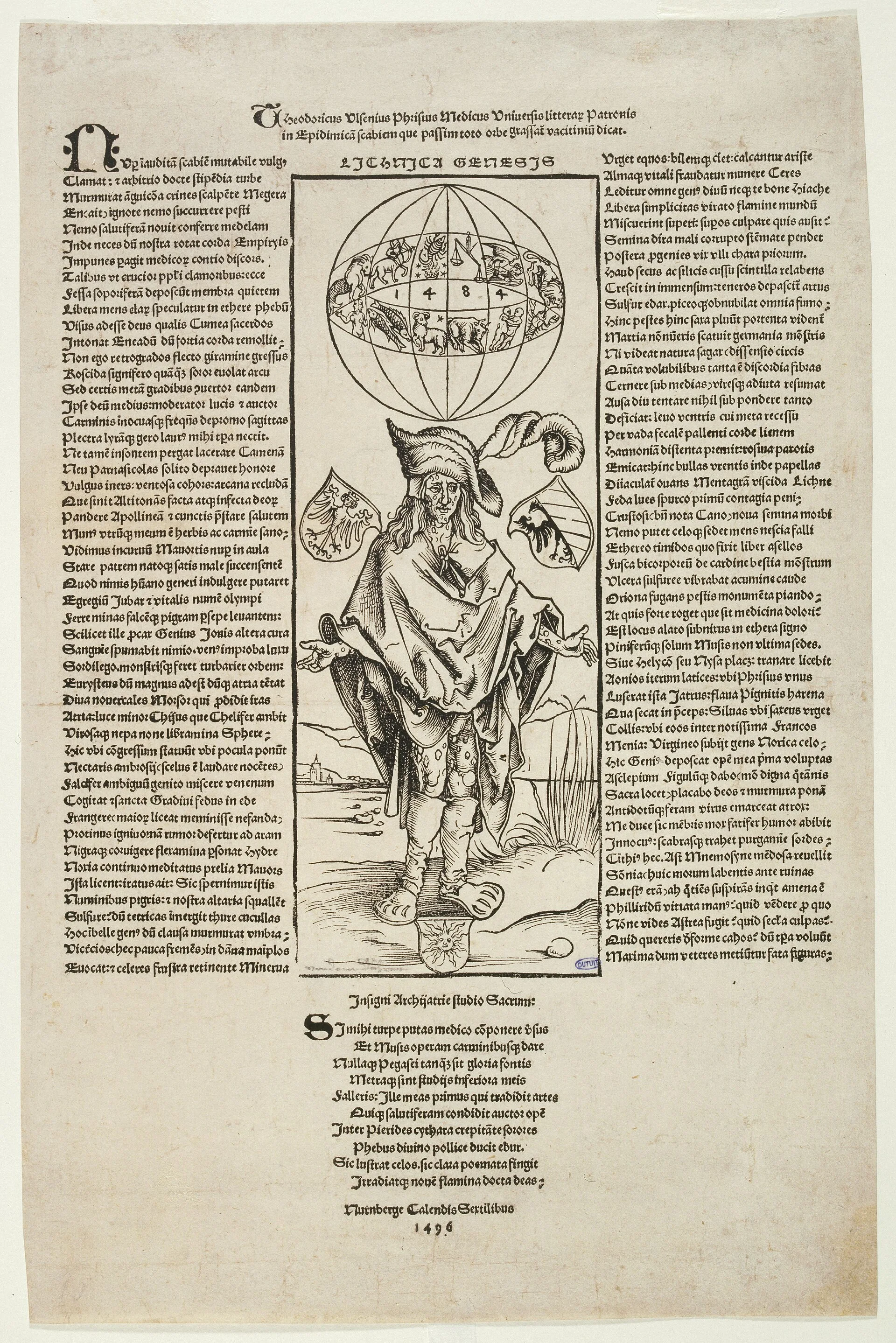
In 1494 Charles VIII of France marched an army drawn from across western Europe into Italy to press a claim on Naples. Within a year the campaign had collapsed and the soldiers had gone home, carrying a disease their physicians could not place: disfiguring, painful and in its early epidemics often fatal. By 1500 it was everywhere in Europe, and every nation had named it after a neighbor. Where it came from has been argued about ever since.
The two hypotheses
The timing invited an answer almost immediately. Columbus had returned from his first Atlantic crossing in early 1493, and within a few decades writers were connecting the new illness to the new contacts. The historian Alfred Crosby gave the modern version its name and its documentary backbone: the Columbian hypothesis, which holds that syphilis came from the Americas with returning crews. A revised form allows that the organism that crossed the Atlantic was an ancestral variety which then evolved rapidly into venereal syphilis under European conditions.
Against this stands the pre-Columbian hypothesis, which holds that treponemal disease was already present in the Old World, perhaps for millennia, and that what changed in the 1490s was the form it took or the attention it received. Syphilis is one of four closely related diseases caused by the bacterium Treponema pallidum. The others are yaws, bejel and pinta, all spread by skin contact rather than sexually, and all sharing about 99 percent of their genetic sequence with syphilis. That similarity is exactly why the family’s history is hard to untangle.
The bones
For most of the twentieth century the evidence was skeletal. Chronic treponemal infection can leave characteristic damage on bone, and dozens of European and other Old World skeletons have been published as pre-Columbian cases.
In 2011, in the Yearbook of Physical Anthropology, Kristin Harper, Molly Zuckerman, Megan Harper, John Kingston and George Armelagos applied one standard to all 54 published reports. They assessed each for diagnostic certainty and for the security of its dating. Not one case cleared both bars. Many rested on bone changes that are not specific to treponemal disease, and many gave no usable account of how the remains had been dated. The authors concluded that solid evidence for an Old World origin was still absent, and Armelagos, who had once laughed at the Columbus theory, said the evidence kept accumulating against him.
The bone evidence has limits in both directions. Radiocarbon dates on skeletons from the fifteenth and sixteenth centuries are difficult to resolve on either side of 1492, antibiotics have made skeletal involvement rare enough that modern diagnostic criteria are hard to establish, and congenital cases are difficult to identify at all.
The DNA
Ancient DNA has begun to replace the argument from bones. In August 2020 a team led by Verena Schünemann, then at the University of Zurich, reported treponemal genomes recovered from remains in Finland, Estonia and the Netherlands, dating from roughly the early fifteenth to the eighteenth centuries. One individual carried yaws, a disease now confined to the tropics. Another carried a previously unknown treponemal lineage with no modern descendant. The team estimated that the common ancestor of all modern T. pallidum subspecies was at least 2,500 years old, and argued that the first European epidemic could not be attributed to Columbus alone. In January 2024 the same group reported T. pallidum endemicum, the bejel organism, in 2,000-year-old remains from coastal Santa Catarina in Brazil, the oldest confirmed find of the pathogen anywhere.
The largest contribution came in December 2024, when Rodrigo Barquera, Kirsten Bos, Johannes Krause and colleagues at the Max Planck Institute for Evolutionary Anthropology published five ancient treponemal genomes in Nature, recovered from pre-contact and early-contact remains in Mexico, Chile, Argentina and Peru after screening hundreds of samples. The five represent early relatives of all three named subspecies: syphilis, yaws and bejel. Their analysis dates the emergence of the whole complex to after humans settled the Americas, which supports an American origin for every T. pallidum genome yet sequenced, ancient or modern.
Where it stands
The 2024 paper puts the root of the family in the Americas, but it does not close the question of syphilis itself. The authors’ best estimate places the emergence of syphilis as we know it just before Columbus arrived, while allowing, within their own margins of error, that it could have arisen in Europe or Africa from an American strain introduced in the late fifteenth or early sixteenth century. They cannot say when the bacterium adopted sexual transmission, or what genetic change made that possible.
Much of the diversity that existed in the Americas before 1492 appears to have been lost in the centuries after, which limits how much DNA can still recover. The authors expect the debate to continue, and say so.