
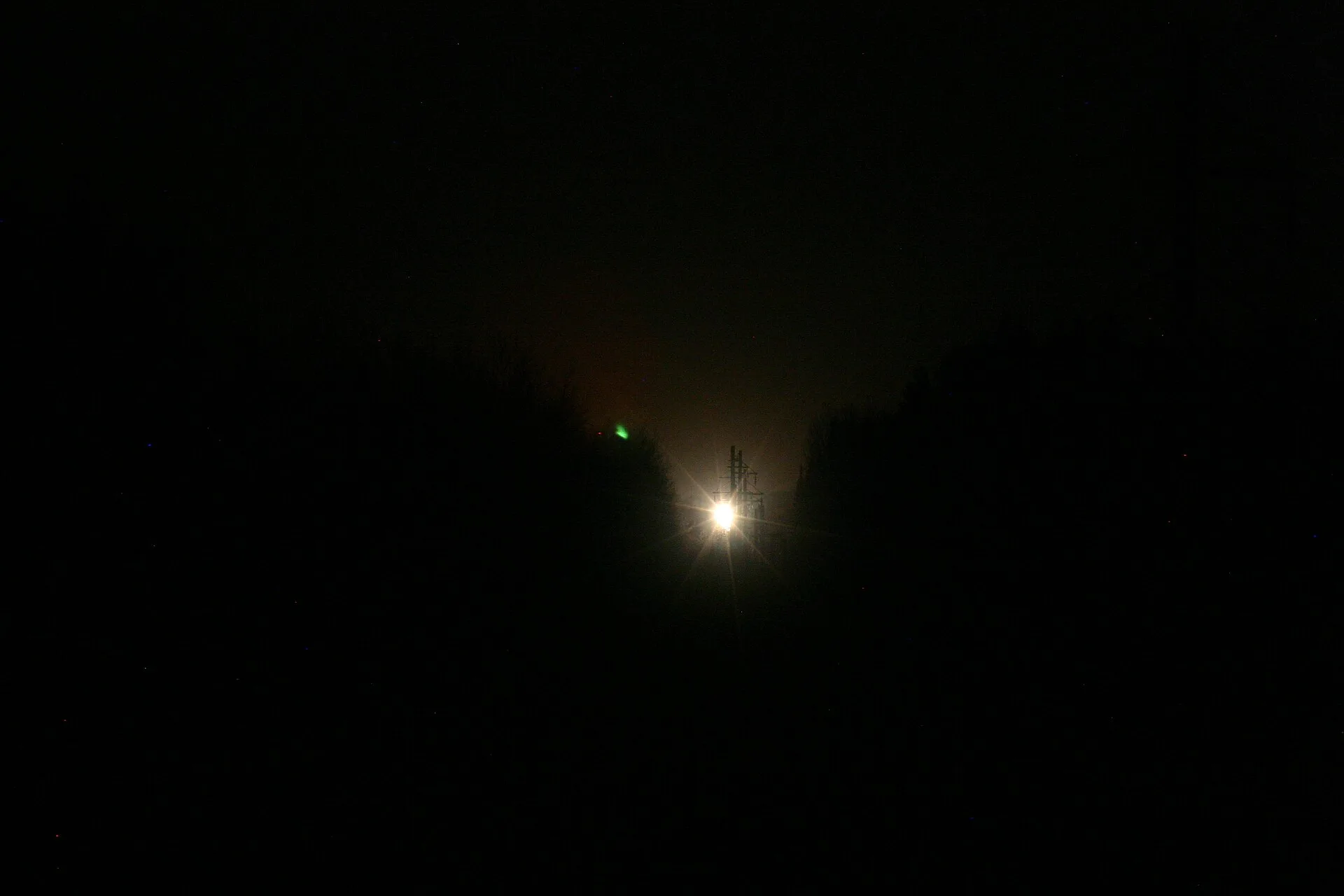
Paulding is a handful of buildings on US 45 in the western Upper Peninsula of Michigan, between Watersmeet and Bruce Crossing. Near it an unmarked gravel track, Robbins Pond Road, leaves the highway and heads into the Ottawa National Forest. It is a surviving piece of the old US 45, and after about half a mile it stops at a guardrail on a slope above a wooded valley, where the former roadbed carries on into the trees below. On most clear evenings a few cars are parked there with their lights off.
What happened
The people in those cars are waiting for a light. It shows up low at the far end of the valley, usually white and sometimes red, grows brighter, seems to drift or bob, and then fades, to be followed a little later by another. Local accounts date the first report to 1966, when a group of high school students told the sheriff what they had seen. The overlook was already a popular parking spot for couples, and talk of the light spread from there.
The best-known explanation is a ghost story. A railroad once ran through the valley, the tale goes, and a brakeman was crushed while trying to stop a train from striking cars stalled on the track; the light is his lantern, still swinging. Other versions make it a grandparent searching for a lost grandchild, or the ghost of a whole train. The Forest Service posts a sign at the overlook identifying it as the place to watch, and paranormal television programs carried the story nationwide.
The investigation
In the spring of 2010 the Michigan Tech student chapter of SPIE, a professional society for optics and photonics, took on the light as a learning exercise. The effort was organized by Jeremy Bos, then a doctoral candidate in electrical engineering, with faculty advisers Christopher Middlebrook and Michael Roggemann. On their second trip to the overlook the students brought a telescope. Through it the light resolved into a pair of car headlights, and the view was sharp enough to make out an Adopt-a-Highway sign beside the road, which let them locate the exact stretch of US 45 on a map.
Then they split up. One student, Bill Norkus, stood at that spot on the highway and logged every passing vehicle while the rest of the group recorded each appearance of the light from the overlook; every sighting matched a car. In a further test, a club member drove the stretch with hazard lights flashing, and the watchers saw a blinking yellow light appear right on schedule. The team also planned to compare the light’s spectrum with that of headlights and began modeling the air between the two points.
The explanations
The students’ account covers the light’s familiar behavior. The highway lies about four and a half miles away and runs over a rise, so headlights climb, hold and sink as cars crest it and drop down the far side. Red lights are taillights, and the occasional burst of color fits police flashers at a traffic stop. Switching between high and low beams changes the brightness. A single point of light against black, with nothing nearby to judge it by, tends to appear to wander, an illusion called autokinesis, and a stable layer of warm air over cooler air can carry light that far with little loss. The team also noted that the first reports came soon after that stretch of highway was rerouted, and that a paranormal investigation group in the 1980s had already concluded the light came from cars.
Where it stands
Not everyone accepts the result; some visitors maintain that what the students tracked was not the real Paulding Light. Bos, now on the Michigan Tech engineering faculty, has said that people are free to believe what they like, and that the light will keep appearing as long as US 45 stays where it is. Visitors still come every night, and the brakeman’s lantern has outlived its explanation. The light is a genuine optical effect; the ghost is folklore.