
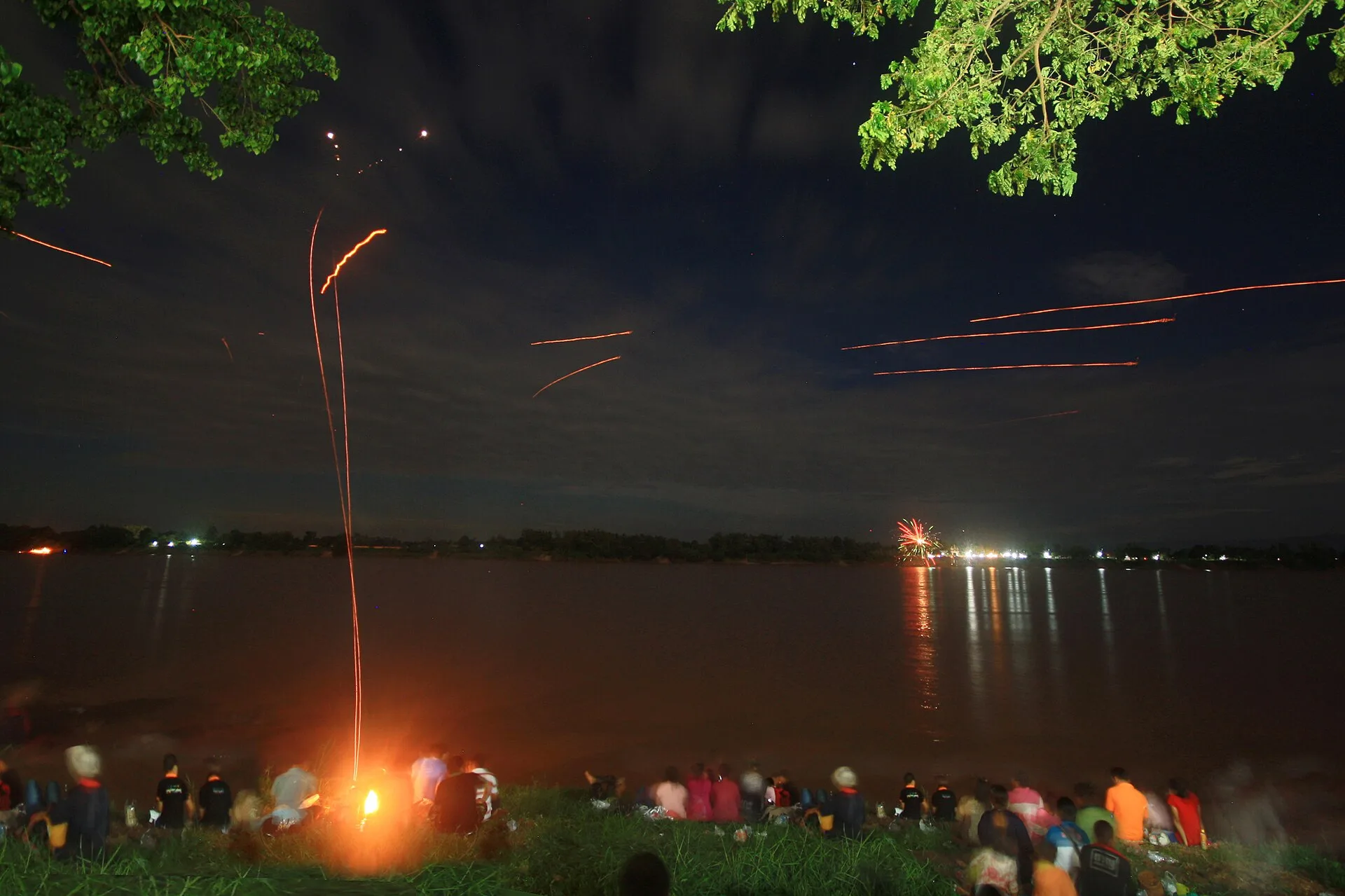
In Thai and Lao tradition the Mekong is home to the naga, a vast hooded river serpent, and to its king, Phaya Nak, a devoted servant of the Buddha. When the three-month Buddhist rains retreat ends on the full moon of the eleventh lunar month, usually in October, the naga is said to greet the Buddha’s return from heaven by sending fireballs up out of the river. On the Thai side, in Nong Khai province, the night has grown into a festival that draws crowds in the hundreds of thousands.
What people see
The lights are not in doubt. From the riverbank at Phon Phisai and other towns along a long stretch of the Mekong, spectators watch reddish-orange points appear low over the water and climb steeply for a few seconds to a height of several hundred feet before fading out. On a busy night there may be dozens or many more. Reports also come from smaller rivers and ponds in the region. Older residents knew them simply as ghost lights; the name Phaya Nak lights was adopted by the local council only in the mid-1980s. The festival is now marketed hard by the province and by Thailand’s national tourism authority, and by the 2020s it was drawing more than 200,000 visitors a year to Nong Khai and neighboring Bueng Kan.
The iTV report
In 2002 the Thai television channel iTV sent a crew to find the source. On its investigative program, the team crossed quietly to the Lao bank opposite Phon Phisai during the festival and filmed soldiers firing tracer rounds into the sky, with the cheers from the Thai crowd rising each time a round went up. The broadcast was received as an attack on a sacred belief, with talk of lawsuits and boycotts. It did not hurt business. Attendance, estimated at 150,000 the year before, rose to around 400,000 after the report and the release of a popular Thai film about the fireballs the same year, and the event grew from one night to several, with concrete grandstands along the river.
The explanations
The most common scientific-sounding explanation is gas. Decaying matter on the riverbed, the argument goes, produces methane and phosphine that bubble up and ignite. A local pediatrician, Manos Kanoksilp, spent years promoting this view, and according to The Nation a team from Thailand’s Science Ministry set up a thermal scanner at the river and declared the mystery solved, saying it detected the gas moments before the lights appeared. Skeptics have not been persuaded. As Brian Dunning of Skeptoid points out, spontaneous ignition of methane needs a precise mix with phosphine compounds unlikely in nature, and in the laboratory such mixtures flash greenish with a pop and black smoke. A burning bubble also has too little mass to streak upward for hundreds of feet without going out. The lights behave like something fired.
The firing explanation has its own problem: no one hears shots. Dunning notes that the river there is about 700 meters wide, so a report from the far bank takes about two and a half seconds to arrive, by which time a cheering crowd and loudspeakers drown it out. Jessada Denduangboripant, a biologist at Chulalongkorn University in Bangkok, has argued from footage that the lights are flares or rounds fired from the Lao side, and in 2023 accepted a businessman’s challenge to prove it on site.
Lao officials reject this. In October 2021, after a Thai man heading a group of conspiracy theorists delivered documents to the Lao embassy in Bangkok, authorities in Vientiane’s Pak Ngum district said border patrols and police enforcing a COVID-19 curfew had watched the riverbank all night and recorded no gunfire or flares. Villagers there nonetheless reported seeing more fireballs than usual that year.
Where it stands
The festival is real, the lights are real, and the belief is sincere. No natural mechanism has been shown that produces fast, red, rising fireballs, and the best direct evidence remains a television crew’s footage of men with guns on the opposite bank. Whether every light on every night is fired by someone cannot be proved from the Thai side, and the Lao authorities deny it. A natural phenomenon from the river, though, is the least supported explanation on offer.