
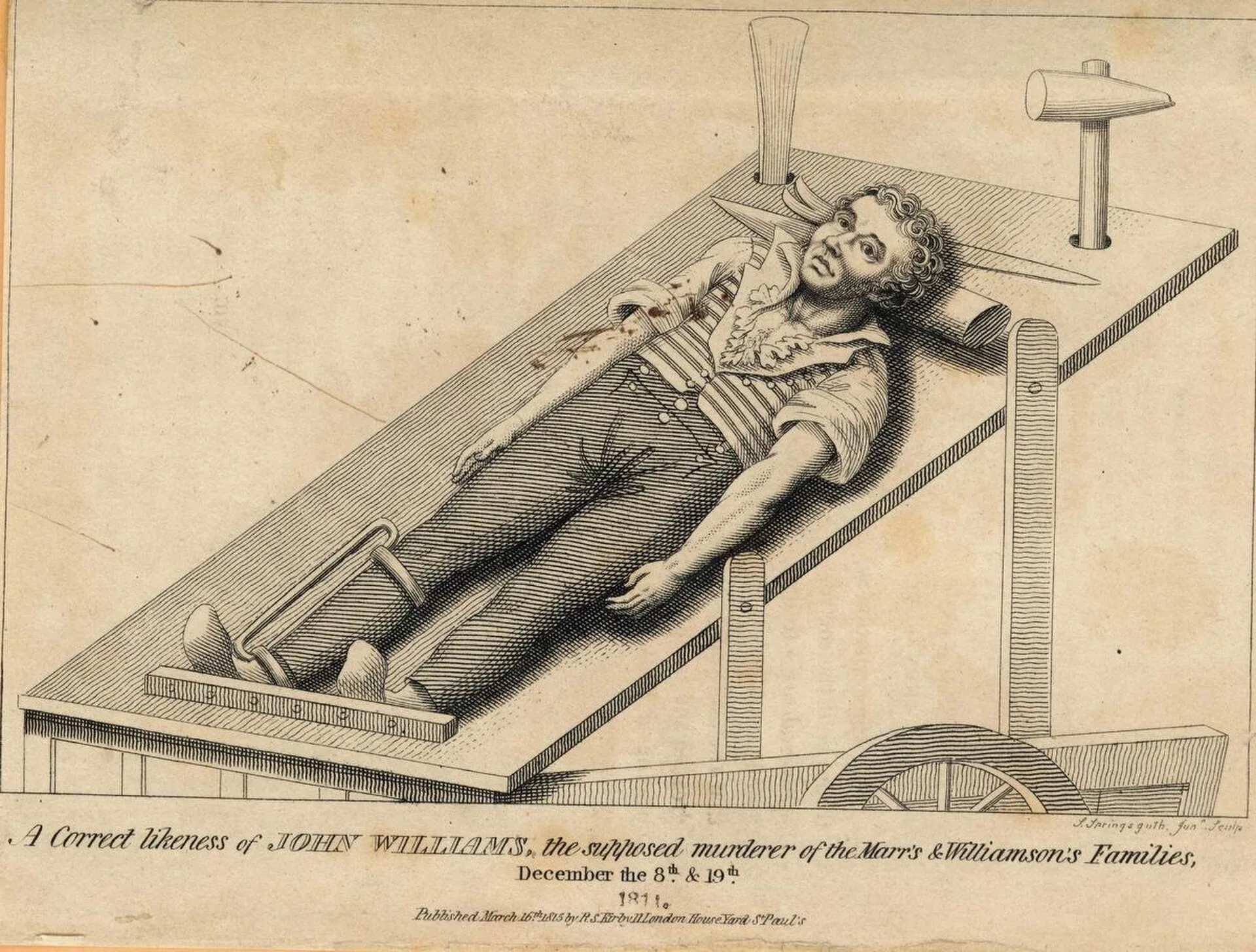
In December 1811 seven people were beaten and cut to death in two households a short walk apart in St George in the East, the riverside parish just downstream of the Tower of London. The man blamed for both attacks, a young Irish seaman named John Williams, never faced a jury. He was found hanged in his cell, and the magistrates took that as proof enough. More than two centuries later, historians are still not sure he was the killer, or that he acted alone.
What happened
Timothy Marr ran a draper’s shop at 29 Ratcliff Highway, then one of the main roads east out of the city, lined with lodging houses, taverns and chandlers serving the docks. Close to midnight on Saturday, December 7, he sent his servant, Margaret Jewell, to buy oysters and pay a baker’s bill. Every shop she tried was shut, and when she came back about twenty minutes later the house was dark and locked. Her knocking brought a night watchman and a neighbor, who got in through the back. Marr, his wife Celia, their fourteen-week-old son and the shop boy, James Gowan, were all dead. A shipwright’s maul, smeared with blood and hair, was found upstairs. Cash in the shop had not been taken.
Twelve days later, on the night of December 19, it happened again at the King’s Arms in New Gravel Lane, a few hundred yards away. The publican John Williamson, his wife Elizabeth and their servant Bridget Harrington were killed. A lodger, John Turner, let himself down from an upper window on knotted sheets, shouting for help, and the Williamsons’ teenage granddaughter was found unharmed in her bed. Turner said he had seen a tall man in a long coat stooping over Mrs Williamson’s body.
The investigation
London had no detective force. Parish constables and watchmen, the Thames River Police at Wapping, the Shadwell magistrates and the Bow Street Runners each chased their own leads, and dozens of people were picked up on rumor and let go. The opening came from the maul. Cleaned, its handle showed punched initials, read as I.P. or J.P., and the landlord of the Pear Tree, a seamen’s lodging house in Wapping, identified it as the property of a sailor lodger who was away at sea. Another Pear Tree lodger was John Williams, whose last voyage had been in the East India Company ship Roxburgh Castle. He had been drinking in the Williamsons’ tavern only hours before they died, had come in late, had money afterward, and had a torn shirt with blood on it. He was sent to Coldbath Fields prison.
On the morning of December 28, before he could be brought back for further questioning, Williams was found hanging by his scarf from a bar in his cell. The magistrates treated the death as a confession and named him the sole culprit for both crimes. On New Year’s Eve his body was paraded on an open cart past the two murder houses and buried at the crossroads of Cannon Street Road and Cable Street, with a stake driven through it, as the custom of the time allowed for suicides. Workmen are said to have turned up the skeleton decades later.
The explanations
Doubts started almost at once. When the House of Commons debated the London watch on January 18, 1812, the Home Secretary, Richard Ryder, called the murders sufficient reason for an inquiry, and the member William Smith told the House that the authors of the Marr killings had still not been discovered, blaming “a set of villains about the town.” Witnesses had spoken of two sets of footprints, of several men running off and of a lame man; Turner’s tall stranger looked nothing like the slight Williams. A shipmate of his, William Ablass, who had been held after an attempted mutiny on the Roxburgh Castle, was questioned and released, as was Cornelius Hart, a carpenter who had worked in Marr’s shop that day.
Thomas De Quincey, who wrote about the case repeatedly, gave it its most famous form in an 1854 postscript to his essays on murder as a fine art, casting Williams as a solitary, almost theatrical killer. Later writers were less certain. In The Maul and the Pear Tree (1971), P. D. James and the police historian T. A. Critchley argued that the evidence was thin, that Williams could not have worked alone if he took part at all, and that he might even have been killed in his cell. The author of the Spitalfields Life blog has instead pointed to organized intimidation connected to Marr’s debts, while calling the staged-suicide theory too elaborate.
Where it stands
No court ever tested the evidence. The panic fed the argument for a professional force, which London finally got with the Metropolitan Police in 1829. The case against Williams rests on a borrowed maul, a bloodied shirt and a suicide, and whether he was the murderer, an accomplice or a convenient scapegoat remains an open question.