
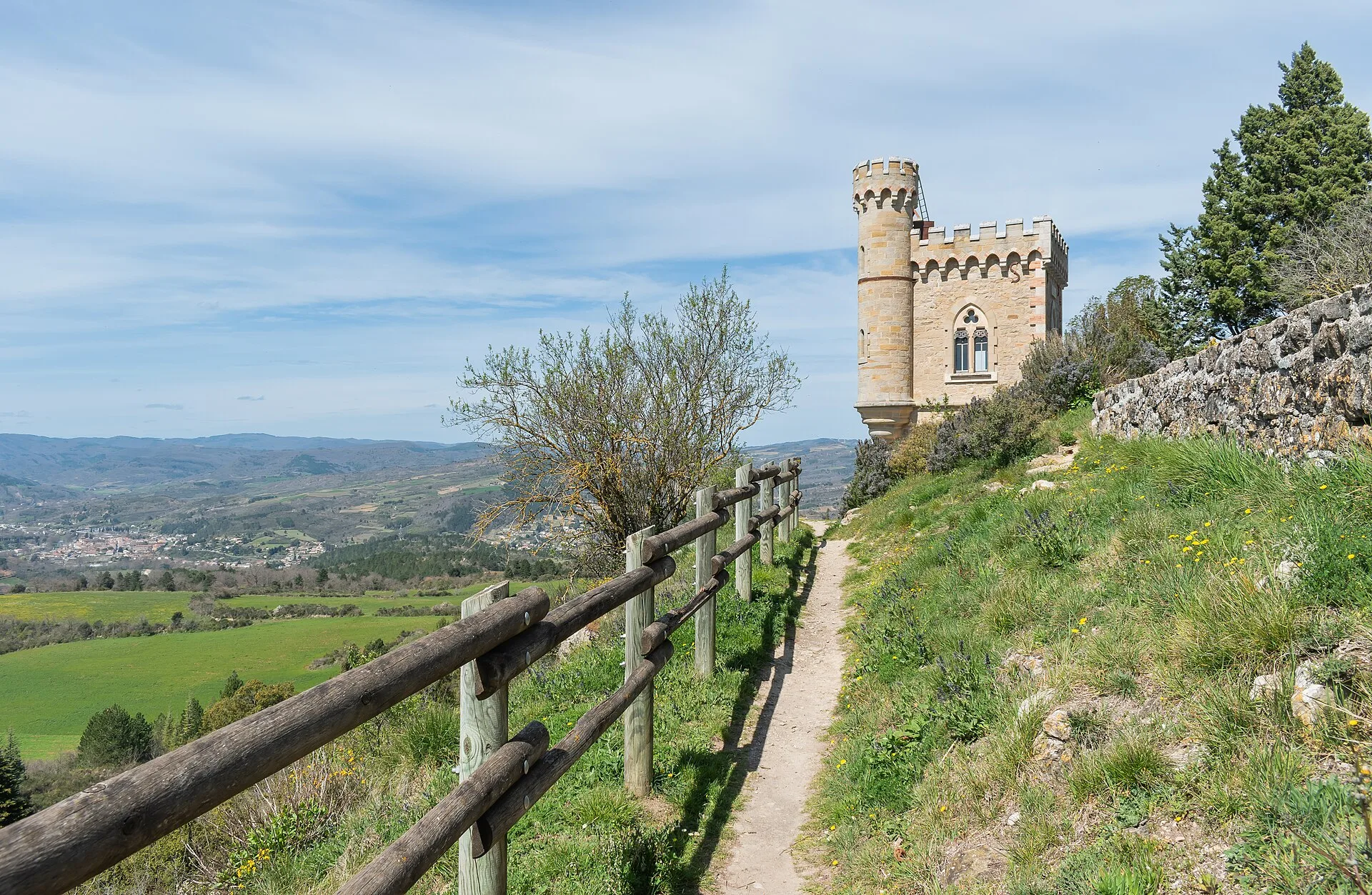
Rennes-le-Château is a hamlet of fewer than a hundred people on a rocky ridge above the upper Aude valley, about 45 kilometers south of Carcassonne. Its own town hall reckons that some 700 books have been written about it and that 120,000 visitors arrive every year. Almost all of them come because of one man, its parish priest from 1885 to 1909, and a legend that was assembled decades after his death.
What happened
François-Bérenger Saunière, born in 1852 to a modest family in the same region, took over the run-down church of Sainte-Marie-Madeleine in 1885. Over the next twenty years he spent money no country priest was expected to have. He restored and redecorated the church, filling it with painted statues, a new altar, Stations of the Cross and a holy-water stoup held up by a grimacing devil. Then, around the turn of the century, he bought land and built an estate: the Villa Bethania, landscaped gardens, a glass orangery, and on the edge of the ridge a small crenellated tower he called the Tour Magdala and used as his library. The property was registered in the name of his housekeeper, Marie Dénarnaud, who stayed loyal to him for life. Villagers talked, and the talk was of treasure, perhaps hidden by the medieval Cathars or the Visigoths who once held the hill.
The investigation
The Church looked into the money first. As Massimo Introvigne of the Center for Studies on New Religions has summarized, Paul-Félix Beuvain de Beauséjour, who had become bishop of Carcassonne in 1902, found that Saunière had been advertising in Catholic periodicals across France and abroad, inviting the faithful to pay for masses to be said for their dead or their intentions. Stipends for masses were legitimate; taking far more of them than one priest could possibly celebrate was not. In 1909 the bishop moved Saunière to another parish. He refused, resigned, and stayed in the village, and in 1910 and 1911 the diocesan court convicted him of trafficking in masses and suspended him from his priestly functions. He would not or could not produce full accounts, and he died in January 1917 without being reinstated.
That might have been the end. In 1956, however, Noël Corbu, who had acquired the estate from Marie Dénarnaud and opened a restaurant there, began telling the local press that the priest had found ancient parchments hidden in a pillar of his altar, leading him to a royal treasure. The story was good for business, and it reached Pierre Plantard, a veteran of fringe esoteric and political groups with a 1953 conviction for fraud, who that same year had registered a small association he called the Priory of Sion. With his friend Philippe de Chérisey, an aristocrat and actor fond of puzzles, Plantard produced coded parchments supposedly found by Saunière and a set of typed genealogies, the Dossiers Secrets d’Henri Lobineau, which were deposited in the national library in Paris in 1967. That year the writer Gérard de Sède published L’Or de Rennes, based on material Plantard supplied.
The explanations
The British scriptwriter Henry Lincoln read de Sède’s book, made BBC documentaries in the 1970s and in 1982 published The Holy Blood and the Holy Grail with Michael Baigent and Richard Leigh. In their version Saunière had stumbled on proof that Jesus and Mary Magdalene had children whose descendants became the Merovingian kings of France, protected ever since by a secret Priory of Sion whose grand masters included Leonardo da Vinci and Isaac Newton. Dan Brown’s novel The Da Vinci Code took the idea to tens of millions of readers in 2003, presenting the Priory’s documents as fact.
The documents were never genuine. De Chérisey admitted in letters and in his own booklets, from 1967 onward, that he had made the parchments, and Plantard in 1989 conceded that the Dossiers were fakes, blaming de Chérisey and an associate. In 1993 a French investigating judge, told that a businessman friend of President Mitterrand, who had died in 1989, had appeared on Plantard’s list of grand masters, had Plantard’s home searched; it held a trove of invented papers, and Plantard admitted under oath that he had made the claims up. A medieval religious house of that name did exist, but it died out long ago and had nothing to do with bloodlines or Rennes-le-Château.
Where it stands
Saunière’s buildings are now a museum, the Domaine de l’Abbé Saunière, and the village still draws treasure hunters. Historians accept the diocese’s explanation for his money and regard the Priory of Sion as a twentieth-century invention; why Saunière decorated his church as he did is the only real puzzle left, and it is a matter of taste rather than of secrets.