
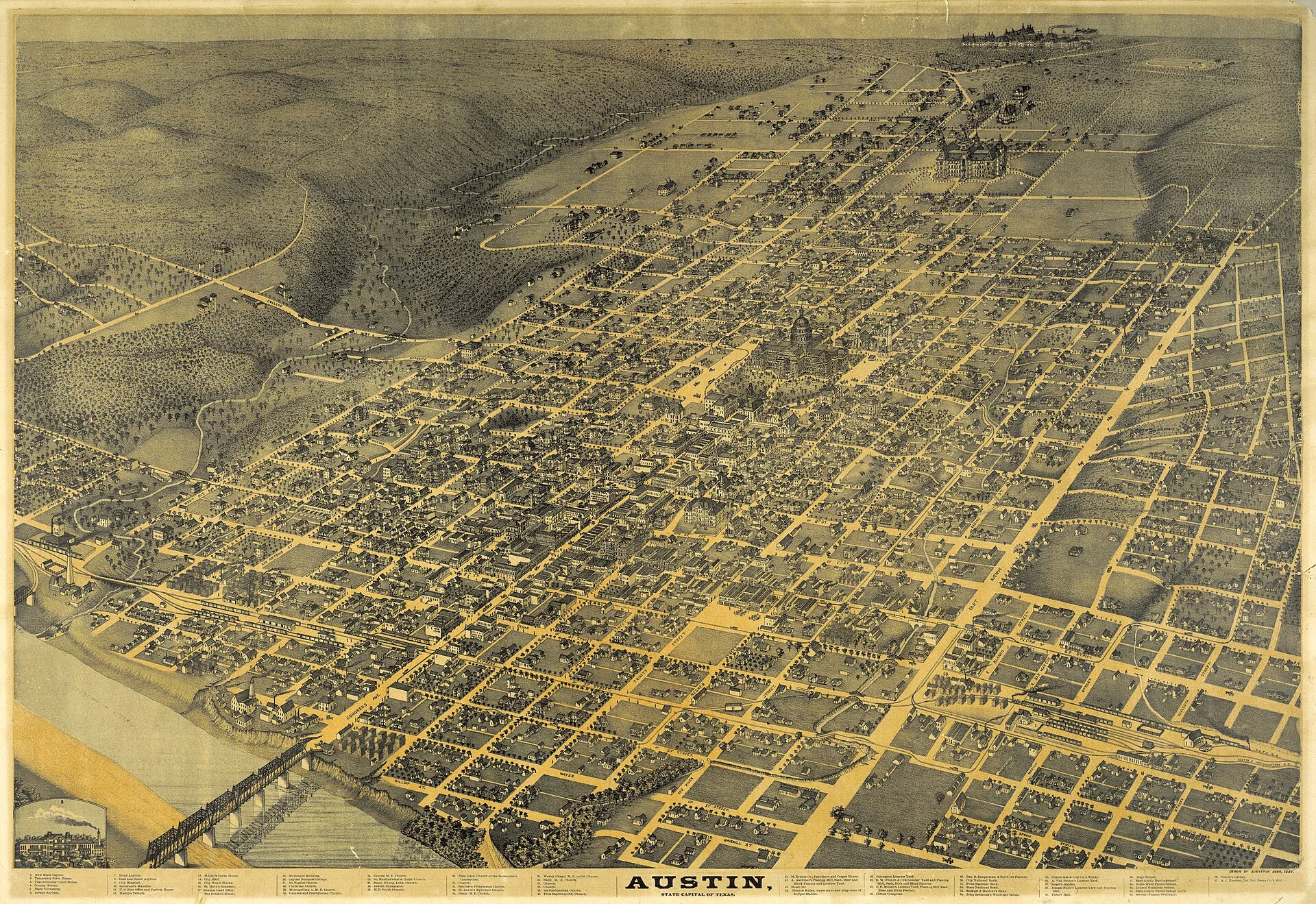
For twelve months from the end of 1884, someone broke into homes in Austin, Texas, at night, attacked the people sleeping inside with an axe or a knife, and often dragged the women out into a yard to finish the job. Eight people died and several more were badly hurt. The city was growing fast, building a new granite capitol and promoting itself as a modern place to live, and the killings made national news. Nobody was ever convicted, and the killer has never been identified. The journalist Skip Hollandsworth, who spent years on the case for Texas Monthly and later a book, calls him America’s first serial killer.
What happened
The first death came on the night of December 30, 1884. Mollie Smith, a young Black cook, was found in the snow behind her employer’s house with an axe wound to the head; her boyfriend, Walter Spence, was badly hurt. Over the following months the same pattern repeated in the servants’ quarters behind white households: Eliza Shelley, another cook, killed in early May 1885; Irene Cross, slashed with a knife later that month; eleven-year-old Mary Ramey, taken from beside her unconscious mother at the end of August, assaulted in a washhouse and stabbed through the ear with an iron rod; and in late September Gracie Vance and her companion Orange Washington beaten to death in the quarters where they slept.
On Christmas Eve the attacks crossed the color line. Within a couple of hours and roughly a mile apart, Susan Hancock, whom one reporter ranked among Austin’s most refined ladies, and Eula Phillips, a seventeen-year-old from a prominent pioneer family, were attacked at their homes. Both had head wounds; Hancock, like several earlier victims, had something thin pushed into her ear.
The writer William Sydney Porter, not yet known as O. Henry, was living in Austin. In a May 1885 letter to a friend he joked that the town was dull apart from the raids of the “Servant Girl Annihilators,” and the name stuck long afterward, although newspapers at the time did not use it.
The investigation
Austin’s small police force had no tools beyond bloodhounds, witnesses and arrests. After each killing officers rounded up Black men, some of whom were roughed up before being released for want of evidence; Hollandsworth found that Walter Spence was tried for Mollie Smith’s murder and acquitted in December 1885. After Christmas Eve a citizens’ committee posted a $3,000 reward, the governor added more, and private detectives arrived from other cities. The city’s leaders preferred to see several unrelated crimes rather than one killer.
The two husbands were charged. Jimmy Phillips was convicted of his wife’s murder, but the verdict was overturned on appeal; Moses Hancock’s prosecution also failed to produce a conviction. The Travis County Archives still hold Susan Hancock’s autopsy and inquest papers and the criminal case files against both men. The attacks stopped after December 1885.
The explanations
When Jack the Ripper began killing women in London’s Whitechapel in 1888, American papers wondered whether the Austin killer had crossed the Atlantic; the historian Philip Sugden traced the idea to an editor at the Atlanta Constitution that October. In November 1888 the Austin Statesman revived the story of a cook called Maurice, described as Malay, who had worked at a hotel near several crime scenes, talked of shipping out to London and left Austin in January 1886. The author Shirley Harrison later proposed the Liverpool cotton merchant James Maybrick as both killers, relying on a disputed diary attributed to Maybrick. Nothing documentary connects the two series.
Closer to home, a 2014 episode of the PBS program History Detectives used geographic profiling to point to Nathan Elgin, a young cook who worked near the crime scenes and was shot dead by police in February 1886 while attacking a girl. Others have suggested that the Christmas Eve murders were not the serial killer’s work at all, which is what the prosecutions of the husbands assumed.
Where it stands
The killings are among the best-documented crimes of 1880s Texas, in newspapers, court files and the inquest record. Who committed them, whether one man or more, and whether he ever surfaced again elsewhere remain unknown, and the London connection is a guess built on timing.