
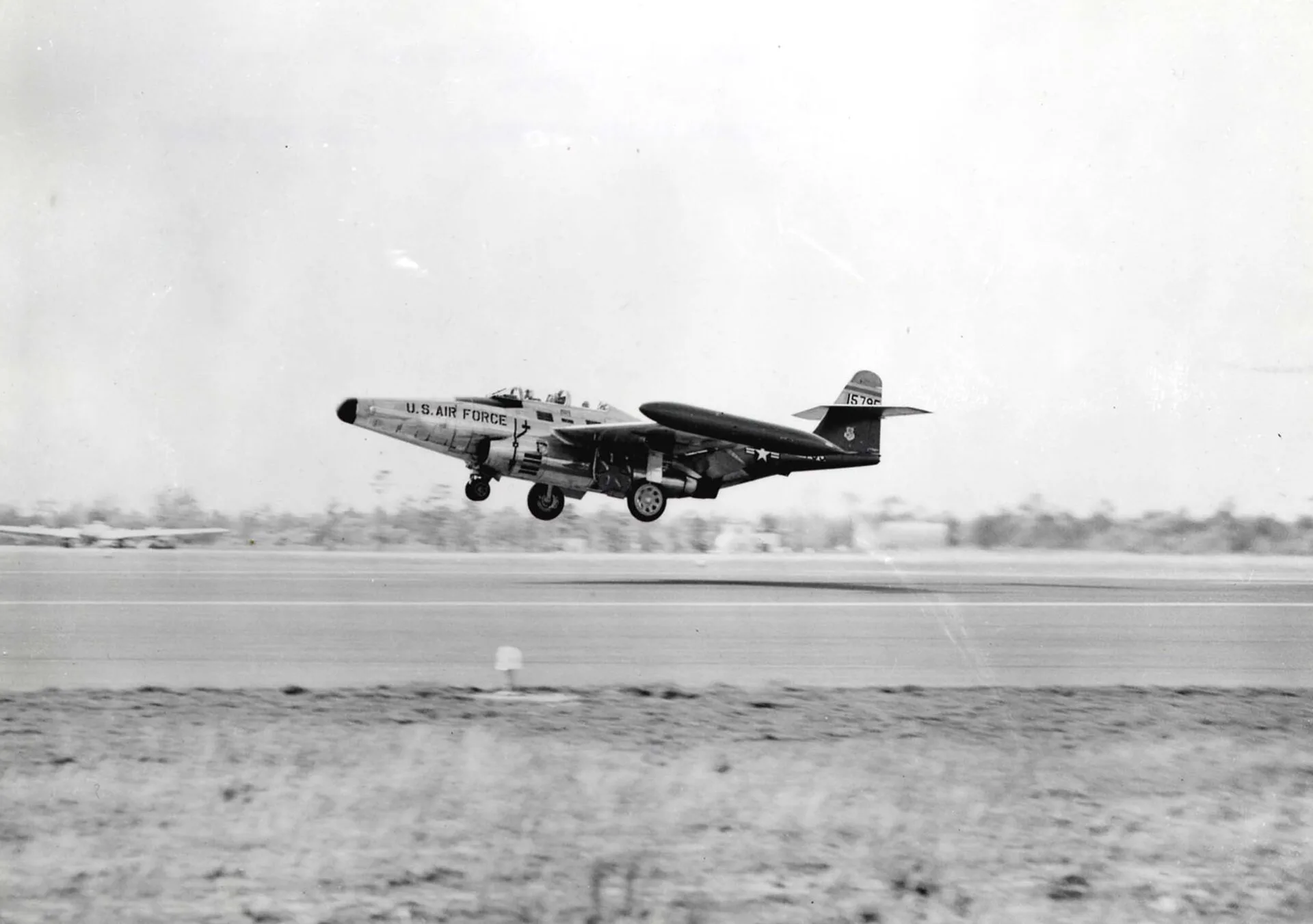
On the evening of November 23, 1953, an Air Force jet interceptor took off from Kinross Air Force Base in Michigan’s Upper Peninsula to identify an unknown aircraft over Lake Superior. Ground radar watched it close on its target until the two returns on the screen became one. Then the jet’s return disappeared. Neither the plane nor its two crewmen has ever been found, and the Kinross incident has become one of the founding cases of the claim that UFOs have taken American aircraft.
What happened
The interceptor was an F-89C Scorpion belonging to a fighter squadron from Truax Field in Madison, Wisconsin, standing alert at Kinross. Its pilot was First Lieutenant Felix Moncla Jr., 27, from Louisiana, with more than 800 hours in his logbook; his radar observer was Second Lieutenant Robert L. Wilson. Controllers at the air defense radar station near Sault Ste. Marie had picked up a target over the lake in restricted airspace near the Soo Locks, the canal locks that carry shipping between Lake Superior and the lower lakes, and sent the Scorpion after it on a stormy night.
Wilson struggled to hold the target on the jet’s own radar, so the ground station steered the chase. For about half an hour the F-89 flew northwest across the lake at around 500 miles an hour, descending to some 8,000 feet as it closed in. Roughly 70 miles off Keweenaw Point, the long finger of land that juts into Lake Superior, the two radar blips merged. Controllers expected them to separate as the fighter passed above or below. Instead the jet’s return, and its identification signal, were gone. Air Force, Coast Guard and Royal Canadian Air Force crews searched the lake in bad weather and found nothing.
The investigation
The first Air Force statement, carried by the Associated Press and printed in the Chicago Tribune, said only that the jet had been tracked until it merged with an object far out over the lake. That account was soon withdrawn. The Air Force’s revised explanation, and its accident report, said the target had been a Royal Canadian Air Force C-47 transport, identified as flight VC-912, flying about 30 miles off its planned course toward Sudbury, Ontario. The F-89, by this version, had completed the intercept, and Moncla had probably become disoriented in the dark and flown into the lake on the way home. The report noted secondhand claims that Moncla was prone to vertigo, while classing them as hearsay. Another F-89 pilot told the accident board he thought he heard a brief radio call from Moncla some forty minutes after the jet vanished.
The Canadian side never fit neatly. Canadian officials said none of their aircraft had been in the area, and the pilot of the transport named in the report later denied in a television documentary that he had been intercepted. The Project Blue Book file put the odd radar picture down to atmospheric conditions and the missing wreckage to the depth of the lake. Investigators for the civilian group NICAP reported that references to the mission had been stripped from official records, and the Air Force’s technical intelligence center said it had no record of a sighting at Kinross that night.
The explanations
The UFO reading of the case rests largely on the merging blips and on the shifting official story. It was popularized by Donald Keyhoe, a retired Marine aviator turned UFO author, in The Flying Saucer Conspiracy, published in 1955. The conventional reading is that radar returns merge whenever an interceptor closes on its quarry, that a crash in Lake Superior in a storm can leave no trace, and that the target was some ordinary aircraft, whether or not it was the Canadian transport. Neither side can prove its case while the lake keeps the wreck.
Two later finds came to nothing. In October 1968 pieces of a military jet were reported near the lake’s eastern shore, but their identity was never confirmed. In 2006 a website for a group calling itself the Great Lakes Dive Company posted side-scan sonar images of what it said was Moncla’s F-89 lying intact in deep water, with one wing sheared off and a strange metallic object nearby. Brendon Baillod, a Great Lakes shipwreck historian, found that no one in the regional diving and salvage community had heard of the company, that its website was registered to a post office box, and that the search it described would have been far beyond the means of a small group. The site was taken down, its spokesman could not be traced, and the claim is now regarded as a hoax.
Where it stands
Moncla and Wilson are still officially missing, presumed dead. Moncla’s gravestone says he disappeared while intercepting a UFO over the Canadian border. The record supports a real tragedy, an unusual and poorly explained radar track, and an official account with holes in it. It does not show what the jet was chasing, and the sonar images that seemed to promise an answer in 2006 were not genuine.