
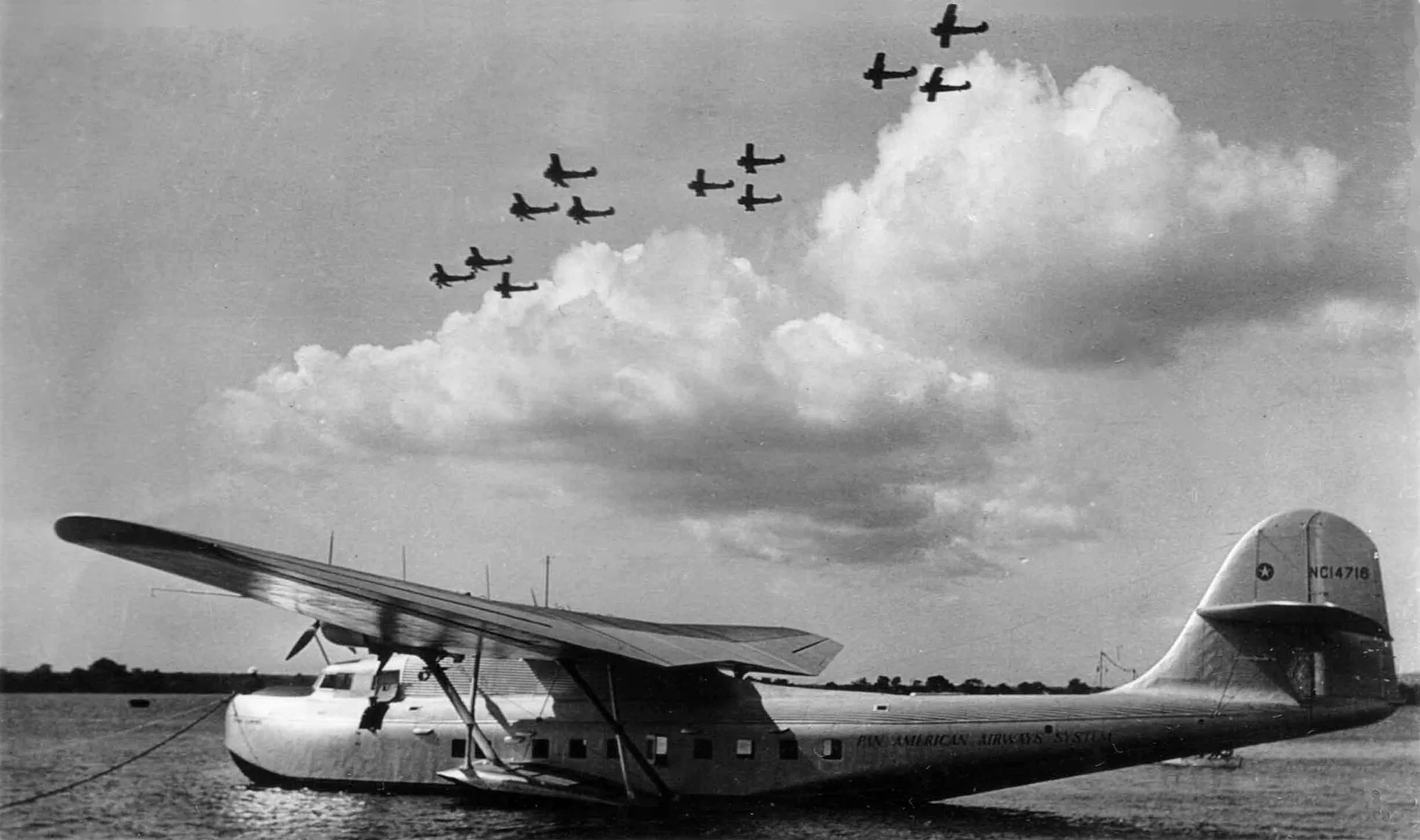
In the summer of 1938 Pan American Airways was the only airline flying passengers across the Pacific. Its three Martin M-130 flying boats, the China Clipper, the Philippine Clipper and the Hawaii Clipper, hopped from San Francisco Bay to Honolulu, Midway, Wake Island and Guam before reaching Manila, a trip of about six days. The Hawaii Clipper had flown the first scheduled passenger crossing in 1936. On its 1938 westbound run, Pan Am Trip 229, it carried nine crew under Captain Leo Terletzky and six passengers. It never reached Manila, and no part of it has been seen since.
What happened
The flying boat lifted off from Apra Harbor, Guam, early on July 29, 1938, local time (still July 28 in the United States), for the last long leg, roughly 1,600 miles to Manila. The crossing normally took about twelve and a half hours, and the tanks held fuel for about seventeen. Routine position reports followed for some eight hours. At 12:11 p.m. Manila time the radio officer, William McCarty, sent a coded report to the Pan Am station on Panay. The Clipper was at 9,100 feet in rough air and rain, with solid cloud above and below, and had spent half of the previous hour flying on instruments. Its dead-reckoning position put it a little under 600 miles east-southeast of Manila.
The Panay operator acknowledged and offered the latest Manila weather. McCarty asked him to wait a minute because he was fighting rain static. When Panay called back, nobody answered. Within the hour every Philippine station had been told to listen on emergency frequencies, and the calls went on all afternoon.
The search
The nearest ship was the Army transport Meigs, about 100 miles away. It reached the last reported position that night and searched in the dark. The next afternoon its crew sighted a roughly circular oil slick some 28 miles south-southeast of the position and lowered a boat, but darkness cut the sampling short and the slick could not be found again in the morning. Navy destroyers and submarines from the 16th Naval District, Army bombers and amphibians, and a Japanese liner diverted at the request of the State Department joined in. The weather cleared, visibility was excellent, and nobody found a seat cushion, a life raft or a slick that could be tied to the plane. The search ended on August 5. Chemists later reported that the little oil collected by the Meigs was not the type the Clipper used.
The Civil Aeronautics Authority’s Air Safety Board found the aircraft airworthy and the crew qualified and fit; Terletzky had about 9,200 flying hours. It also recorded one stray lead: a telephone worker on Lahuy Island, off southeastern Luzon, said he had heard a big plane passing over the overcast at around 3 p.m. that day, when no military or private aircraft were known to be flying nearby. A second air search of the area found nothing. In its report of November 18, 1938, the board said it would not discuss theories that the facts did not support and left the case open in case new evidence appeared.
The theories
The passenger list has fed speculation ever since. It included a medical school dean and a government plant pathologist, Fred Meier, who planned to sample microbes in the upper air; an executive of the Curtiss-Wright company, which wanted to sell fighters to China; an Army Reserve major; and Wah Sun “Watson” Choy, a New Jersey restaurateur reported to be carrying $3 million in gold certificates for Chiang Kai-shek’s government. Japan was then at war with China.
In 1980 Ronald W. Jackson’s book China Clipper proposed that Japanese officers stowed away on Guam and hijacked the flying boat. Charles N. Hill’s Fix on the Rising Sun (2000) added that the Clipper was flown to Truk, where everyone aboard was killed. The researcher Guy Noffsinger has led several expeditions to Micronesia, using ground-penetrating radar to look under concrete slabs for remains. None of this has produced physical evidence. A flying boat wreck photographed at Truk in 1964 turned out to be a British Short Sunderland, and postwar rumors of the Clipper turning up in Japan, or of its engine parts doing so, were never documented.
The duller explanations have their own support. Martin had raised concerns about the M-130’s sponson struts, and some of Terletzky’s fellow pilots doubted his skill. In a 2023 article for the American Aviation Historical Society Journal, J.B. Rivard argued that the rain, the static and the sudden silence point to a lightning strike. Because a plunge into the sea should have left floating debris in an area searchers covered thoroughly, he suggested the crippled Clipper may have kept going without its radio and come down later, perhaps over land, which would fit the Lahuy report.
Where it stands
Rivard notes that whether it lies on a hillside or the seabed, most of the aircraft’s roughly 16 tons of metal should still exist. It has not been found. The two sister ships were also lost, the Philippine Clipper in California in 1943 and the China Clipper in Trinidad in 1945, but their wrecks were located. The Hawaii Clipper’s fate is unknown, and the case for a hijacking rests on motive and rumor rather than evidence.