
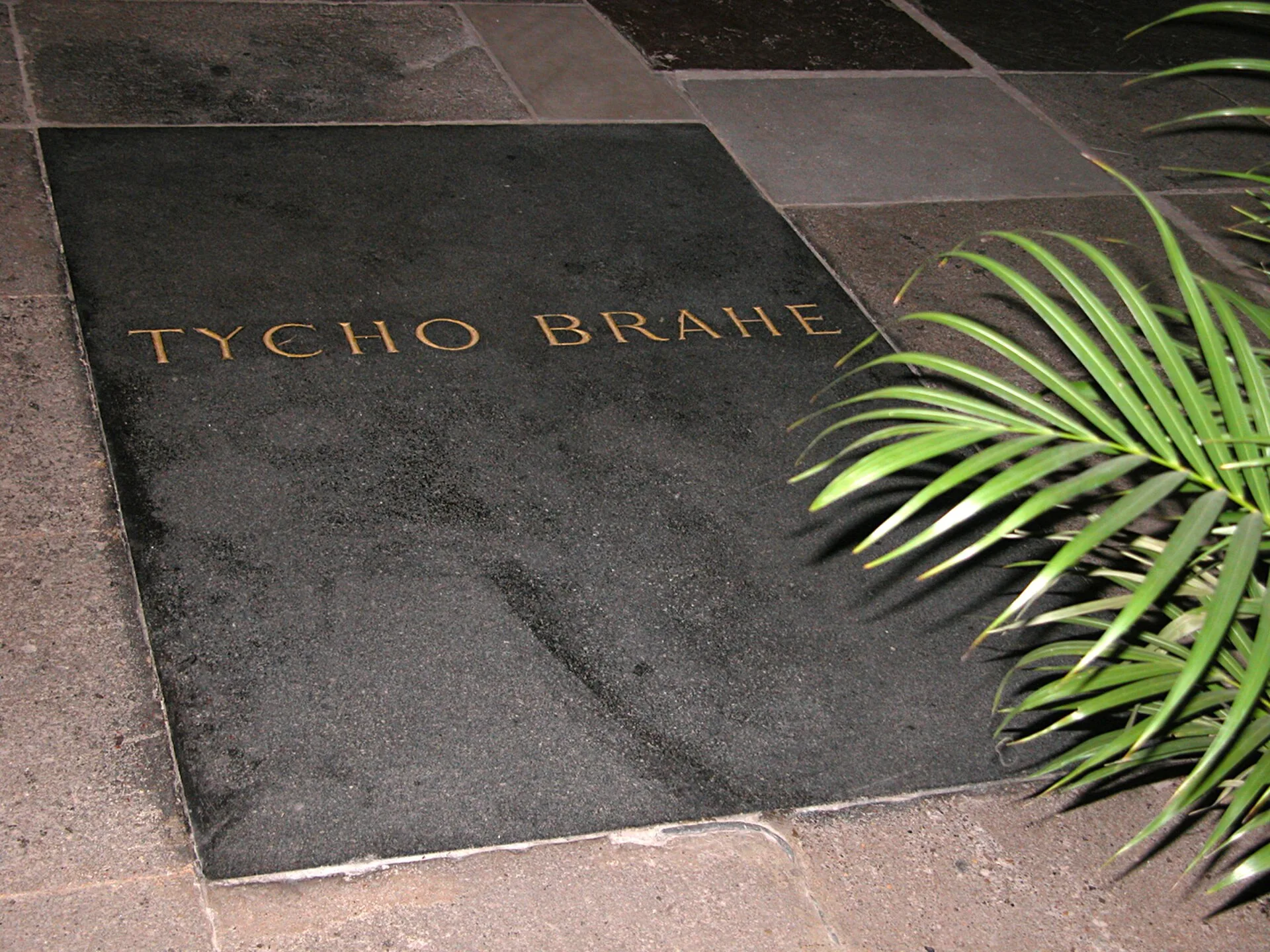
Tycho Brahe was the best naked-eye astronomer of his age. A Danish nobleman with a metal patch where part of his nose had been cut off in a student duel, he spent two decades measuring the sky from his island observatory of Uraniborg, then lost the favor of the young Christian IV and moved in 1599 to Prague as imperial mathematician to Rudolf II. There he hired Johannes Kepler. In October 1601, at 54, he fell ill and died within a fortnight, and the way he died has been argued over ever since.
What happened
The main account is Kepler’s, written down soon afterward. On October 13, 1601 Tycho dined at the house of a Bohemian nobleman, Peter Vok of Rosenberg. He drank, felt the need to relieve himself, and stayed seated because leaving the table would have been rude. By the time he got home he could hardly pass water at all, and what little came was agonizing. Fever, sleeplessness and delirium followed. In his last nights, Kepler wrote, he kept saying, in Latin, “Let me not seem to have lived for nothing.” He died on October 24 and was buried in the Týn Church on Prague’s Old Town Square. His physician, Johannes Jessenius, gave the funeral oration.
That version, death by an overstretched bladder brought on by good manners, became the standard anecdote. Modern doctors reading Kepler’s description have suggested a urinary blockage from an enlarged prostate, a kidney or bladder infection, or kidney failure, any of which would fit a man of his age and appetites.
The investigation
For the tercentenary in 1901 the tomb was opened. The body was examined and samples of Tycho’s mustache were taken and kept. Those hairs became the basis of a new theory. Tests in the 1990s, including a 1996 analysis at Lund University using a technique that can track elements along a hair strand, reported mercury, and a rise in it shortly before death. Mercury was a common ingredient in alchemical medicine, and Tycho prepared his own remedies, so one reading was that he had dosed himself. Another was murder. In their 2004 book Heavenly Intrigue, Joshua and Anne-Lee Gilder argued that Kepler poisoned him to get hold of his observations. Reviewing the book for the Journal for the History of Astronomy, the physicist Marcelo Gleiser accepted that a dose of mercury was plausible but called the case against Kepler close to preposterous. A separate theory pointed at a Danish cousin acting for Christian IV.
To settle it, archaeologist Jens Vellev of Aarhus University won permission from the Prague authorities to reopen the grave. From 15 to November 19, 2010 a Danish and Czech team removed Tycho’s remains, CT-scanned the skeleton, studied it at the Czech National Museum, took samples of bone, beard and clothing, and then reburied him in the church with a Catholic ceremony.
The explanations
The results were announced in November 2012. Kaare Lund Rasmussen of the University of Southern Denmark found nothing abnormal about the mercury in Tycho’s bones, which reflect exposure over his last five to ten years. Jan Kučera of the Czech Nuclear Physics Institute measured the beard, which records roughly the final eight weeks, and found mercury falling from the top of the normal range to the bottom of it as death approached. Three separate methods gave the same answer: not enough mercury to kill him. Vellev went so far as to say that murder was impossible, since no poison turned up at a lethal level. The same tests showed that the famous silver nose was probably brass; the green stain on the bone held copper and zinc in equal parts.
That leaves the old explanation standing more or less by default. A urinary illness lasting eleven days fits Kepler’s description and nothing in the remains contradicts it, though bones cannot confirm a disease of soft tissue.
Where it stands
The poisoning theory, which had seemed to have chemistry on its side, did not survive better chemistry. Analyses of Tycho’s teeth were still incomplete when the 2012 results were released, and the exact illness can only be inferred from a four-century-old account. Murder by mercury, and Kepler as the poisoner, are no longer supported by any physical evidence.