
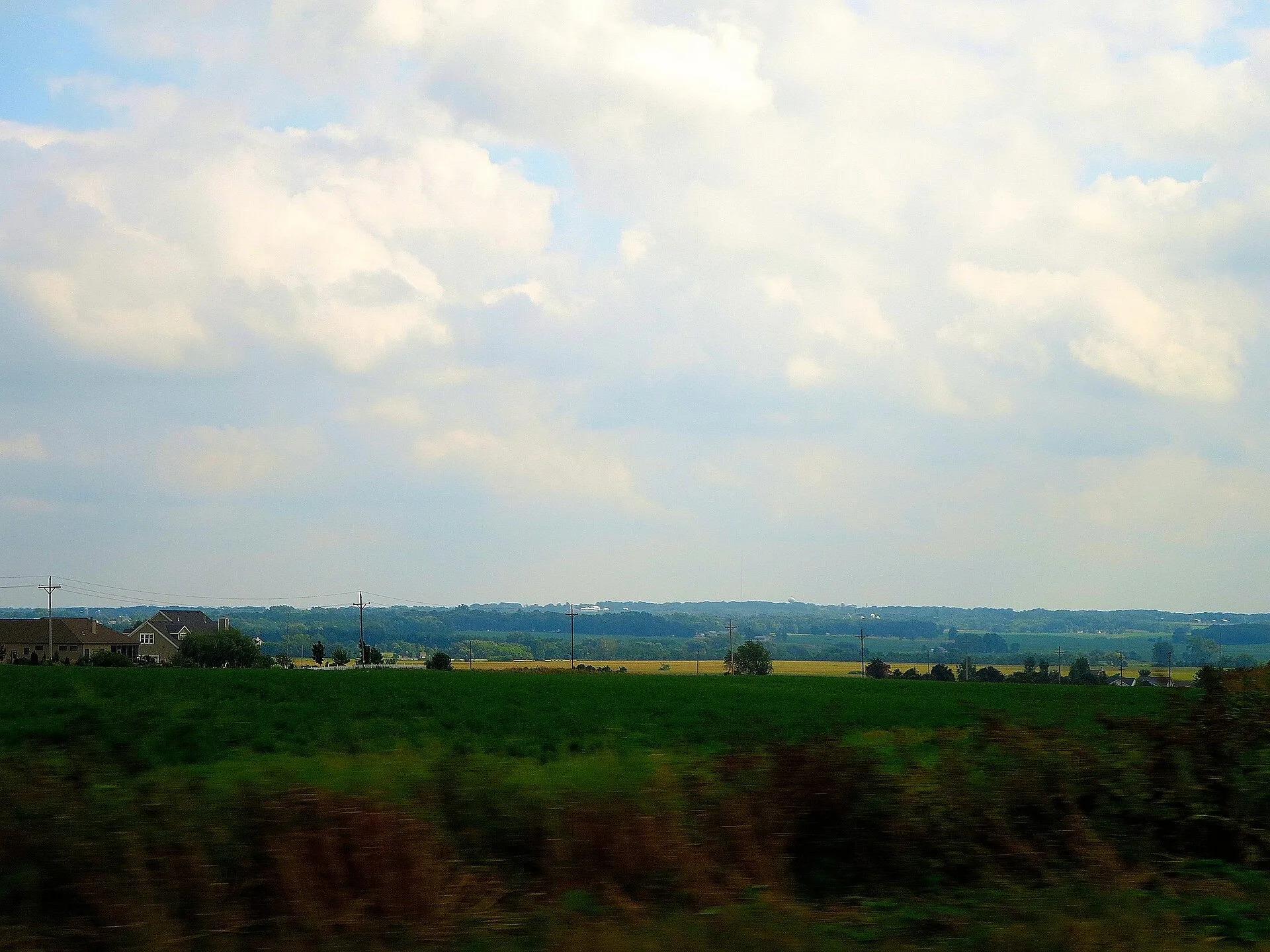
Bray Road is a rural two-lane road through cornfields and woodlots on the outskirts of Elkhorn, the county seat of Walworth County in southeastern Wisconsin. From the late 1980s, people driving it at night began telling friends about an animal they could not place: a heavy, fur-covered body, a head like a wolf’s, eyes that shone in headlights, and the alarming habit of standing up on its hind legs.
What happened
The accounts that circulated around Elkhorn described something six or seven feet tall when upright, with a long muzzle, pointed ears and glowing red or yellow eyes. Some witnesses saw it crouched at the roadside eating roadkill before it fled into the trees. Others saw a large dog-like animal running on all fours across the fields, once apparently chasing a deer. One woman said she had struck something on Bray Road, got out to look, and was chased back to her car by a red-eyed creature that left scratches down the rear door as she drove away. There were also rumors of partly eaten deer and livestock.
The reporting
In 1991 the stories reached Linda Godfrey, a former art teacher working as a reporter for the Walworth County Week, a weekly supplement of the Janesville Gazette. Her editor sent her to find out whether there was anything in them. When she asked an animal control officer she knew about unusual reports, he took a manila envelope from his desk drawer with the word ‘werewolf’ written on it. Godfrey tracked down witnesses who included a young single mother, a high school student and a farmer, and she came away convinced that they were frightened rather than playing a joke.
Her article appeared at the end of 1991, and within two weeks the Beast of Bray Road was national news. Television crews drove the road filming fields and interviewing locals, and letters arrived from people hundreds of miles away who said they had seen something similar. Godfrey stayed at the paper for another decade, kept collecting reports, and in 2003 published The Beast of Bray Road: Tailing Wisconsin’s Werewolf. She went on to write more than twenty books and was described by her local paper as a world-renowned cryptozoologist when she died in November 2022.
A story set in 1936, told by a night watchman at St. Coletta School near Jefferson, in the next county north, is often presented as the first sighting: he said a tall, shaggy, dog-faced figure was digging into a Native American burial mound on the grounds and growled at him the following night. It rests on one man’s account.
The explanations
Godfrey herself did not insist that every witness had seen the same thing; she wrote that some probably saw ordinary animals, a few may have been hoaxing, and others saw something she could not explain. The ordinary candidates are well documented. Gray wolves do turn up in Walworth County from time to time, and any big canid glimpsed for a second in headlights tends to grow in the retelling. Big dogs such as Newfoundlands or Great Pyrenees have been suggested, and black bears, which have been sighted in the county and can rise on their hind legs, look strange and almost hairless when afflicted with mange. Once a name like the Beast of Bray Road exists, unrelated sightings of any large animal tend to be filed under it.
Where it stands
Reports have continued at a lower rate. In 2017 a retired teacher with a farm near the road described glowing red eyes at the edge of a field, and witnesses reported upright, hair-covered figures in other Walworth County towns in 2018 and 2020. The legend has inspired a 2005 horror film, a 2018 documentary by Seth Breedlove’s Small Town Monsters, and a locally made film in 2025. No photograph, carcass or track has ever been tied to it, and it remains a regional legend.