
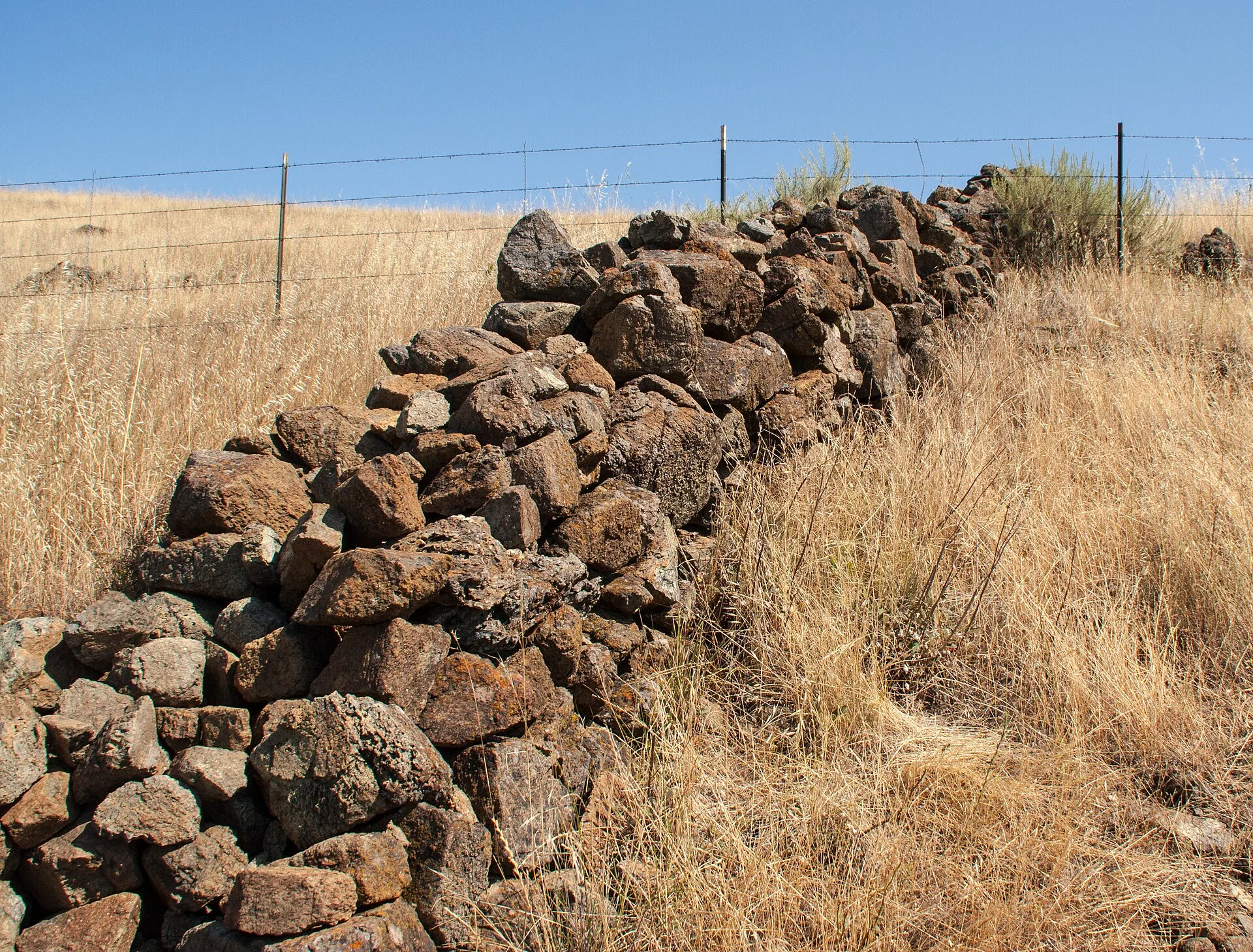
Walk the high ridges of the East Bay and sooner or later the trail crosses a line of piled rock. Some runs are a few yards long and some stretch for half a mile. They follow crests, turn corners, occasionally close into a rectangle or a circle, and then stop for no obvious reason. The stones are local, stacked without mortar, mostly small enough for one person to lift, with a few that would have taken a crew, and nearly all are crusted with lichen. Because the best-known section sits above Berkeley, they are often called the Berkeley mystery walls, but similar walls turn up in the hills from Berkeley down past Mission Peak to the slopes above Milpitas and San Jose, and farther north in the state as well.
A century of theories
KQED’s Bay Curious team traced the earliest printed mention of the mystery to the Sunday San Francisco Chronicle of March 8, 1896, which described old walls half a mile east of Grizzly Peak that had long puzzled antiquarians and wondered whether a forgotten race or the Aztecs had raised them for defense. In 1904 the Chronicle ran a large Sunday feature by Harold French, a keen hiker and writer who clerked at the San Francisco Mint, asking whether colonists from Atlantis or a pre-Toltec people had lived in the Berkeley Hills. Weeks later the paper announced that Henry Coffinberry Myers, a University of California chemistry professor, had dug up a carved five-faced stone head, axes and pottery that proved the walls prehistoric. KQED concluded the find was almost certainly a hoax; Myers soon left to run a sugar refinery in Hawaii and the paper never mentioned it again. The same year a UC professor of Asian languages, John Fryer, was quoted saying the walls must be Chinese work. In 1908 Joseph Voyle, a self-styled professor who headed the Berkeley Society for Psychical Research, announced the walls were prehistoric after a divining rod guided him to them, and the papers followed his expedition with glee.
Later enthusiasts kept the question alive. A Fremont physician, Robert Fisher, and a Berkeley friend, Russell Swanson, attributed the walls and nearby standing stones to a people they called the Earliers, and Fisher floated the idea that some served as markers for visitors from space. Television producers have since asked archaeologists whether a Chinese admiral or West African seafarers of 30,000 years ago might have left them.
What archaeologists think
Professional interest has been thin, partly, one archaeologist told KQED, because scholars did not want to be associated with the wilder theories. Even in French’s day a University of California anthropologist was quoted guessing that they were old sheep corrals or ranch boundaries. In the late 1980s Breck Parkman, a California State Parks archaeologist, toured Monument Peak with Fisher and judged most of the walls to date from the later 1800s, perhaps built by Chinese laborers or Basque sheepherders, while flagging a handful of features, possible hunting blinds and prayer circles, that might be Native American.
Jeff Fentress, a retired San Francisco State archaeologist who grew up in Berkeley hearing that the walls were built by Lemurians, has measured and mapped sections so they can be recorded and protected. He points out that there is no trace of any of the exotic visitors ever reaching the Bay Area and no record of the Ohlone or neighboring peoples building long walls. The likeliest builders, in his view, are the ranchers and farmers of the Mexican and American eras, many of them from European countries with long dry-stone traditions, using hired or forced labor; Chinese crews elsewhere in California were paid a penny a foot for ranch walls. An experimental lichen-growth study put the Berkeley section at roughly 1850 to 1880. Fentress concedes this is an argument from context, and says real answers would need systematic mapping, comparison with old property maps, excavation at the bases and many more lichen samples.
Where it stands
Not everyone accepts the ranch explanation. Amateur researchers profiled by the San Francisco Chronicle in 2020 argue that features such as a stone enclosure in Morgan Territory and a rectangle on Walpert Ridge were Native ceremonial sites, not livestock pens. The walls remain undocumented in the sense that matters most: nobody wrote down who built them. But the case for an ancient lost civilization has never rested on anything more than the walls themselves, and the one set of artifacts ever offered as proof, in 1904, was almost certainly a hoax.