
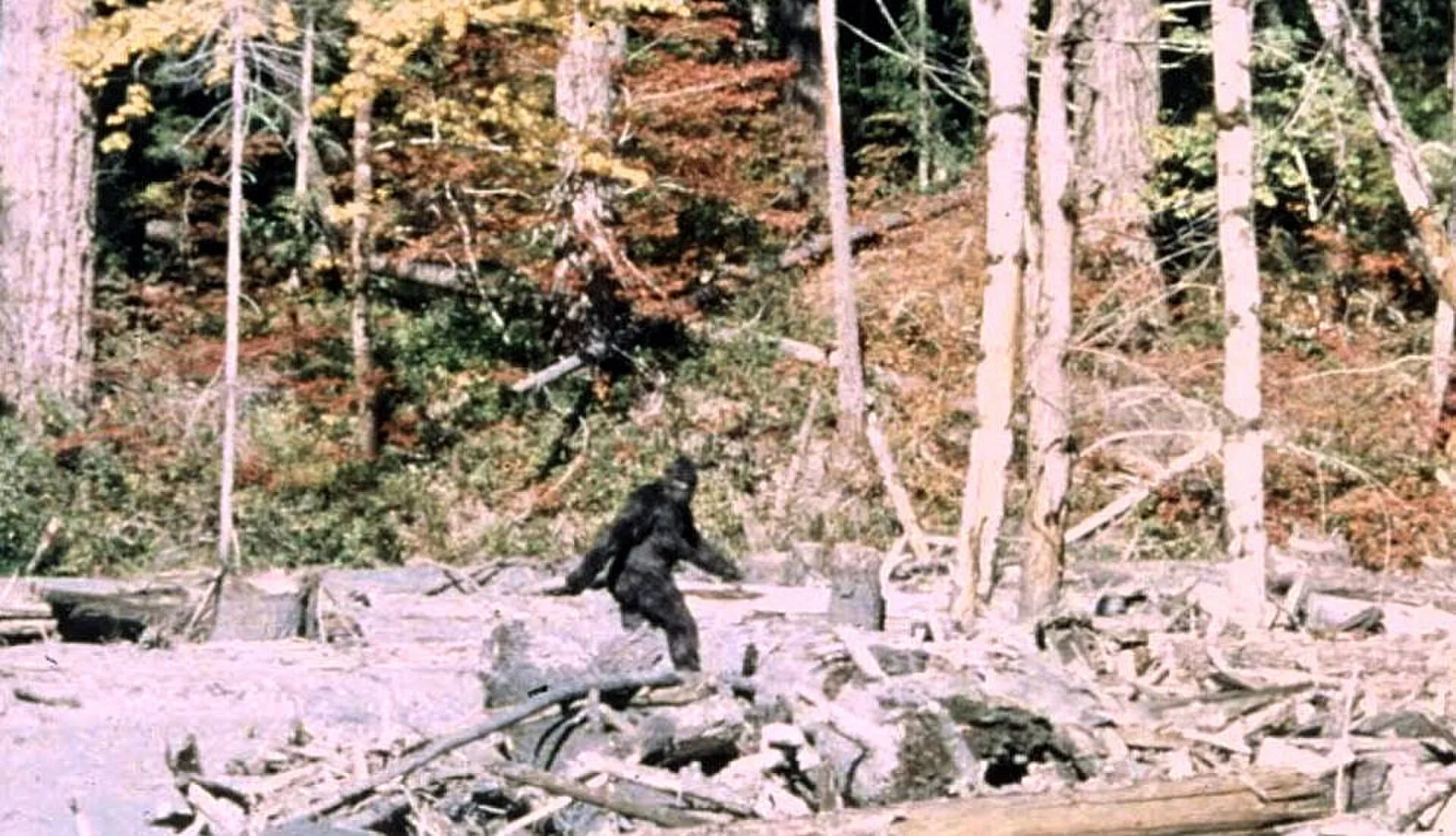
Bluff Creek is a tributary of the Klamath River in the Six Rivers National Forest of northern California, reached in 1967 by about twenty-five miles of logging road from the village of Orleans, and by then it was known to people hunting for Bigfoot. Among them was Roger Patterson, a former rodeo rider from Yakima, Washington, who had self-published a book on the subject in 1966 and wanted to make a documentary.
What happened
By their account, Patterson and his friend Bob Gimlin were riding along the creek in the early afternoon of October 20, 1967 when they came upon a large figure by the water. Patterson filmed it with a 16mm Cine-Kodak K-100 camera rented from a shop in Yakima, and much of the footage is badly shaken. The footage, 954 frames lasting about a minute, shows a dark, hair-covered, heavily built biped walking away across a gravel bar with a swinging gait. In frame 352 it turns its head and upper body to look back at the camera. The figure is usually described as female, and supporters often call it Patty. Patterson said the film was developed in Yakima by his brother-in-law, Al DeAtley, and it was screened to scientists and journalists within days.
The analyses
The film was never accepted by mainstream science, and decades of study have not settled it. A key unknown is the speed: the camera’s dial had no fixed stops and Patterson did not note the setting. Run at 24 frames a second the walk looks much like a human’s; at 16 or 18 it looks heavier and less human. The British primatologist John Napier, who studied it in the early 1970s, saw features he thought pointed to a hoax, while the anthropologist Grover Krantz argued that Patterson lacked the skill to fake it. In 1999 the anthropologists David Daegling and Daniel Schmitt concluded in the Skeptical Inquirer that the subject could not be identified with any confidence and that its gait could be reproduced by a person. The special-effects artist Bill Munns has argued at length that the subject is a real, non-human animal. The images are simply too grainy and unstable to decide the question on their own.
The hoax claims
Doubts about the circumstances are older. Skeptoid’s Brian Dunning found the timeline Patterson gave for filming, driving out and having the film developed impossible as given, and DeAtley later said he could not remember when or where it was processed. Patterson, who was ill with cancer, formed a company to exploit the footage within two weeks, and lawsuits over the rights ran through the 1970s. He died in 1972.
In 1999 Bob Heironimus, a laborer who had been Gimlin’s neighbor, said through a lawyer that he had been the figure in the film. The writer Greg Long laid out his account in the 2004 book The Making of Bigfoot: Heironimus said he had been promised $1,000 to wear a suit for a day and never received it. Long also found Philip Morris, a North Carolina maker of carnival gorilla suits, who said Patterson bought a suit from him by mail in 1967 for $435 and later asked for advice on lengthening its arms. Reviewing the book for the Skeptics Society, Daniel Loxton noted that the two men’s descriptions of the suit do not match, since Heironimus recalled a horsehide costume built by Patterson, and that no suit has ever surfaced. Gimlin’s lawyer called Heironimus’s story false.
Where it stands
Gimlin has continued to say he saw a real animal. The exact filming site, overgrown after decades of regrowth, was relocated by enthusiasts in 2011. The film itself, published without a copyright notice, is in the public domain in the United States, which is one reason frame 352 is everywhere. With no specimen, no suit and no agreed analysis, the film proves neither that Bigfoot exists nor that it was faked; it remains unproven.