
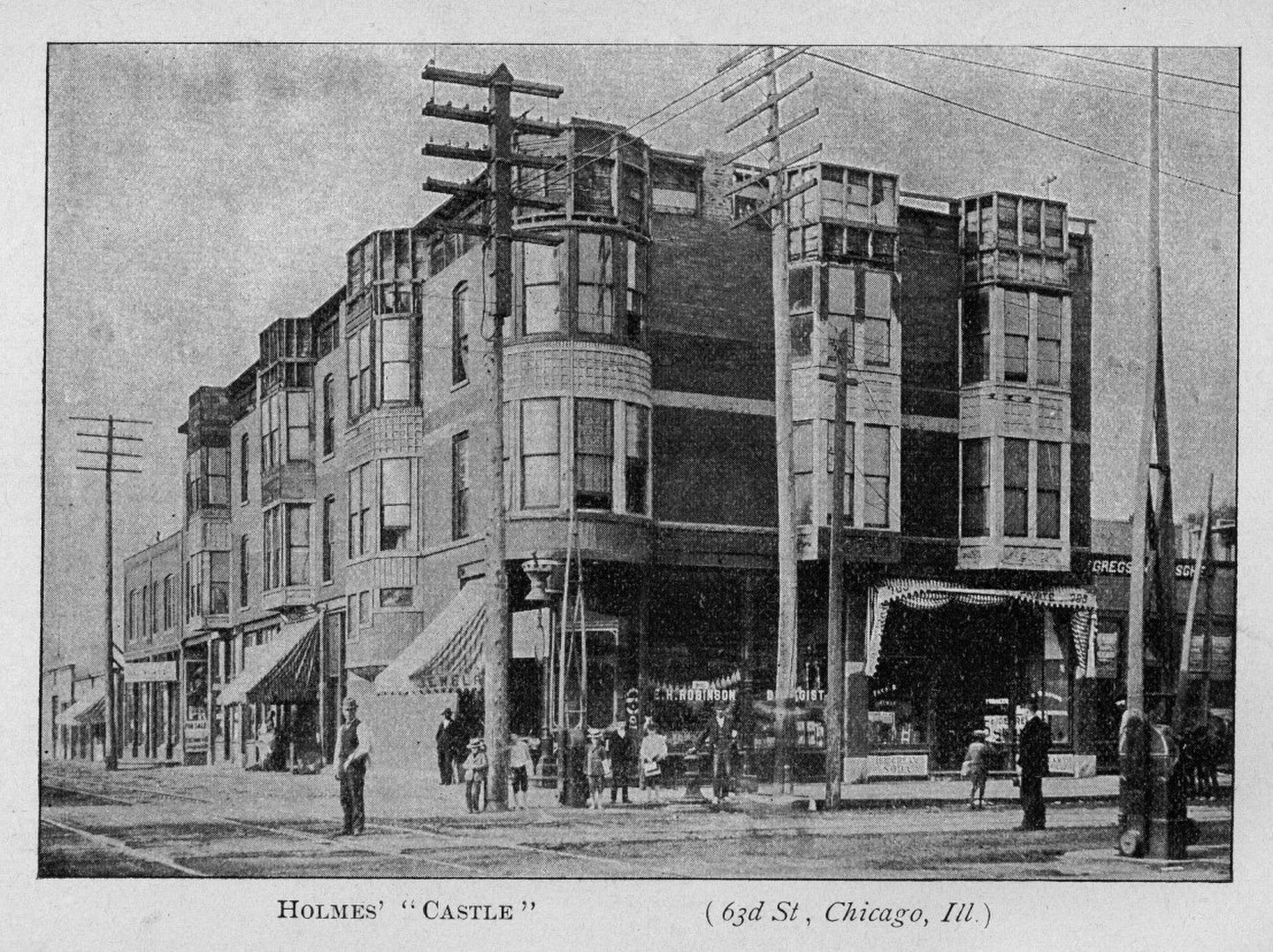
Herman Webster Mudgett was born in New Hampshire in 1861, trained in medicine at the University of Michigan and arrived in Chicago in the mid-1880s under the name Henry Howard Holmes. He took over a drugstore in Englewood, on the south side, and across the street at 63rd and Wallace he put up a building that the papers of the time simply called the Holmes block or, later, the Castle. It is the building, far more than the man, that carries the legend.
What happened
The ground floor, built in 1887, held shops, including Holmes’s own pharmacy. A second floor of long-term apartments followed, and in 1892 Holmes added a third story that he told suppliers and investors would be rooms for visitors to the coming World’s Fair. It was never finished, furnished or opened. The building did contain odd rooms and passages, but Chicago knew about them before the fair began: in March 1893 the Chicago Tribune reported that creditors had found furniture Holmes had bought on credit hidden behind false walls. During the fair he tried to burn the place for the insurance.
Holmes’s downfall was a different scheme. In 1894 he and a partner, Benjamin Pitezel, arranged to fake Pitezel’s death and collect on a 10,000-dollar life policy. Pitezel was found dead in Philadelphia that September, and Holmes, pretending to help the family, took custody of three of the Pitezel children, Alice, Nellie and Howard. He was arrested in Boston in November 1894 on a Texas horse-fraud warrant. In the summer of 1895 Philadelphia detective Frank Geyer traced the children across the Midwest and into Canada, finding the two girls buried in a cellar in Toronto and the boy’s remains in a stove in Irvington, Indiana. Geyer’s own account of the search was published in 1896.
The investigation
The discoveries sent Chicago police into the Englewood building in July 1895, and for about a week reporters recorded each find as proof of a slaughterhouse: a rope meant hangings, a scarred table meant dismemberment, ashes in a stove meant cremation. Most claims were retracted within days, since a wood stove cannot cremate a body, but the corrections never caught up with the headlines.
Holmes was tried in Philadelphia for Pitezel’s murder alone, convicted in late 1895 and sentenced to death. While awaiting execution he sold the newspapers a confession, printed in April 1896, in which he claimed 27 murders. Several of the people he named were alive. He was hanged at Moyamensing Prison on May 7, 1896, nine days short of his 35th birthday.
The explanations
Chicago historian Adam Selzer spent years in court records, coroner’s files and the digitised press for his 2017 book, and his conclusions are now the standard corrective. Four murders rest on hard evidence: Benjamin Pitezel and his three children. Around five more are probable, among them Julia Conner and her daughter Pearl, who vanished at Christmas 1891, Emeline Cigrand, and the sisters Minnie and Nannie Williams, all people Holmes already knew and in most cases had been swindling. There is no evidence that strangers were lured in from the fair and no evidence of gas chambers or a crematorium; the chute to the basement was a standard feature of commercial buildings of the period.
The larger numbers have traceable authors. Holmes’s 27 was his own, produced for money. The claim of 200 victims first appeared as an aside in Herbert Asbury’s 1940 pulp history Gem of the Prairie and was not taken seriously at the time. Erik Larson’s 2003 bestseller The Devil in the White City, which revived the story, is open in its notes about how much of its Holmes material is imagined.
Where it stands
The building is long gone and a post office occupies the corner at 63rd and Wallace. Holmes remains one of the earliest documented American serial killers, and the deaths of the Pitezel family are as well established as any crime of the 1890s. The castle, with its hundreds of victims, belongs to the newspapers that built it.