
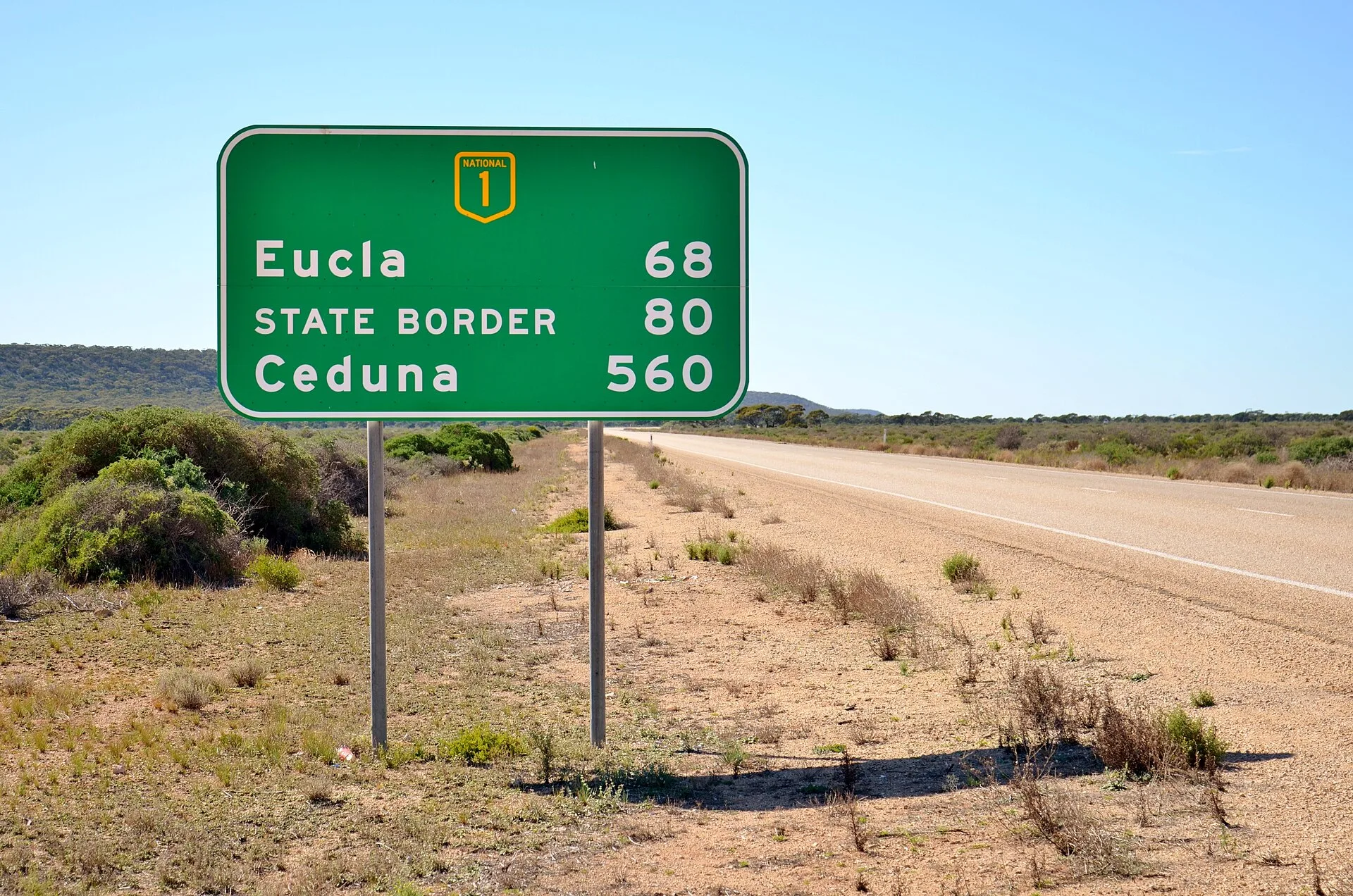
The Eyre Highway crosses the southern edge of the Nullarbor Plain between Norseman in Western Australia and Ceduna in South Australia, a long run of flat, nearly treeless country where the stops are roadhouses hours apart. It is a road people drive through the night. In January 1988 one family’s drive along it produced a story that ran on front pages around the world for several days and then quietly fell apart.
What happened
Faye Knowles of Perth had set out with her three grown sons, Sean, Patrick and Wayne, and two dogs in a 1984 Ford Telstar, heading for relatives in Melbourne. They had been on the road about thirteen hours. Some time before dawn on January 20, with Sean driving and the others half asleep, they noticed a light on the road ahead, west of the Mundrabilla Roadhouse. At first they took it for an oncoming truck. It grew brighter, seemed to jump about, and frightened them into swerving. Later they described it as white with a yellow center and shaped like an egg sitting in an eggcup, about a meter across.
Believing it was following them, Sean pushed the car to around 200 kilometers an hour. The family reported a humming sound, a gray or blackish mist entering through a window, a strange smell, and their voices sounding slow and deep. Something thumped onto the roof; Faye said she reached up through the window and touched something soft. Then, they said, the car was lifted and dropped, a rear tire burst, and the car slewed to a stop. They hid in the scrub for a quarter of an hour, fitted the spare and carried on to the Mundrabilla Roadhouse, where truck drivers saw how upset they were. Accounts of the time range from about 2:45 to after 5 in the morning.
The investigation
By the time the family reached South Australia the story was international news, with reports that the car had been coated in black ash and its roof dented. A truck driver, Graham Henley, who had been somewhere ahead of them on the highway, said he too had seen a white and yellow light that came and went and seemed too high to be a vehicle. The crew of a tuna boat in the Great Australian Bight reported a light that night as well.
The car was examined several times, by South Australian police and by UFO groups. According to a 1989 report by A. T. Brunt, a former South Australian regional director of the Bureau of Meteorology, none of these inspections found anything unusual. There was no ash inside or out; the only deposit was dark dust on the front wheel rims, consistent with brake linings. The burst rear tire looked like an ordinary high-speed failure, and the marks on the roof were minor and could not be shown to be new. Robert Bartholomew, a sociologist who studies collective delusions, notes that the Australian Mineral Development Laboratories analyzed the dust and found clay and salt, which is what a car crossing the Nullarbor would collect.
The explanations
Brunt pulled the weather records. On the morning of January 20 a long ridge of high pressure lay along the southern coast of Western Australia, with a strong temperature inversion over the whole stretch. Warm air sitting on cooler air bends light downward, producing a superior mirage that can lift the image of a light far below the horizon into the sky, enlarge it, stretch it vertically and make it flicker and jump as the observer moves. The same effect explains Queensland’s Min Min light and the train headlights that Nullarbor railway passengers see an hour before the train arrives. Brunt concluded that the family’s first impression had been right: they were looking at the distorted headlights of a vehicle, perhaps one descending into Eucla about 100 kilometers east.
Brian Dunning of Skeptoid, reviewing a television interview recorded soon afterward, found the family far less sure than the headlines. Asked whether the car was lifted, Faye said they did not really know but thought so; Sean said the tire burst at the moment the object landed, not after a drop. The Telstar’s tires were rated for 180 km/h, so a blowout after minutes at 200 was likely in any case. Bartholomew files the night under small-group panics, in which tired people in an isolated, dark place frighten one another into reinterpreting ordinary sights and sounds.
Where it stands
The Knowles family stood by their account. There is no reason to doubt that they saw a light that terrified them. But the physical evidence that made the story famous did not survive inspection, the only corroborating witness saw a light rather than a craft, and the conditions that night were right for exactly the kind of mirage that has fooled travelers on that road before and since.