
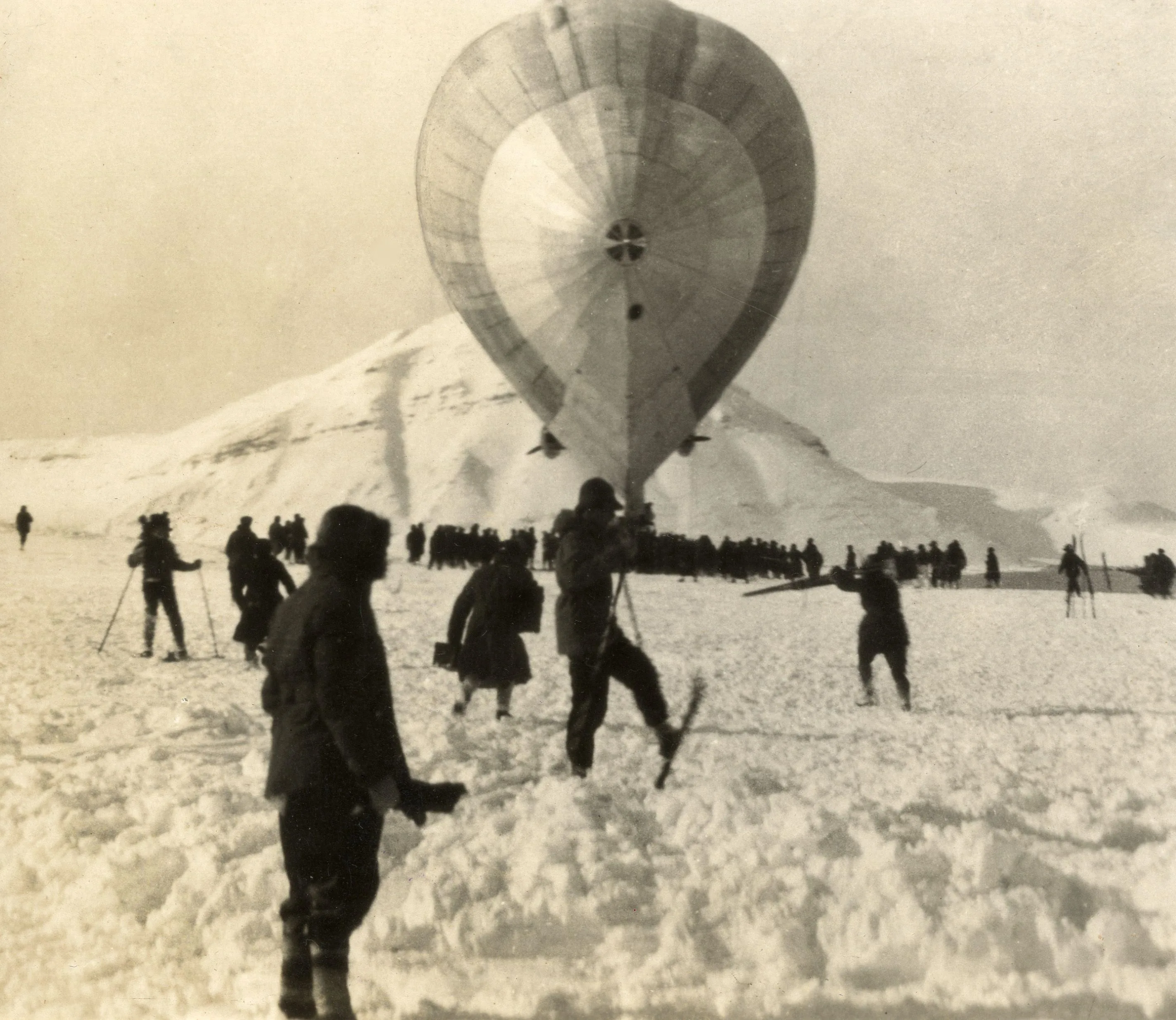
Two years after he had piloted the airship Norge across the Arctic with Roald Amundsen, the Italian engineer Umberto Nobile returned to the far north with a ship of his own. The Italia, a 106-meter semi-rigid airship built to his design, flew from Milan to Kings Bay on Spitsbergen in the spring of 1928 for a series of scientific flights. On May 24, after a nineteen-hour run helped by a tail wind, it circled the North Pole, where the crew dropped an Italian flag and a cross given by Pope Pius XI. The return journey turned into one of the most famous disasters in polar history, and parts of it have never been explained.
What happened
Heading back into the wind, the airship spent more than a day fighting gales and fog, with ice forming on the propellers and tearing the fabric. Nobile had gone without real sleep for two days or more. On the morning of May 25 an elevator jammed and the ship dropped toward the ice before recovering; Nobile let it rise above the cloud into sunshine, then brought it back down. About an hour later it became heavy at the stern and began to fall. Engines were stopped, ballast could not be released in time, and the control gondola struck the pack ice northeast of Nordaustlandet and was ripped away.
Ten men were thrown onto the ice. One, the mechanic Vincenzo Pomella, died within minutes. Relieved of the gondola’s weight, the rest of the airship rose and drifted off eastward carrying six men, among them the chief engineer Ettore Arduino, who threw supplies down to the survivors as he passed. Neither the envelope nor any of the six has been found.
The rescue
The nine on the floe sheltered in a tent they streaked with red dye and depended on a short-wave set that the radio operator, Giuseppe Biagi, got working within hours. For days nobody heard them; a Soviet radio amateur finally picked up their call in early June. On May 30 the Swedish meteorologist Finn Malmgren set off on foot toward land with two Italian officers, Filippo Zappi and Adalberto Mariano. Malmgren weakened and was left behind in mid-June. The two Italians were found by the Soviet icebreaker Krasin on July 12, Zappi in fair condition and Mariano unable to walk, and the rest of the camp was reached the same day. Malmgren’s death rests entirely on their account, and rumors about it followed both men for years.
The search drew some two dozen aircraft, sixteen ships and more than a thousand men from at least six countries. Amundsen, who had quarreled publicly with Nobile after the Norge flight, joined it anyway. On June 18 he left Tromsø in a French Navy Latham 47 flying boat with five companions, heading for Spitsbergen. The aircraft never arrived. A wing float and a fuel tank later turned up at sea; nothing else has been found, and a privately organized sonar search near Bear Island in 2009 was a long shot from the start. A Swedish pilot who landed at the tent on June 23 took Nobile out first, a decision that was held against him for the rest of his life. Counting the rescuers who were lost, seventeen people died.
Blame
Norway received Nobile with open hostility. In a 2005 essay in Polar Research, the Tromsø historian Steinar Aas describes a smear campaign that had run since Amundsen’s attacks on him in 1927 and crowds in Narvik urged by local papers to jeer the returning general. In Rome, a commission of inquiry appointed by Mussolini’s government reported in 1929 that he was responsible for the crash and for leaving his men; he resigned from the air force and spent years abroad, and was only rehabilitated after the fall of Fascism. A 2019 study in the same journal by Gregg Bendrick and Sergio Alessandrini argues that the root problem was the absence of a second-in-command, which left Nobile making critical decisions after roughly three days without sleep. Other suggested causes include a stuck gas valve, a torn gas cell and fabric damaged during de-icing. One of the surviving engineers examined eleven candidate causes and settled on none.
Where it stands
In August 2018 the PolarQuest expedition sailed to the position of the first SOS and swept the seabed with multibeam sonar along the likely drift path. It found no trace of the airship’s hundred-meter metal keel. The six men in the envelope and the six aboard Amundsen’s Latham remain missing, the cause of the crash is still argued over, and the verdict that ruined Nobile looks, nearly a century on, at least as political as it was technical.