
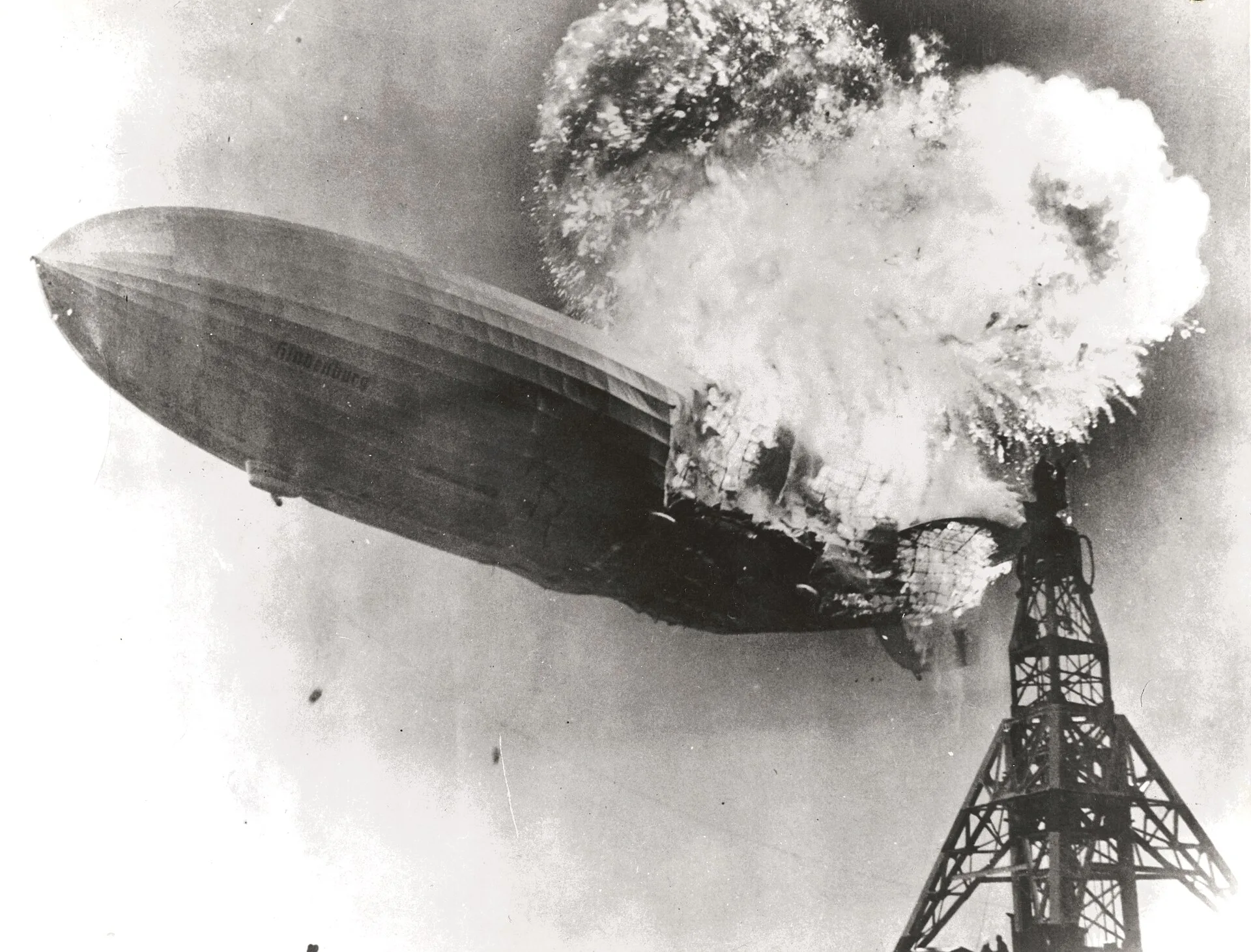
At about 7:25 on the evening of May 6, 1937, the German airship Hindenburg caught fire while landing at the Naval Air Station in Lakehurst, New Jersey. In roughly half a minute the largest aircraft ever flown was a burning skeleton on the sand. Thirty-five of the 97 people on board died, along with one man on the ground crew. Because reporters and newsreel cameras had come to cover the first transatlantic arrival of the season, the disaster was filmed, photographed and narrated live, and the question of what lit the fire has been argued ever since.
What happened
LZ 129 Hindenburg was 804 feet long and held about seven million cubic feet of hydrogen. It had been designed for helium, which the United States would not sell to Germany. The ship left Frankfurt on May 3 with 36 passengers and 61 crew, fought headwinds across the Atlantic, and reached Lakehurst in the afternoon of the 6th to find thunderstorms over the field. Captain Max Pruss cruised along the Jersey shore until the weather eased, then came in shortly after seven for a “flying moor,” dropping lines from the air to be winched down to the mast. The ship was heavy at the tail, and the crew dumped water ballast and sent men forward to trim it.
Four minutes or so after the landing ropes touched the ground, members of the ground party saw the outer cover ripple on the port side near the stern, as if gas were pushing against it from inside. Witnesses then saw flame on top of the ship just ahead of the upper tail fin. The fire raced forward through the gas cells, the stern dropped, and the bow, still in the air, burned last. Most of the passengers, in public rooms low in the hull, were able to jump or climb out as the wreck settled. Many crew members high in the bow could not.
The investigation
The U.S. Commerce Department convened a board of inquiry at Lakehurst within days, chaired by its solicitor, South Trimble Jr. A German commission led by Hugo Eckener, the head of the Zeppelin company, took part. The American report, published in August 1937, found that hydrogen had leaked into the upper stern near gas cells 4 and 5 and formed a combustible mixture with air. It called a brush discharge, the faint electrical glow also known as St. Elmo’s fire, the most probable means of ignition, in an atmosphere charged by the passing storms. The board had looked at sabotage, from bombs to incendiary bullets fired from the ground, and found no evidence for any of it. The German side favored a more powerful spark between the ship’s fabric skin and its metal frame.
The explanations
Sabotage remained the popular suspicion. Commander Charles Rosendahl, who ran the Lakehurst station, believed in it, and anti-Nazi feeling made the idea easy to accept. In 1962 the writer A. A. Hoehling named a rigger, Erich Spehl, who had died of his burns, as the likely bomber; a 1972 book by Michael Mooney took up the idea, and it became the basis of the 1975 film The Hindenburg. No fragment of a bomb was ever identified, the FBI found nothing against the passenger most often suspected, the vaudeville acrobat Joseph Späh, and airship historians have generally dismissed the case against Spehl as speculation.
A second challenge came in the 1990s from the retired NASA engineer Addison Bain, who argued that the aluminum-and-iron-oxide dope on the outer cover was itself highly flammable and that the ship would have burned even if filled with helium. Critics, among them the former NASA space scientist A. J. Dessler, argued that such coatings burn far too slowly to explain a fire that consumed the ship in little more than half a minute, and the airship historian Dan Grossman notes that the hydrogen, not the fabric, did the damage.
Two televised investigations tested the electrostatic theory directly. A 2012 Discovery Channel program, with Grossman and the British engineer Jem Stansfield, concluded that the gas ignited above a hydrogen vent near the tail. In 2021 NOVA enlisted Konstantinos Giapis, a chemical engineer at Caltech. On a model of the doped skin, kept apart from an aluminum frame by wooden pegs as on the real ship, he found that light rain made sparks jump the gap once the frame was grounded. He also found the mooring ropes conducted even when dry, and calculated that a grounded frame would take about four minutes to build up a spark-sized charge, roughly the delay seen at Lakehurst.
Where it stands
Every formal investigation and most later research point to the same chain: a hydrogen leak near the stern, an electrically charged ship and a spark. The source of the leak is still uncertain, and the exact spark cannot be proved, but no physical evidence of sabotage has ever surfaced.