
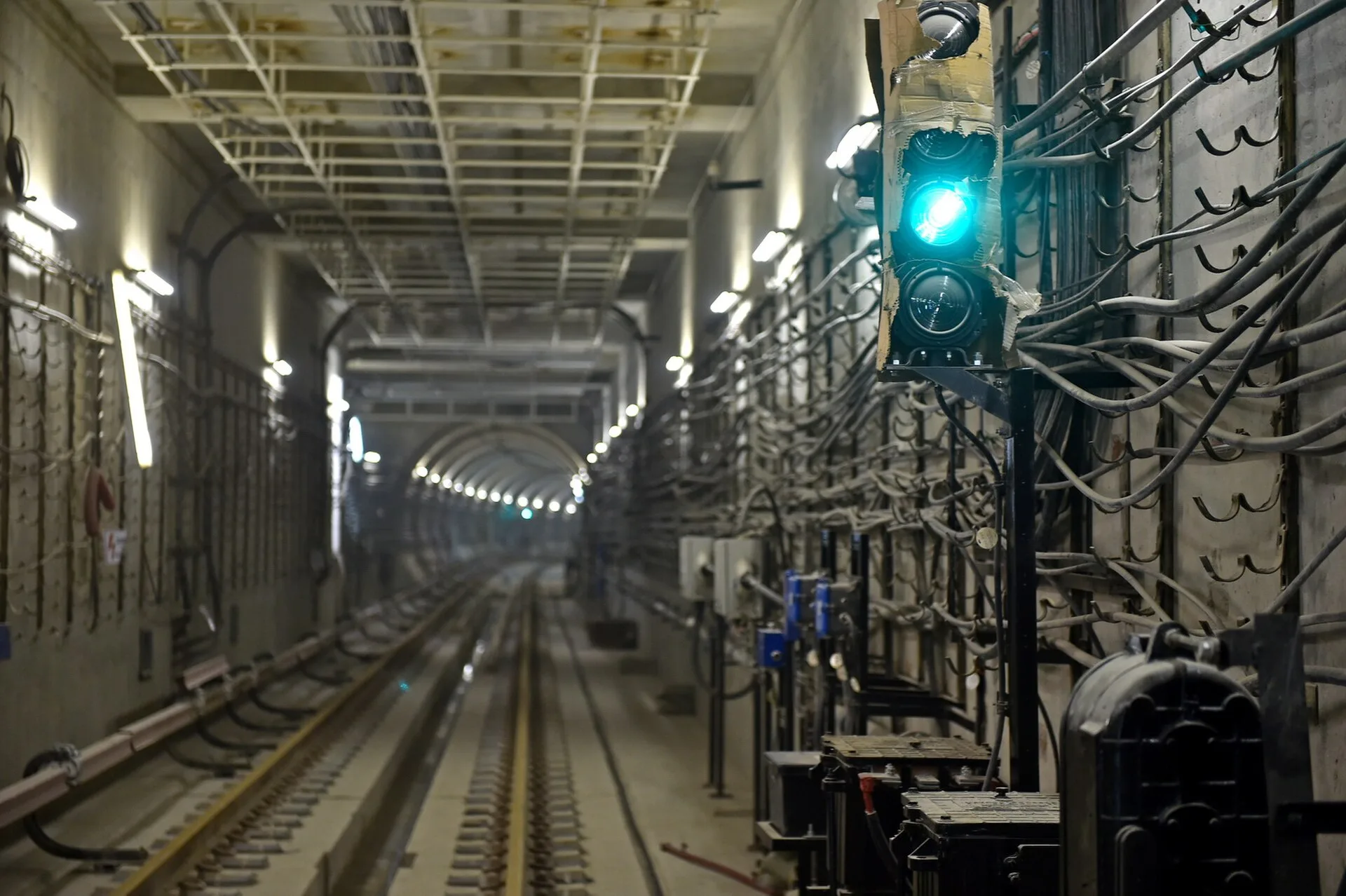
The Moscow Metro is one of the deepest in the world, and the idea that the Kremlin keeps its own railway far below the public lines, running to bunkers on the edge of the city and beyond, has been part of the city’s folklore since the late Soviet years. It even has a name, Metro-2, and a map that circulates online showing four lines from the Kremlin to Vnukovo, to the Federal Security Service’s offices and to a buried town at Ramenki in the southwest.
What happened
The most authoritative description came not from Moscow but from Washington. In 1991 the US Department of Defense published Military Forces in Transition, a public assessment of the Soviet armed forces as the USSR dissolved. A section on leadership survival said the Soviets had dug deep command posts under Moscow itself and beyond its edge, and had joined them with a set of dedicated deep rail lines so the leadership could get out quickly and safely. It placed one post at the Kremlin and another, described in the Soviet press as an enormous bunker, beside Moscow State University; it estimated them at 200 to 300 meters deep, with room for about 10,000 people; and it said a dedicated line ran out from the city, perhaps as far as the VIP terminal at Vnukovo airfield 27 kilometers to the southwest. An illustration showed excavation shafts of the type used by the metro builders, captioned as the works for the Ramenki facility.
The following year the writer Vladimir Gonik serialized a novel, Preispodnyaya, built on two decades of stories he said he had gathered, and claimed the term Metro-2 had been given to him by his sources. He also admitted he had deliberately altered sensitive details. In August 1992 Time magazine reported, citing former KGB officers, that the Kremlin and other key buildings were still linked by rail tunnels to Ramenki, about six miles from the center, where a KGB officer who claimed to have worked on the project had described to a Soviet newspaper an underground city of 500 acres, on several levels between 230 and 395 feet down, begun in the late 1960s and finished by the mid-1970s, with food for 30 years. The novel and the article between them fixed the legend.
The investigation
Nobody in authority has ever confirmed the four-line map, but several have confirmed something. In 2004 Vladimir Shevchenko, a former chief of protocol to Gorbachev and Yeltsin, said a single-track line had run from the Kremlin to Stalin’s dacha at Volynskoye and was no longer in use, and that other tunnels connected the General Staff and government buildings; in 2008 he described the Kremlin line as decayed and in need of major repair. Dmitry Gayev, head of the Moscow Metro from 1995 to 2011, said he would be surprised if such a system did not exist and did not rule out that it might one day carry passengers. In 1992 a senior state broadcasting official told Time that the communications bunker at Sofrino, 30 miles out, was obsolete and being stripped for parts.
Moscow’s urban explorers, the diggers, have claimed more. In 2005 a BBC reporter was shown photographs by a 22-year-old digger who said he had walked the full length of a secret line: large, well-lit tunnels with rails set into a concrete floor, running 25 kilometers into the countryside. One Russian journalist who wrote about the network was called in for questioning by the FSB.
The most careful work is recent and archival. In 2021 the historian Dmitry Yurkov published a study of Moscow’s special fortification drawn from declassified construction records. It documents a deep single-track tunnel begun in the mid-1950s; a shelter complex at sites 54 and 54a near Moscow State University, built between 1956 and about 1963 under a project called Order 10-A; a central command facility, site 103, linked to the tunnel by a branch; and remote ventilation shafts, one of which passed with its tunnel from the metro to the KGB in the late 1960s. That amounts to one line from the Kremlin area to the university district with a spur to the northwest. Lines to Vnukovo and Izmailovo appear nowhere in the records.
The explanations
The confirmed facts are enough to explain the legend. Every nuclear power built hardened command posts and ways to reach them, and the Soviet Union, which dug its public metro deep enough to double as a shelter, naturally dug its private one deeper. What the archive does not support is the underground city for tens of thousands, the 30-year larder, or a second network as extensive as the first. Those details come from a novelist who admitted inventing some of them, from anonymous former officers, and from each other. Two declassified facilities now open as museums, the Tagansky command post known as Bunker-42 and an air-filtration station called Bunker-703, are often cited as proof of Metro-2; neither is connected to it.
Where it stands
The Russian government neither confirms nor denies that Metro-2 exists, which is the normal posture for a continuity-of-government system anywhere. The best reading of the evidence is that a deep leadership tunnel from the Kremlin toward the southwest was built in the 1950s and 1960s, has been maintained in some form since, and is smaller, older and less glamorous than the map suggests. The rest remains a story Moscow tells about itself.