
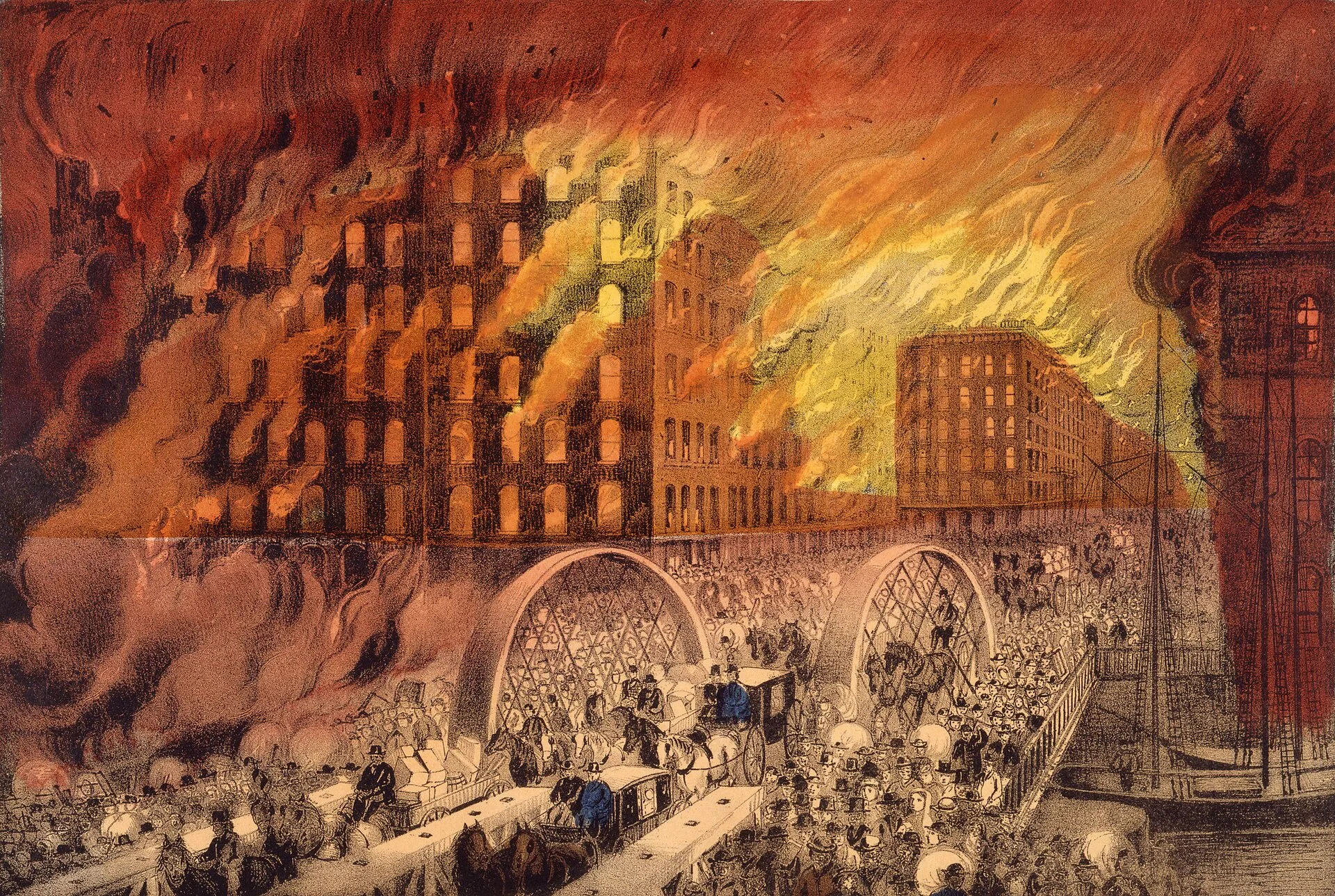
The summer and autumn of 1871 had been dry across the upper Midwest, and Chicago was a city of wood: wooden houses, wooden sidewalks, wooden barns full of hay. Late on the evening of Sunday October 8 a fire started on the West Side, in or beside the barn behind the cottage of Patrick and Catherine O’Leary on DeKoven Street. A strong wind carried it north and east across the river into the business district. By the time rain put it out on the morning of October 10 it had burned about three square miles, killed roughly 300 people and left around 100,000, a third of the city, without homes.
What happened
The O’Learys were Irish immigrants. Catherine, in her early forties, kept five cows, which she milked twice a day, plus a horse and a calf; the family lived in the rear of a double cottage and rented the front to a family called McLaughlin. The barn held hay, coal and wood shavings for winter. The cottage survived the fire; the barn and all the animals but one calf did not.
The story that she had been milking by lantern light when the cow kicked it over was in print within days. The Chicago Times, without naming her, described a welfare cheat who had vowed revenge when her relief was cut off. Frank Leslie’s Illustrated named her twenty days after the fire. Michael Ahern, a reporter on the Chicago Republican, wrote the cow and the lantern, and the cow has been Daisy, Madeline or Gwendolyn ever since. Curiosity-seekers claimed to have found pieces of a broken lamp behind the cottage. Cartoonists drew her as an aged, drunken crone; she was sober, hard-working and forty-four.
The investigation
That autumn the Board of Police and Fire Commissioners took sworn testimony from fifty witnesses. Catherine O’Leary swore she had been in bed when the alarm was raised. Daniel Sullivan, a neighbor with a wooden leg who said he had seen the flames from across the street and run to the barn to free the animals, confirmed that she had been in the house. Those who claimed to have heard her admit being in the barn contradicted one another about why. The board concluded that whether the fire began with a spark from a chimney on a windy night or by human agency it was unable to determine. A. T. Andreas printed the hearings in his History of Chicago in 1884, set out four theories, from a kicked lamp to boys smoking in the barn and a neighbor’s party guest fetching milk, and wrote that the cause was now a mystery and must ever remain so.
Ahern’s own account changed. Decades later, in a Chicago Tribune piece around the fire’s fortieth anniversary, he boasted that he and two colleagues, both by then dead, had invented the cow, and offered instead a guest at the McLaughlins’ party who had gone out for milk; other accounts date his admission as early as 1893, and a long-time colleague said he had ghost-written the original story under Ahern’s byline. Whichever year, the man credited with the legend disowned it.
The explanations
That the fire began at the O’Leary barn is not in doubt; the question is what set it off, and the record cannot say. The Chicago History Museum, which holds the cowbells supposedly dug from the site, regards definitive knowledge as highly unlikely. The leading modern suspect is Sullivan. Richard F. Bales, a lawyer with the Chicago Title Insurance Company, which keeps the only set of land records to survive the fire, mapped the block from those records and compared it with the inquiry transcripts, and concluded that Sullivan could not have seen the barn from where he said he was sitting; his 2002 book argues that Sullivan was in the barn, started the fire by accident and then raised the alarm. Other historians call the theory supposition, and a later mock trial sided with Sullivan. The remaining candidates are the ones Andreas listed, plus a comet, since fires broke out the same night at Peshtigo, Wisconsin, and in Michigan, and an anarchist conspiracy that a local paper and a New York poem dramatized.
Why the cow stuck is easier. A poor Irish Catholic immigrant woman with a lantern turned a catastrophe into a comic accident: nobody’s fault but a clumsy foreigner’s, and therefore nobody’s responsibility. The caricature drew on anti-Irish, anti-Catholic and anti-poor feeling. A song of the 1890s, Old Mother Leary, fixed the lantern in every schoolchild’s head.
Where it stands
Catherine O’Leary refused every promoter who offered her money to appear, moved house repeatedly around 50th and Halsted to escape the reporters who came each October, and died in early July 1895, a year after Patrick. Her son Jim became a well-connected saloon keeper in the stockyards district. The Chicago Historical Society put a plaque on the site in 1881; the city built its fire academy on the block in the early 1960s, with a bronze flame by Egon Weiner out front. In 1971 the Chicago Association of Commerce absolved her and blamed Sullivan, and in October 1997, 126 years on, the City Council’s Committee on Police and Fire held a hearing at the Fire Academy and exonerated Catherine O’Leary and her cow, naming no one else. The fire is history. The cow is a reporter’s invention.