
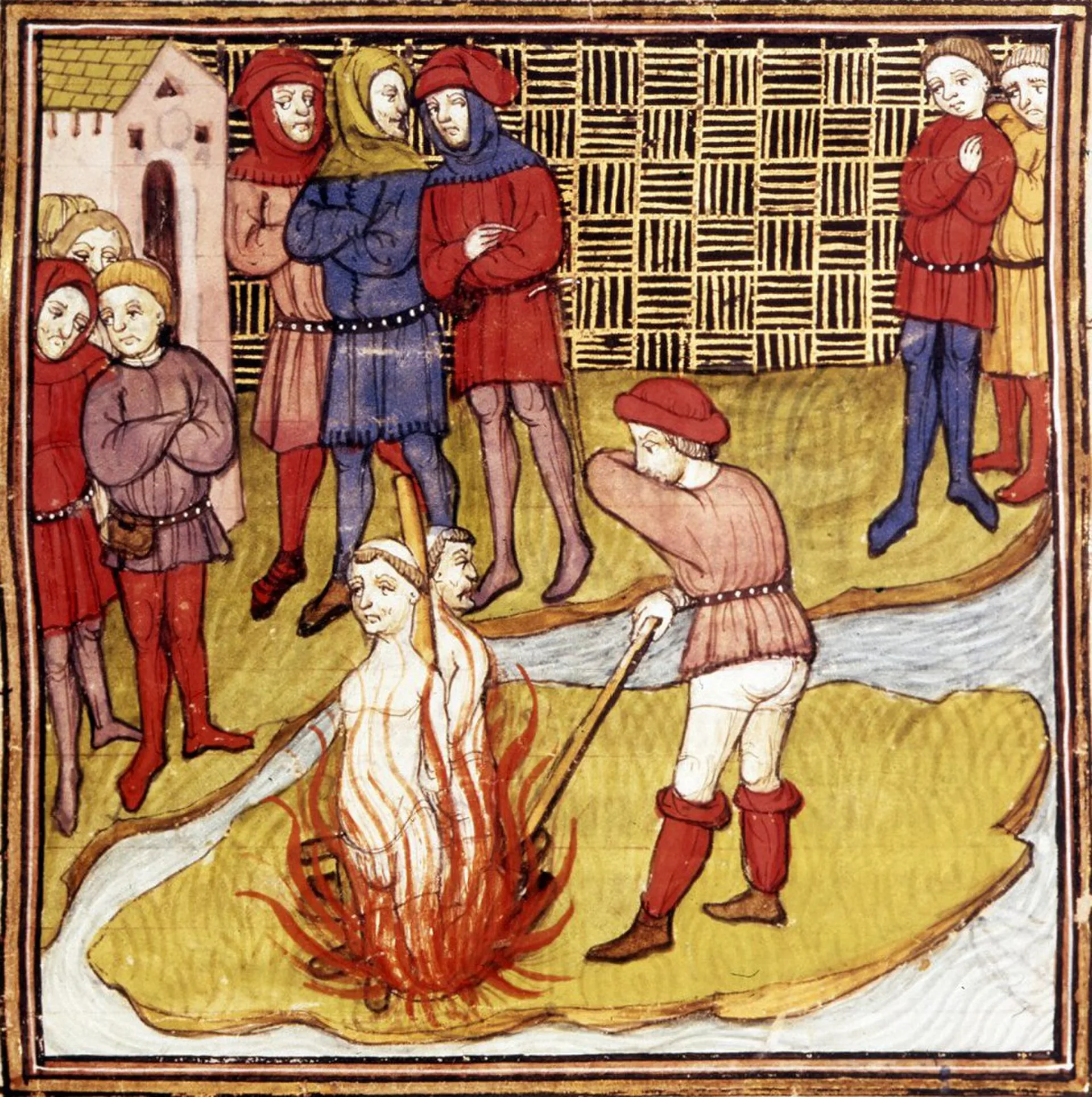
The Poor Fellow-Soldiers of Christ and of the Temple of Solomon were founded in Jerusalem in the years after the First Crusade to protect pilgrims on the roads to the holy places. By 1300 the Templars were a military order answerable only to the pope, with estates across Europe, a fleet, a banking network that moved money for kings, and a Paris headquarters, the Temple, that served as the French royal treasury. Their reason for existing had ended in 1291 when Acre, the last crusader city, fell, and they were living in France on wealth that the French crown had borrowed heavily against.
What happened
Philip IV sent sealed orders to his officers in September 1307 with instructions not to open them until the appointed day. At dawn on Friday October 13 they were opened, and across the kingdom the Templars were taken from their houses. In Paris the Grand Master, Jacques de Molay, who had attended a royal funeral the day before, was arrested with the senior officers of the order. The number taken is still argued over; the brothers in France numbered in the hundreds, and the figure of 15,000 sometimes given includes servants, tenants and associates. The charges, drawn up by the king’s minister Guillaume de Nogaret, accused the order of making recruits deny Christ and spit on the cross at initiation, of obscene kisses, of worshipping an idol and of licensed sodomy; the final list ran to 127 articles.
The confessions came under torture. Brothers were starved, hung with weights, stretched and burned; several died, and within days Molay himself had confessed to denying Christ. Clement V protested at the king’s intrusion on a papal order and then, on November 22, 1307, ordered every ruler in Christendom to arrest the Templars in his own lands. In England, Edward II, who married Philip’s daughter in January 1308, moved slowly and without torture; in Aragon the brothers held out in their castles for months; in Germany some were acquitted outright.
The investigation
In 1308 the pope’s own commissioners took over. A document found by the Vatican archivist Barbara Frale in 2001, misfiled since 1628 under a vague catalog note, records three cardinals interrogating Molay and the other leaders at the castle of Chinon in August 1308. The Chinon parchment shows the cardinals hearing the confessions, imposing penance and absolving the men of heresy, restoring them to the sacraments; Clement meant to reform the order, not destroy it. Publication of the parchment by the Vatican in 2007, in a 300-page edition of 799 copies, made headlines as a papal pardon seven centuries late.
It did not save them. In May 1310 the archbishop of Sens, a royal appointee, had 54 brothers who had withdrawn their confessions burned outside Paris as relapsed heretics, which ended the order’s defense. At the Council of Vienne the pope, with Philip’s army nearby, suppressed the Templars by the bull Vox in excelso of March 22, 1312, not as a finding of guilt but for the good of the Church, and transferred their property to the Hospitallers. On March 18, 1314 Molay and the Preceptor of Normandy, Geoffroi de Charney, were brought out in Paris to confirm their confessions and accept life imprisonment. Instead they recanted, and that evening the king had them burned on an island in the Seine. The story that Molay called the pope and the king to meet him before God within the year is a later embellishment; Clement died in April 1314 and Philip in November.
The explanations
The historian Malcolm Barber, whose study of the trial remains the standard account, sets out the two readings that still compete: that Philip believed the charges, which had been circulating as rumor, or that he needed the Templars’ money and their destruction was the only way to get it. Most scholars accept the second. What nobody seriously maintains is that the order was guilty as charged. Modern secret-society lore, from eighteenth-century Freemasonry to the Holy Grail books of the 1980s and The Da Vinci Code of 2003, has used the Templars as a surviving hidden brotherhood; the historical order ended in 1312, and its members were pensioned, absorbed into other orders or, in a few cases, executed.
The date is the other legacy. National Geographic put the question to Nathaniel Lachenmeyer, author of a history of the number thirteen, and he found no trace of Friday the 13th as a combined superstition before the twentieth century. Thirteen at table was unlucky, Friday was unlucky, but the pairing first appears in print around Thomas Lawson’s 1907 stock-market novel Friday, the Thirteenth, and the Templar explanation was attached to it later still, gaining its present currency through Dan Brown. The arrest fell on a Friday the 13th; nobody in 1307 thought the date remarkable, and nobody for six centuries afterward said so.
Where it stands
The trial records, the papal bulls and the Chinon parchment are all published, and the facts of the arrest are not in doubt. The claim that the Templars survive as a secret society is folklore, and the claim that their fall is the root of the Friday-the-13th superstition is a twentieth-century rationalization that happens to match a real date. The order was destroyed by a king who owed it money, with a pope who had declared its leaders absolved standing by.