
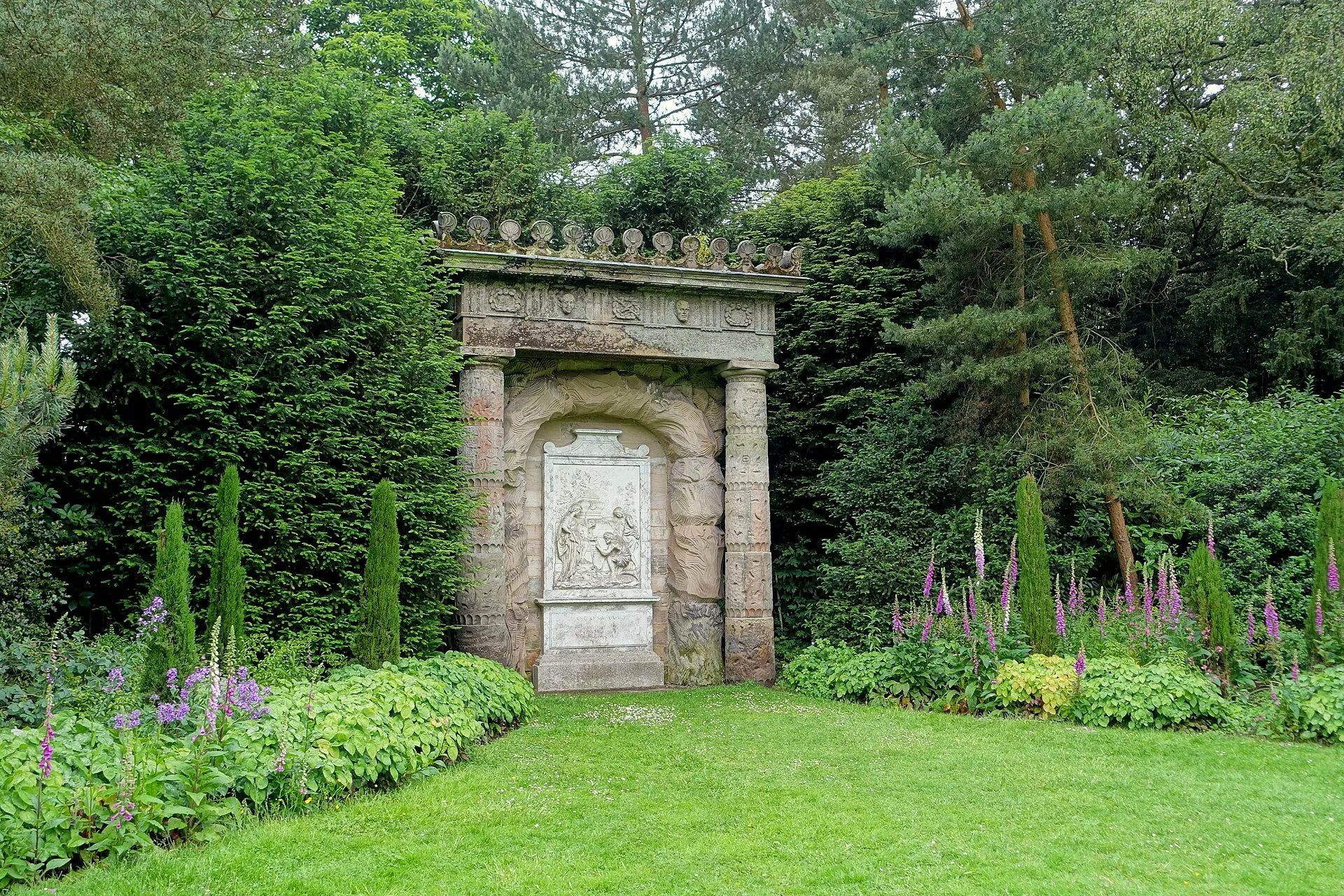
In the gardens of Shugborough Hall, the Anson family seat near Stafford, stands a stone garden monument framed by rough-cut rustic stonework and a pair of Doric columns. Set into it is a marble relief of shepherds gathered around a tomb, and beneath the relief someone carved ten letters: OUOSVAVV on one line, with a D and an M placed below at either end. For two centuries nobody has been able to say for certain what they mean.
What happened
The monument was put up for Thomas Anson, a Lichfield MP, member of the Royal Society and enthusiast for Greek architecture, who spent decades filling the Shugborough grounds with follies and temples. The relief, carved by the Antwerp-born sculptor Peter Scheemakers around 1748 to 1750, copies the later of Nicolas Poussin’s two paintings titled Et in Arcadia ego, in which shepherds puzzle over that Latin phrase cut into a tomb. Scheemakers reversed the composition, as though working from an engraving, and changed details, adding a second, smaller sarcophagus on top of the tomb.
The D and M are the easy part. On Roman tombstones they stand for Dis Manibus, “to the spirits of the departed,” and fit a scene about death in paradise. The eight letters between them are the problem. The earliest known record of them is an 1817 history of the neighboring parish of Tixall by Sir Thomas and Arthur Clifford. The Cliffords described the relief, suggested Anson had meant it as a private memorial to some early loss because he liked to stand over it lost in thought, and printed the letters, adding that Anson had never explained them and that they remained an enigma. An earlier description of the monument by the traveler Thomas Pennant did not mention the letters at all, so when they were carved is itself uncertain.
The investigation
For most of its life the inscription was a family curiosity. A Countess of Lichfield favored an English verse whose initials she thought matched the letters, though nobody has found the poem. In 1951 the novelist Oliver Stonor proposed a Latin reading in which a grieving widower honors the virtues of the best of wives and sisters.
The puzzle grew famous through The Holy Blood and the Holy Grail, the 1982 bestseller that tied Poussin to a supposed secret society, the Priory of Sion, and to the bloodline of Jesus. The book mentioned the Shugborough relief only in passing, but after The Da Vinci Code revived its ideas in 2003, the estate leaned into the connection. In 2004, while Staffordshire County Council managed the property, Shugborough invited two Second World War veterans of the Bletchley Park codebreaking center, the mathematician Oliver Lawn and his linguist wife Sheila, to examine the letters. Publicity for the visit repeated the claim that they might reveal the hiding place of the Holy Grail, guarded in legend by the Knights Templar. Oliver Lawn said the text was probably Latin or Greek and tied to some historical event. No solution came of it, and Sheila Lawn later leaned toward Stonor’s widower reading.
The explanations
Proposals have only multiplied. In 2011 the historian A. J. Morton argued the letters were little more than nineteenth-century graffiti, an abbreviation of local place names and of members of the Anson and Venables-Vernon families. The American linguist Keith Massey read them as a Latin prayer that all might follow the way to true life, echoing a verse in John’s gospel. Others have offered a line from Ecclesiastes on vanity, a cipher spelling Magdalen, and even map coordinates for treasure buried by Admiral George Anson, Thomas’s brother. In 2022 the classics magazine Antigone suggested a Latin dedication to Anne Venables-Vernon, the young wife of George Venables-Vernon, Anson’s predecessor as MP for Lichfield, who died in 1742 after a year of marriage.
Every reading suffers from the same weakness. Initials can be expanded into almost any sentence, and there is no record from Anson or his circle to check a solution against. The Grail theories add a further problem: no document connects the Ansons to the Templars, and the Priory of Sion story rests on a book that historians treat as pseudohistory.
Where it stands
The monument, now in the care of the National Trust, still draws would-be solvers; a spokesman said in 2014 that the estate heard from five or six of them a week. The letters may be a private memorial, a pious motto or later graffiti. They are almost certainly not directions to the Grail, but what they actually say remains unknown.