
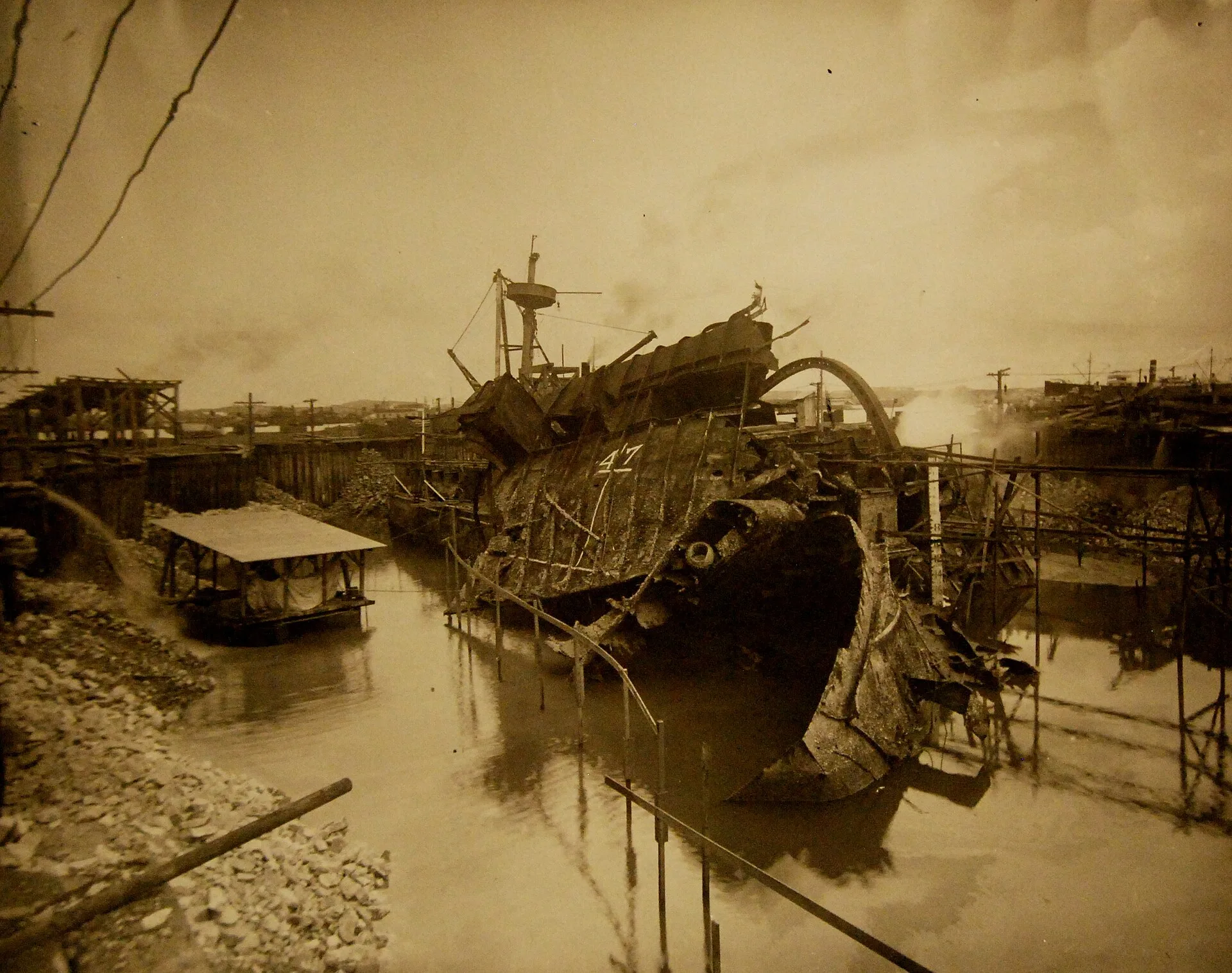
The battleship USS Maine arrived in Havana harbor on January 25, 1898, sent by President William McKinley as a show of interest while Cuban rebels fought for independence from Spain. Spanish officials were told of the visit only hours before. Three weeks later, at about 9:40 on the night of February 15, the forward part of the ship erupted. Several tons of powder in her forward magazines went up together, wrecking the bow and sinking the Maine in the shallow harbor with her upper works still showing. Most of the officers, quartered aft, survived; the enlisted men sleeping forward did not. Of 355 men aboard, 261 were killed.
What happened next
Within days the New York Journal and the New York World, locked in a circulation war, were blaming Spain and offering rewards for the culprits. “Remember the Maine!” became a national slogan. Spain, which badly wanted to avoid war, held its own inquiry and found that a fire in a coal bunker beside a magazine had set off the explosion. It noted that no detonating cables had been found and that the calm water made a contact mine improbable. American newspapers ignored it, and the Spanish were not allowed to examine the wreck closely.
The US Navy’s court of inquiry, led by Captain William T. Sampson, reached Havana on February 21. Working fast with divers in murky water, it fixed on a section of keel near frame 18 that had been bent upward into an inverted V and concluded in late March that a submerged mine had set off two or more forward magazines. It said it could not determine who was responsible. Congress authorized force against Spain in April, and within months the United States had taken Cuba, Puerto Rico, Guam and the Philippines.
The second look
The wreck sat in the harbor for more than a decade until Army engineers built a cofferdam around it in 1911 and pumped it dry, recovering the remains of dozens of sailors for burial at Arlington. A new board under Rear Admiral Charles Vreeland, which this time included engineers, examined the exposed hull. It decided the bent keel had been caused by the magazines, not by anything outside, and that the first blast had occurred farther aft than the 1898 court believed. Yet it still found an external explosion, pointing to a bottom plate pushed inward, and so kept the mine. In March 1912 the patched hull was towed out to sea and sunk with full honors.
Rickover and after
In 1974 Admiral Hyman Rickover, the head of the Navy’s nuclear propulsion program, read a newspaper article about the Maine and asked a team of experts to reexamine the evidence using the 1911 photographs and modern knowledge of explosions. His 1976 book, How the Battleship Maine Was Destroyed, concluded that the ship was almost certainly destroyed from within, most probably by spontaneous combustion in a bunker of bituminous coal next to a magazine. Coal fires of that kind had broken out on other warships of the period. The team argued that a mine would have done far more damage to the plate the Vreeland board relied on, though it conceded that no simple explanation existed.
The question did not close. A 1995 Smithsonian Institution Press book by Peggy and Harold Samuels criticized the Rickover analysis and blamed Spanish extremists, citing period reports of plots but no new physical evidence. For the centenary, National Geographic commissioned computer modeling from the firm Advanced Marine Enterprises, which found both a coal fire and a mine to be feasible. Samuel Cox, director of the Naval History and Heritage Command, noted in 2018 that both earlier boards included officers familiar with bunker fires and rejected that cause, and that analysis of the Maine’s coal suggests it was less volatile than Rickover assumed. He nonetheless judged a mine highly unlikely and leaned toward an internal cause.
The false flag version
A third story holds that Americans destroyed their own ship to get a war. In 1998 a curator at Havana’s City Museum told the Associated Press that this was the standard Cuban view. No document or physical evidence supports it, and even the Cuban naval historian quoted in the same report accepted Rickover’s accident finding, arguing only that Washington exploited the disaster.
Where it stands
There is no proof that Spain, Cuban rebels or Americans destroyed the Maine on purpose. The balance of expert opinion favors an internal accident, but the evidence was lost when the hull was scuttled in deep water in 1912, and the cause may never be known for certain. What is certain is how the disaster was used: a newspaper war turned an unexplained explosion into a cause for a real one.