
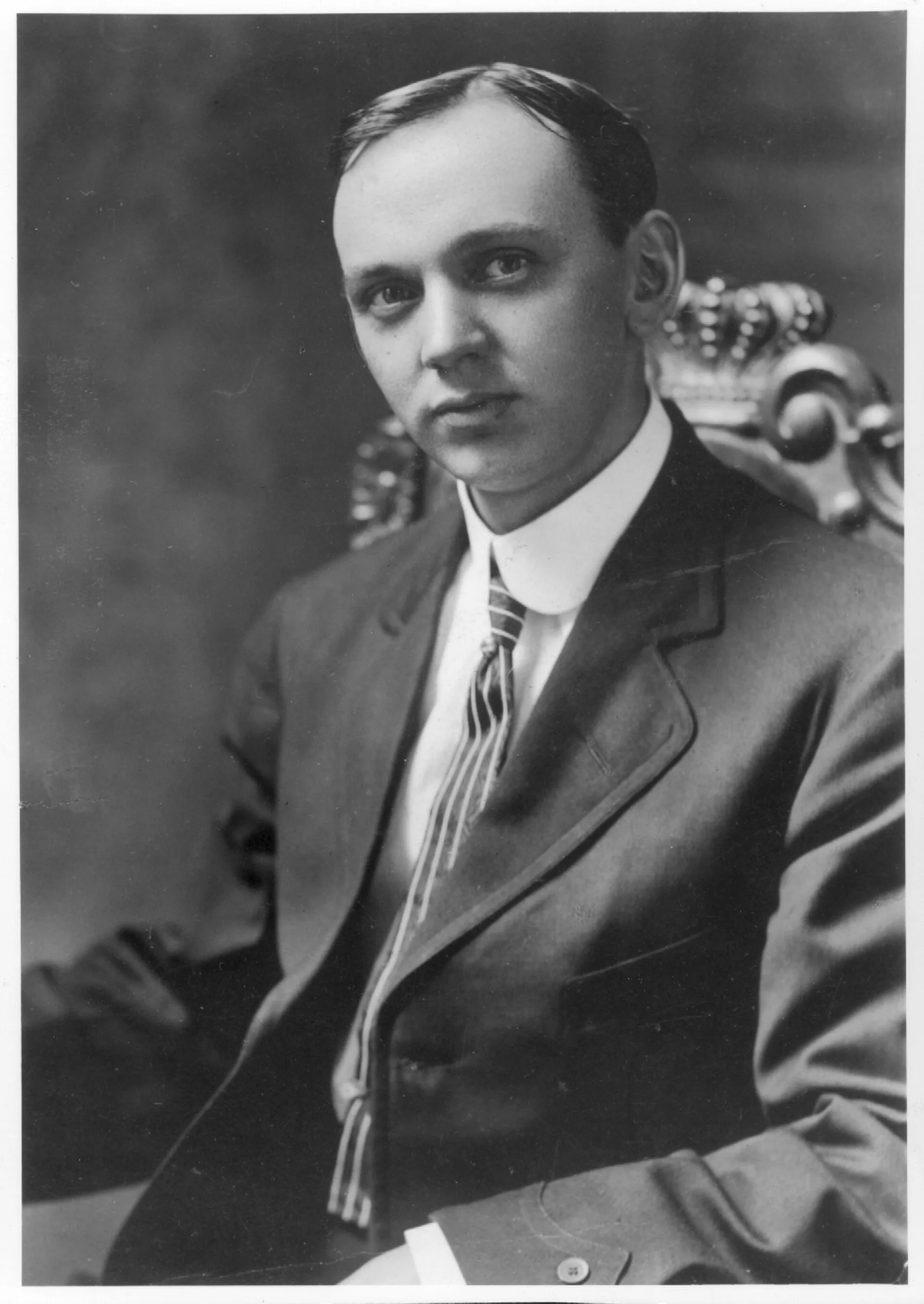
Edgar Cayce was a photographer and Sunday-school teacher from western Kentucky who, for more than forty years, would lie down on a couch, appear to fall asleep and then answer questions in a steady voice. Admirers came to call him the Sleeping Prophet. By the time he died in Virginia Beach in January 1945, transcripts of more than 14,000 of these sessions, which he and his followers called readings, had been preserved, and the organization he left behind still publishes and teaches from them.
What happened
Cayce was born near Hopkinsville, Kentucky, in March 1877 and left school after the eighth grade. According to the Dictionary of Virginia Biography, his trance work began in earnest around 1901, when he had lost his voice and a local hypnotist named Al Layne put him under; in that state Cayce described his own condition and how to treat it, and his voice came back. Layne then used him to diagnose other patients until the state medical board stopped it in 1903. In 1910 a homeopath, Wesley Ketchum, presented the results to a Boston medical meeting, and The New York Times ran a story that called Cayce an uneducated man who became a doctor under hypnosis. National attention followed.
For the next decade Cayce moved between photography, oil ventures in Texas and paid readings. From 1923 his secretary Gladys Davis recorded nearly every session. That same year a Dayton publisher, Arthur Lammers, began asking him about reincarnation, ancient wisdom and lost lands, and the readings widened from sore backs and bad digestion into “life readings” that told clients who they had been in earlier existences, often in ancient Egypt or Atlantis. With backing from the New York financier Morton Blumenthal, Cayce settled in Virginia Beach in 1925, opened a hospital in 1929 and chartered a small university in 1930. The Depression and a falling-out among his backers closed both in 1931, and that summer the loyal core of his backers regrouped under a new name, the Association for Research and Enlightenment, or A.R.E., which still has its headquarters in the city.
The predictions
Most of the readings concern health, but a number look ahead. The best known appears in a reading dated June 28, 1940, later printed by the A.R.E. in Edgar Cayce on Atlantis: Poseidia, which earlier readings placed in the area of the Bahamas near Bimini, would be among the first parts of Atlantis to rise again, and listeners were told to expect it in ’68 and ’69. Other readings said China would become a Christian country by 1968, that the United States would find an Atlantean death ray in 1958, and that much of California would slide into the sea. None of these came to pass.
In September 1968, three divers off North Bimini reported a long, straight line of flat limestone blocks in shallow water, and Cayce enthusiasts hailed the Bimini Road as the predicted sign. In 1980 the geologist Eugene Shinn of the US Geological Survey and the anthropologist Marshall McKusick reported in Nature that the blocks are beachrock, a sandstone that forms quickly in the calcium-rich water off Bimini and cracks into rectangular slabs. Beachrock of this kind can set so fast that it locks in bottle caps and broken glass, and radiocarbon dates on cores from the road came out at a few thousand years, far too young for Plato’s Atlantis. No continent or temple surfaced in 1968, 1969 or later.
The explanations
The readings are hard to test, because the transcripts record what Cayce said but rarely whether the client recovered. The philosopher Dale Beyerstein argued that they cannot separate anything Cayce perceived psychically from what he picked up from patients’ letters, from his assistants or by plain observation. Martin Gardner noted how much of the medical advice echoed the osteopathy of the day, a subject Cayce read about and that several of his helpers practiced. The Society for Psychical Research’s encyclopedia, which is sympathetic to Cayce, still records a long list of failures: missing people not found, oil wells and buried treasure that did not pay out, and patients advised after they had already died. Scholars including K. Paul Johnson have also shown how closely the Atlantis and past-life material follows Theosophical books in circulation in the 1920s.
Where it stands
Cayce himself was by most accounts sincere and convinced the information came from beyond him. His influence is real: the readings became foundation texts for the New Age movement and did much to popularize ideas about karma, reincarnation and Atlantis, and the A.R.E. counted tens of thousands of members at the end of the twentieth century. As prophecy, the record is poor. His most specific dated prediction, a rising Atlantis in 1968 and 1969, was not fulfilled, and the formation offered as its fulfillment is natural rock.