
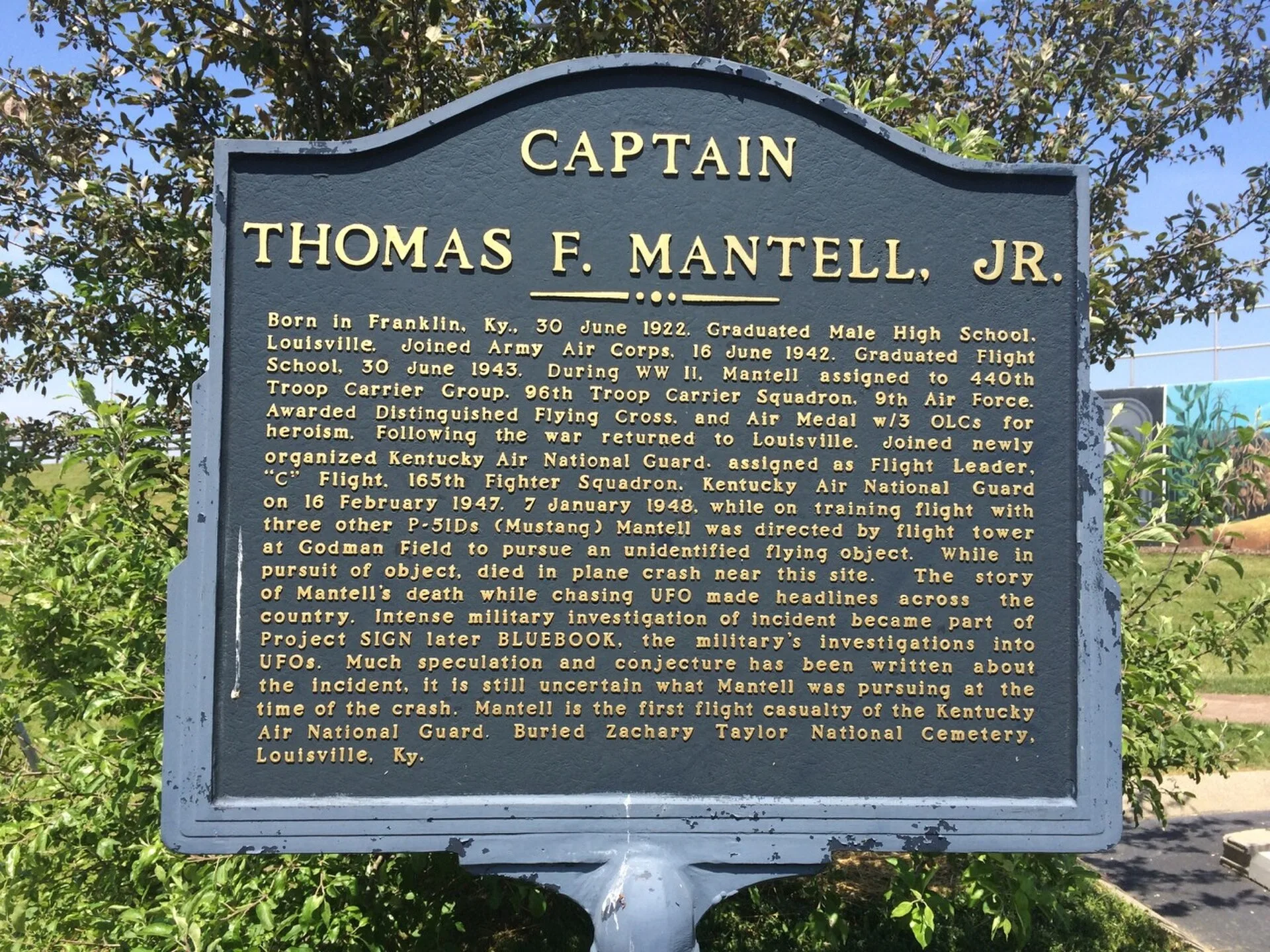
Capt. Thomas F. Mantell Jr. was 25 years old, a Second World War veteran with a Distinguished Flying Cross and more than 2,800 hours in the air. On January 7, 1948 he became the first American pilot whose death was publicly tied to a UFO. Coming barely six months after the first wave of flying saucer reports, his crash did more than any other early case to convince the public, and some in the Air Force, that the saucers were dangerous.
What happened
Early that afternoon police and members of the public across central Kentucky began reporting a large, bright object in the sky. Soon afterward personnel in the control tower at Godman Army Airfield, at Fort Knox, saw it too, describing something white and round, with what looked like a cone beneath it, hanging high in the sky. The base commander, Col. Guy Hix, came to see it. A flight of four F-51D Mustangs of the Kentucky Air National Guard’s 165th Fighter Squadron, led by Mantell, was passing nearby, and the tower asked the pilots to take a look.
Mantell and two wingmen climbed toward the object while the fourth pilot continued to base. Mantell radioed that it appeared metallic and of tremendous size and that he was going to keep climbing. The Mustangs had no oxygen equipment suitable for that altitude. His wingmen broke off at around 22,000 feet; Mantell kept going. Radio contact faded, and in mid-afternoon his plane came down on a farm south of Franklin, near the Tennessee line, roughly ninety miles from Fort Knox. He was killed.
The investigation
The Air Force accident investigation concluded that Mantell had blacked out from lack of oxygen above about 25,000 feet, after which the unpiloted Mustang climbed further, then fell into a spiraling dive and broke up before striking the ground. That part of the story was never seriously in doubt. The harder question was what he had been chasing.
Project Sign, the Air Force’s first UFO study, took up the case. The astronomer J. Allen Hynek, then a consultant, initially suggested the planet Venus, which was in roughly the right part of the sky, but he later withdrew the idea, judging that Venus would have been too faint to see as a large object in daylight haze. In 1952 Capt. Edward Ruppelt, head of the successor Project Blue Book, reviewed the file and concluded that Mantell had almost certainly been chasing a Skyhook balloon. Skyhook was a classified Navy program that sent up enormous plastic balloons to carry instruments to the edge of the stratosphere. Lit by the sun, such a balloon looks silvery and metallic, appears to hang motionless, and is far higher than it seems. Ruppelt believed one had been launched that day from Clinton County Air Force Base in Ohio. Pilots and tower crews of the day had no way of knowing such balloons existed.
The explanations
The Skyhook explanation fits the descriptions and the object’s slow drift, and the Army’s own 2023 retrospective says many suspect it, but it notes that no document has been found confirming a specific balloon flight and track. Within months of the crash, other stories circulated: that Mantell had been shot down by the craft, that his body was missing or riddled with holes, or that the wreckage was radioactive. The crash and accident records support none of them.
Where it stands
Mantell died chasing an object that was unidentified to him, and the Air Force’s handling of the case, with a planet explanation that did not hold, kept suspicion alive for years. The most probable answer is a secret research balloon. In 2001 a historical marker was placed in Franklin, the town where Mantell was born, near the site of the crash.