
The San Luis Valley in south-central Colorado is a high, flat basin of farms and ranch land, about 7,600 feet up and walled in by the San Juan Mountains to the west and the Sangre de Cristo range to the east. Clear skies and few lights make it a good place to watch the night, and residents have long reported things in it they could not name. One dead horse in 1967 turned that local reputation into a national one.
What happened
On September 7, 1967 a three-year-old Appaloosa mare failed to come in for water at Harry King’s ranch north-east of Alamosa. Two days later King found her body about a quarter of a mile from the house. By his account the skin and flesh had been removed from the head and neck, leaving clean, pale bone that ended in a straight line just ahead of the shoulders, while the rest of the carcass was intact. When he went back with the mare’s owners, his sister Nellie Lewis and her husband Berle, they described a sickly sweet smell, a piece of hide that made Nellie’s hand burn, dark patches like exhaust marks, a flattened bush and a ring of small round holes in the ground. A Forest Service ranger with a Geiger counter was said to have found high radiation. The county sheriff suggested lightning and declined to treat it as a mystery.
Nellie Lewis wrote for the Valley Courier in Alamosa. Her account ran there under the headline “Flying Saucers Killed My Horse!”, and in early October the Associated Press sent it nationwide. Newspapers named the mare Snippy. Her name was actually Lady; Snippy was another horse in the family, a parent, though accounts disagree on which one. The name stuck anyway.
The investigation
The timing put the case in front of the University of Colorado’s Air Force-funded study of UFOs, led by the physicist Edward Condon. Its report, published in 1969, lists it as case 32 with names removed. By the time investigators arrived several hundred sightseers had trampled the site, so they concentrated on the carcass and, learning that no veterinarian had examined it, brought one in. He found evidence of a severe infection in a hind leg that could have crippled or killed the mare, and a knife cut in the neck, perhaps made by someone who found her dying. Birds such as magpies cannot open a horse’s hide, but given a cut they will strip the flesh, which would account for the bare head and neck. A second dead horse nearby had died of encephalitis. Questioned again, the ranger said his meter had shown only slight activity; the team measured nothing above normal background. The report found no evidence that the death had any unusual cause.
The local veterinarian, Wallace Leary, later took the remains, boiled the bones clean and wired them into a standing skeleton. According to the Denver Public Library, he came across two small bullet holes on the mare’s right side while doing so, a likely source of the infection. Later press reports carried a claim that two students from the college in Alamosa had shot the mare.
Why it mattered
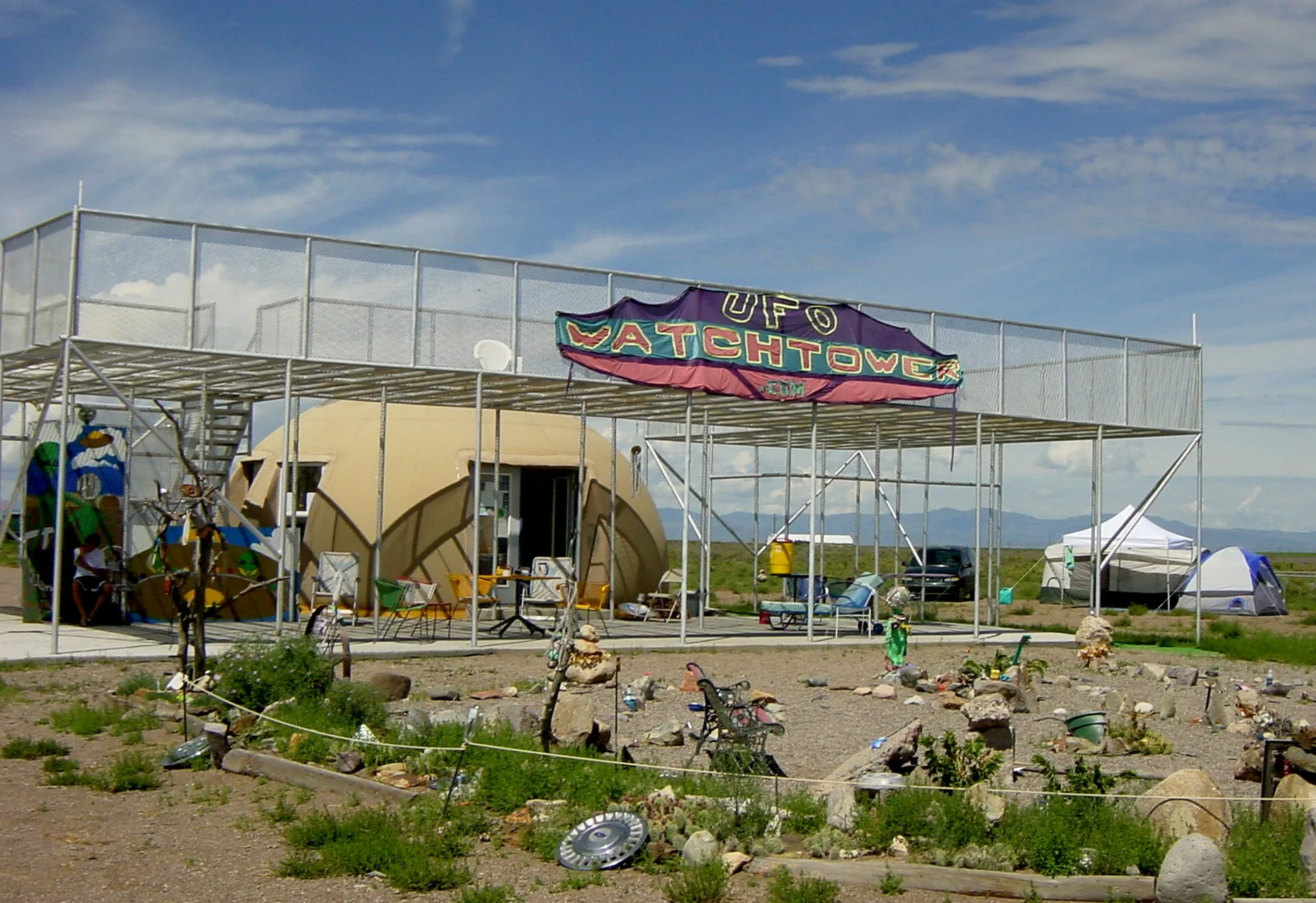
Snippy was the first widely reported case to tie an animal’s death to flying saucers. When ranchers across the West began reporting cattle with missing eyes, tongues and organs in the 1970s, the 1967 horse became the founding example, and the television journalist Linda Moulton Howe revisited it in her 1989 book An Alien Harvest. The valley’s reputation grew with it. In the summer of 2000 Judy Messoline, a rancher who had given up on cattle, opened the UFO Watchtower beside Colorado Highway 17 north of Hooper: a domed gift shop, a ten-foot viewing platform, a campground, and binders of sightings logged by visitors.
Where it stands
The skeleton changed hands several times, failed to sell on eBay at a $50,000 asking price, and sat in storage in Alamosa until Messoline bought it in 2021 for $2,000. It is now displayed at the Watchtower. The scientific record on the death itself is unusually clear for a case of this kind: an infected, possibly shot mare, a knife, scavenging birds and a sheriff who guessed wrong about lightning.