
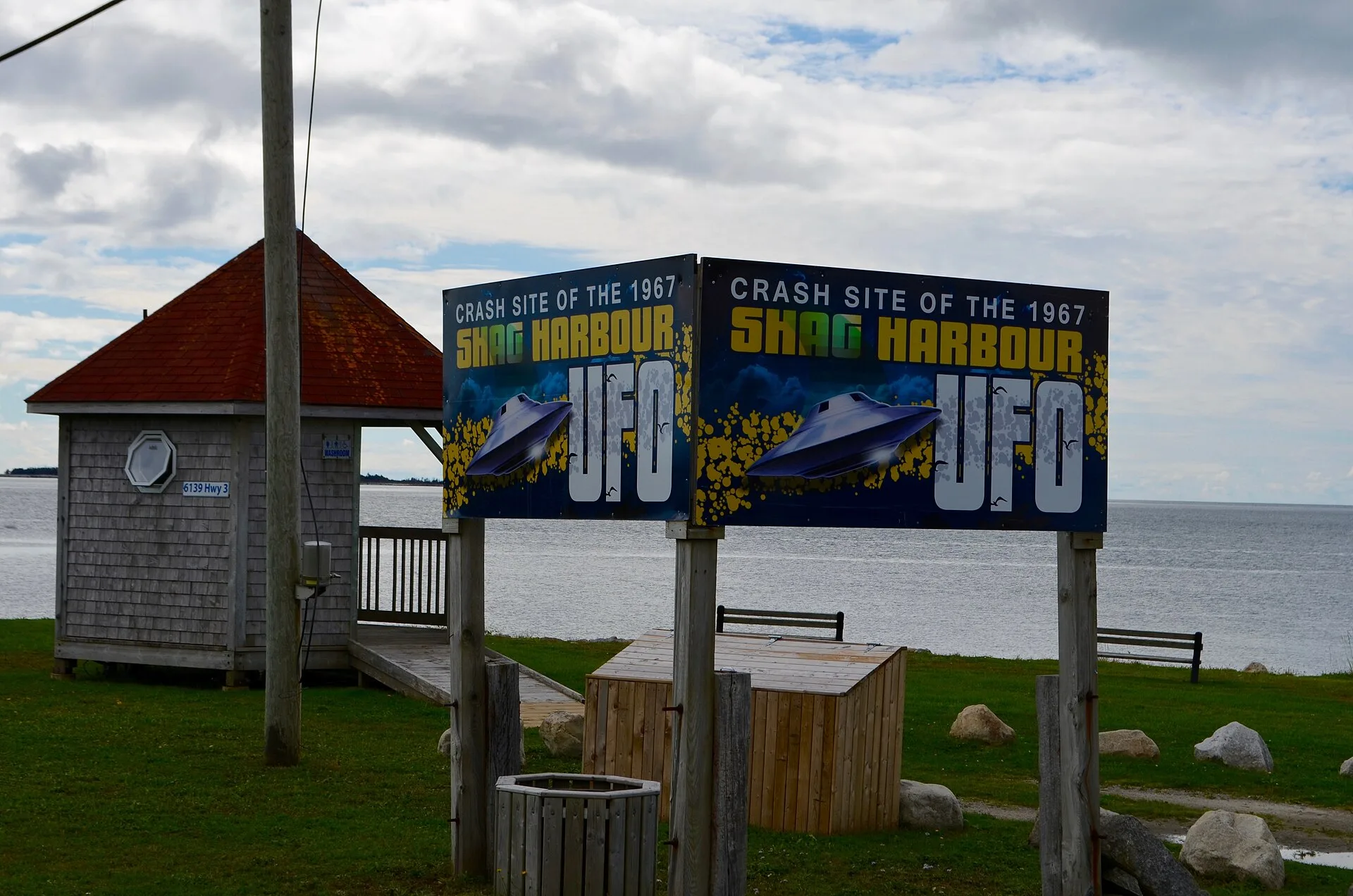
Shag Harbour is a lobster-fishing village on the southern tip of Nova Scotia, in Shelburne County. Its UFO case is unusual for two reasons: some of the first witnesses were police officers, and the search that followed left a paper trail in federal files, now held by Library and Archives Canada. That trail is why the case is often called the best-documented UFO sighting in Canada.
What happened
On the night of Wednesday, October 4, 1967, at about 11:20pm, Laurie Wickens, then 17, was driving along the shore road with friends when they saw a row of lights, four by most accounts, angling down toward the water. The lights went out and something seemed to settle on the surface. Wickens telephoned the RCMP detachment at Barrington Passage, believing a plane had crashed. Other people along the shore made similar calls.
Three RCMP officers reached the wharf and, along with a dozen or so local people, saw a light floating on the water a short way offshore. It drifted and then disappeared before anyone could reach it. Fishermen took their boats out within half an hour, and a Coast Guard cutter followed. They found no wreckage and no survivors, only a broad patch of yellowish, bubbling foam on the surface where the light had been. Reports later surfaced that an airliner crew over the Gulf of Maine had seen a similar row of lights that evening.
The investigation
The RCMP contacted the Rescue Coordination Centre in Halifax, which checked for missing aircraft and found none. Two days later Navy divers were sent to search the bottom of the harbor. They worked for several days and, according to the military’s records, found nothing before the search was called off. Message traffic between Halifax and Ottawa during the search used the term unidentified flying object, and a defense memo written shortly afterward stated that the sighting had not been caused by a flare, float, aircraft or any other known object. The case was also sent to the University of Colorado study of UFOs led by Edward Condon, then running for the US Air Force.
Much of what is now known was assembled decades later by two Nova Scotia researchers, Chris Styles and the aviation writer Don Ledger. Their 2001 book Dark Object reproduced RCMP reports and military messages. It also relayed claims from unnamed former military sources that the object had moved underwater to a spot off Shelburne, near a secret military installation, and that a secret recovery attempt was made there. Those claims have never been corroborated, and Styles himself has said he does not know what the object was.
The explanations
A crashed aircraft was ruled out at the time, since none was missing. Other conventional ideas include a meteor striking the water, flares, or an unannounced military exercise, but none has been shown to fit the timing and the descriptions. A meteor would not normally float, and the government’s own memo dismissed flares. The foam has prompted guesses about fuel or chemicals but was never sampled. On the other side, nothing in the record supports a craft, as no debris was found and the stories of an underwater recovery have no documentation.
It is worth being precise about the official label. In 1967 the military used unidentified flying object in its literal sense, for something seen in the air that could not be identified. The documents confirm that officials could not explain what the witnesses saw; they do not say it was from another world.
Where it stands
The Canadian Encyclopedia, like most serious summaries, lists the case as unsolved. Shag Harbour has embraced its place in UFO history, with a small interpretive center, a lookout over the water and an annual festival. The witnesses were credible and the search was real; what went into the water remains unknown.