
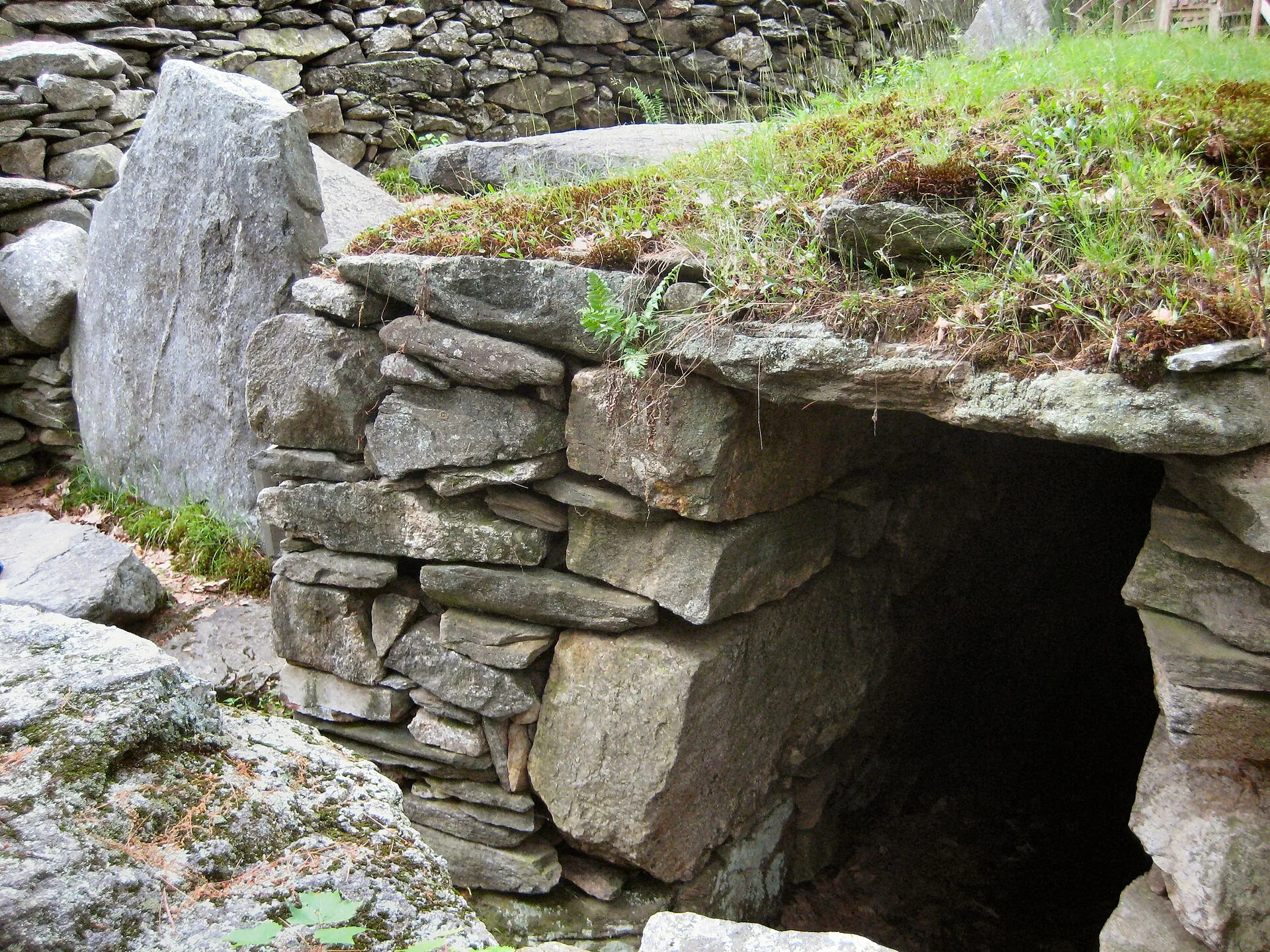
Drivers on Interstate 93 in southern New Hampshire pass signs for America’s Stonehenge, a private attraction on a wooded hilltop in North Salem. Visitors pay to walk among dry-stone chambers, low walls, upright slabs and a nine-foot grooved stone slab once billed as a sacrificial table. The owners present it as a site whose earliest construction goes back some 4,000 years and whose standing stones mark solstice sunrises. Archaeologists outside the site read the same rocks very differently.
A farm called Pattee’s
The earliest printed description is modest. Edgar Gilbert’s History of Salem, N.H., published in 1907, lists the spot among the town’s old house sites as Jonathan Pattee’s Cave. Pattee, it says, had lived in those woods about seventy years earlier and took in the town’s paupers before Salem bought a poor farm; several of his caves were still standing and had been used for storage. The site’s present owners agree that the Pattee family lived on the hill in the first half of the nineteenth century. Like many New England hills it was also quarried for granite, and drill marks survive on some stones.
Mystery Hill
In 1936 the hill was bought by William Goodwin, an insurance executive with a passion for pre-Columbian voyages. He named it Mystery Hill and became convinced that the chambers had been built by Culdee monks from Ireland centuries before Columbus. He also set about restoring them. Curtis Runnels, an archaeologist at Boston University, says Goodwin is documented as having rearranged many of the stones, so that no one can now tell what is original and what is his. In 1956 the hill was bought by Robert Stone, whose family opened it to paying visitors in 1958 and still runs it.
The theories multiplied. In 1975 Barry Fell, a Harvard marine biologist who had turned to ancient inscriptions, was present when a carved tablet came out of one of the chambers, and he read its marks as ogham, an early Celtic script. His 1976 book America B.C. argued that Celts, Phoenicians and Iberians had built sites across New England. A 1977 episode of the television series In Search Of featured Mystery Hill, with the parapsychologist Hans Holzer finding Phoenician writing on the rocks. In 1982 the owners renamed the attraction America’s Stonehenge.
The evidence
Radiocarbon dates from charcoal on the hill run back into the second millennium BC, and the owners cite those dates, newer luminescence tests and alignments to sunrise points as evidence that the stones themselves are that old. Archaeologists accept that people were on the hill in prehistory; Runnels describes Mystery Hill as two genuine archaeological sites, one Native American and one colonial. What no one has found is anything European from the Bronze Age, here or anywhere else in the Americas: no bronze tools, pottery, burials or metalwork. Fell’s inscriptions were widely dismissed by specialists as plow scratches and root marks. The grooved table closely resembles the slabs New England farmers used to leach lye from wood ash for soap, or to press cider, and Runnels has said the stone arrangements were built by owners of the property in the nineteenth and twentieth centuries.
Where it stands
America’s Stonehenge remains open, with snowshoe trails and school tours, and its owners continue to describe it as an ancient monument. The documentary trail runs the other way: a farmer’s storage caves in 1907, a collector’s reconstruction in the 1930s and a rebranding in 1982. The hill has a real prehistory, but the case for a European Stonehenge in New Hampshire rests on alignments, and on dates from material around stones that were quarried, reset and rearranged over the past two centuries.