
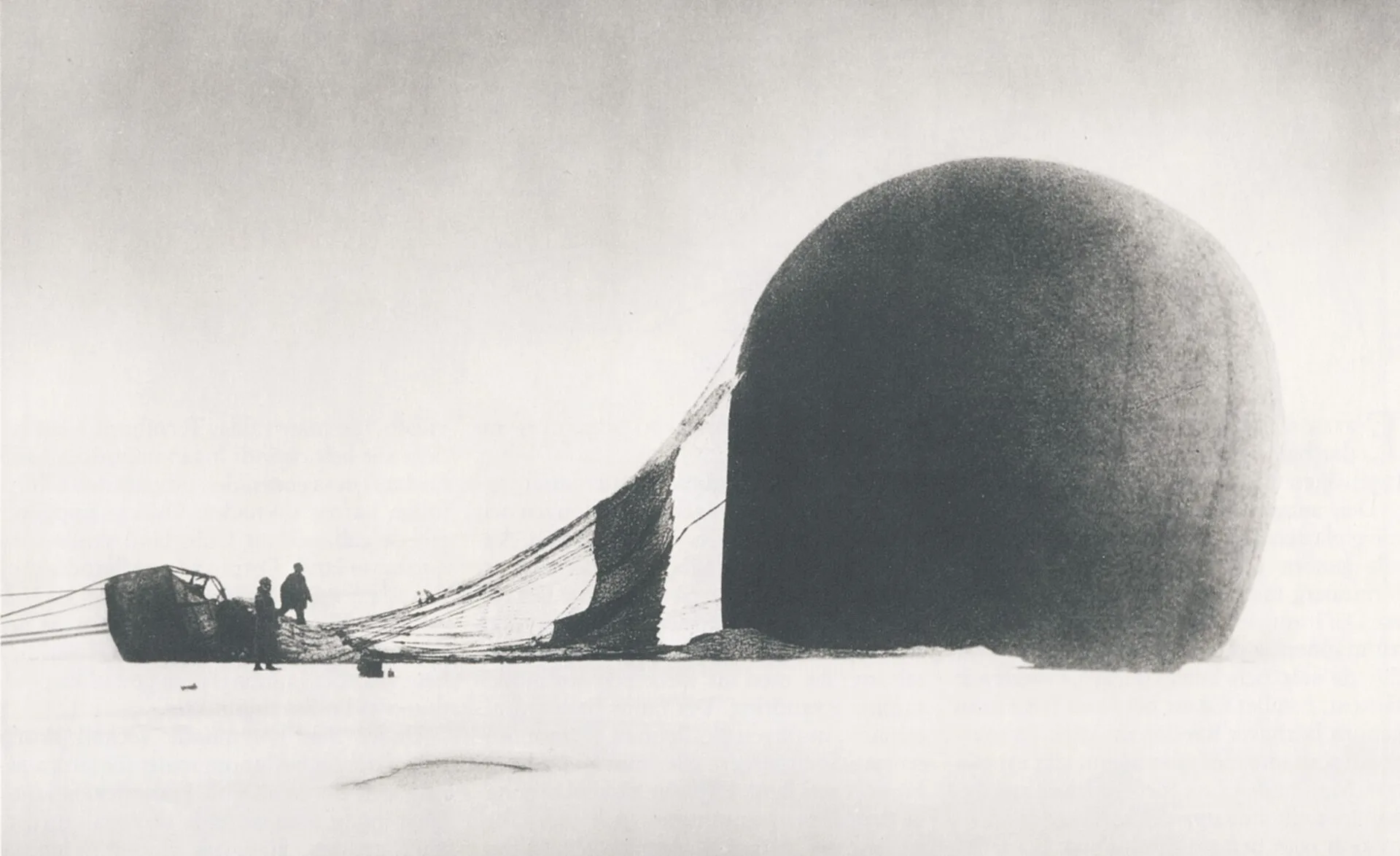
Salomon August Andrée was a Swedish engineer at the national patent office with a passion for ballooning. In the 1890s he proposed reaching the North Pole not by ship or sledge but by air, in a hydrogen balloon that could be partly steered by long ropes dragging along the ice to slow it below the speed of the wind. With backing from Alfred Nobel, King Oscar II and the Stockholm newspaper Aftonbladet, he had a large varnished-silk balloon made in Paris and a hangar built on Danskøya (Danes Island) in northwest Svalbard. A first attempt in 1896 was abandoned for lack of a favorable wind. For 1897 Andrée replaced his skeptical meteorologist, Nils Ekholm, with a young engineer, Knut Frænkel; the third man was the physicist and photographer Nils Strindberg, aged 24.
What happened
The balloon, named Örnen (the Eagle), rose from Danskøya on July 11, 1897. Almost at once it sagged toward the sea, and most of the drag ropes twisted free of their couplings and were lost; the crew threw out sand to stay airborne. Without the ropes the balloon could not be steered at all. A message buoy dropped that day, and a pigeon message dated July 13 that was recovered after the bird was shot on a Norwegian ship, both reported that all was well. After that, nothing was heard.
For 33 years their fate was a matter of rumor. Newspapers carried reports of balloon wreckage, of men falling from the sky and of Arctic peoples who had supposedly killed them. Then, in August 1930, the Norwegian sealing and research vessel Bratvaag stopped at Kvitøya, or White Island, an ice-capped island at the eastern edge of the Svalbard archipelago that is usually locked in pack ice. That summer was unusually warm. Crew members ashore found the expedition’s boat frozen into the snow, then a camp, two bodies and Andrée’s diary. A few weeks later a ship chartered by journalists, the Isbjørn, landed on the same spot and found the third body, a notebook and Strindberg’s rolls of exposed film.
The investigation
The diaries told the story. The flight had lasted a little over two days, much of it with the basket bumping across the ice under a balloon weighed down by fog and rain, before the men came down on the pack ice on July 14, far short of the Pole. Nobody was hurt. After a week sorting their gear they set off on foot, hauling heavily loaded sledges toward a supply depot in Franz Josef Land, then turned toward Svalbard when they realized the ice was carrying them backward. They shot seals and polar bears for food and suffered constantly from wet clothing, sore feet and diarrhea. In mid-September they gave up and built a snow hut on a large floe, which drifted south until it broke apart against Kvitøya in early October. They moved ashore around October 5. Andrée’s last legible entries date from a few days later. In Stockholm a photographer at the Royal Institute of Technology managed to develop dozens of Strindberg’s frames, which showed the downed balloon, the camps and the march.
Strindberg had died first and been buried by the others in a gap among the rocks. The other two were found in the remains of the tent. The bodies were brought to Stockholm in October 1930 to a huge national funeral and cremated after only a limited examination, which left the central question open.
The explanations
The best-known answer is trichinosis. In a 1952 book the physician Ernst Tryde argued that the men were infected by parasites in half-cooked bear meat, and larvae of Trichinella were later found in bear remains from the camp. Critics point out that the diaries do not record fever, the disease’s main symptom, and that the explorers Fridtjof Nansen and Hjalmar Johansen had lived on bear meat in the same region without harm. Other proposals include vitamin A poisoning from liver, carbon monoxide from a faulty stove, scurvy, lead from food tins, cold and exhaustion, and suicide with the opium and morphine they carried. In 2000 Mark Personne, a senior physician at the Swedish Poisons Information Centre, argued in Läkartidningen, the journal of the Swedish Medical Association, for botulism from contaminated meat. The physician and author Bea Uusma, after examining the clothing and records, has concluded that a polar bear attack killed Strindberg and probably injured Frænkel, and that Andrée may have taken morphine once he was alone. The Grenna Museum in Sweden, which holds the expedition collection, now devotes part of its exhibition to her work.
Where it stands
How the expedition ended is known in detail. Why three fit men died within days of reaching solid ground, with food, guns and fuel around them, is not. With the bodies cremated in 1930, each theory rests on readings of the diaries and the objects recovered, and none has been proven.