
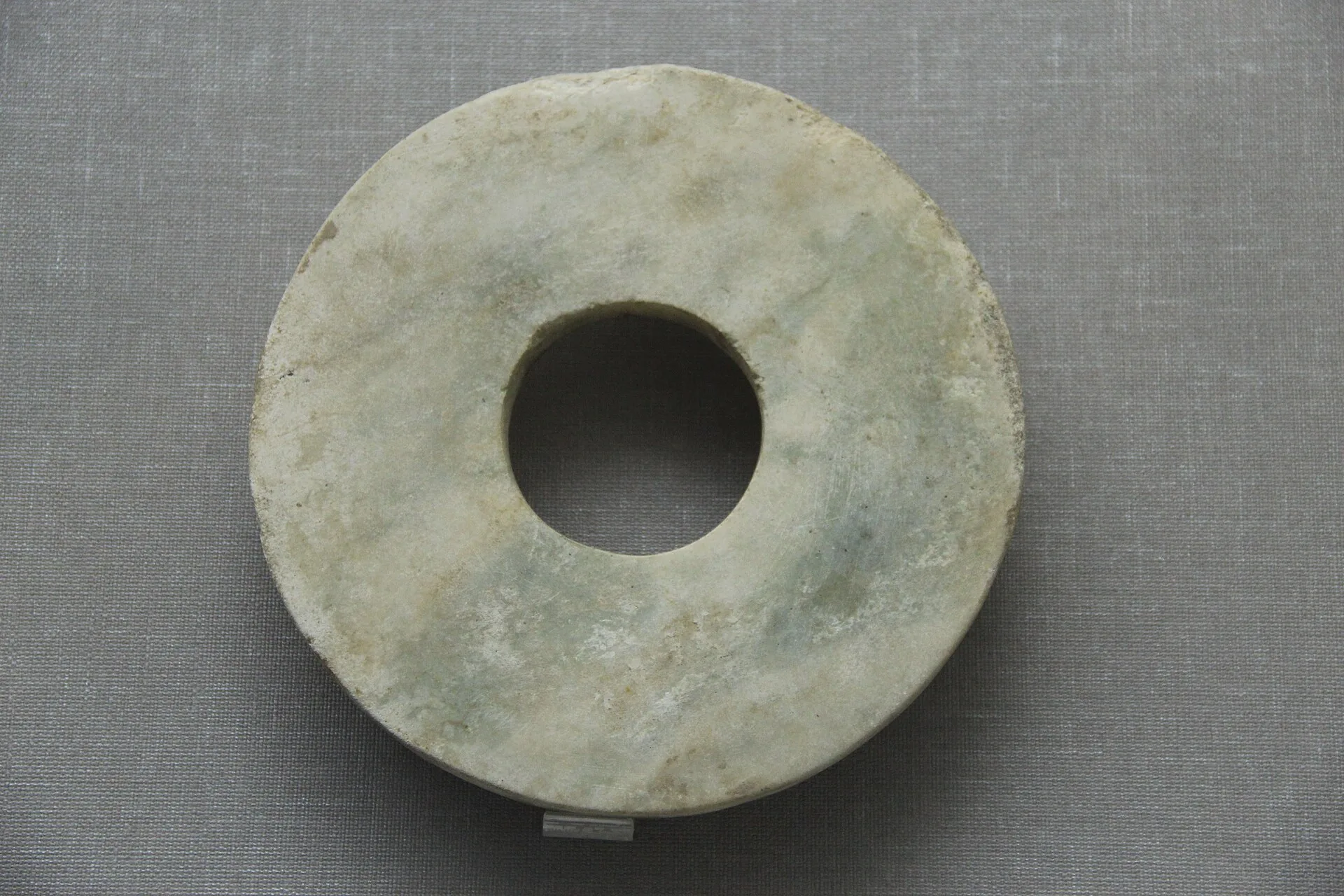
The Bayan Har range is a remote spine of mountains on the Tibetan plateau in Qinghai, near where the Yellow and Yangtze rivers rise. Since the 1960s it has been the setting for one of the most repeated stories in ancient-astronaut literature: a cache of carved stone discs that supposedly record the crash of an alien ship there some twelve thousand years ago. The discs have a name, the Dropa stones, a count, 716, and a cast of scientists. What they do not have is any trace outside the story itself.
What happened
In its usual form the tale runs like this. In 1937 or 1938 an expedition led by an archaeologist called Chi Pu Tei explored caves in the Bayan Har and found rows of graves holding small skeletons with oversized skulls, wall paintings of the sun, moon and stars, and a granite disc about a foot across with a hole in the middle. A groove spiralled from the hole to the rim, and inside it ran a line of tiny characters. Hundreds more discs followed. Around 1962 a Professor Tsum Um Nui of an academy of prehistory in Beijing announced that he had translated them: they told how a ship carrying a people called the Dropa came down in the mountains, could not be repaired, and how its crew were hunted by local tribesmen. Ridiculed, the professor went into exile in Japan and died. Soviet scientists, the story adds, tested some discs and found them rich in cobalt, able to conduct electricity and given to humming when spun on a turntable.
A later chapter has an Austrian engineer named Ernst Wegerer, sometimes spelled Wegener, visiting the Banpo Museum in Xi’an in 1974, being shown two of the discs and photographing them. By 1994, the tellers say, both the discs and the museum’s director had vanished.
The investigation
The archaeologist Keith Fitzpatrick-Matthews, who runs the Bad Archaeology website, traced the story backwards through its printed versions. The oldest he found was a February 1960 article in the Soviet Literaturnaya Gazeta about the Soviet mathematician Matest Agrest’s speculation that aliens had visited Earth in antiquity. In July 1962 a fuller version, with the names and the numbers, appeared in Das Vegetarische Universum, a German vegetarian magazine, under the byline Reinhardt Wegemann and credited to a Tokyo news agency called DINA. No writer of that name and no such agency has ever been found. The same text resurfaced in a German UFO newsletter in 1964, then in Belgian and Russian translation, and in 1967 Vyacheslav Zaitsev condensed it for Sputnik, the Soviet digest magazine sold abroad. From there it reached Erich von Däniken, whose bestselling books carried it worldwide.
Every checkable detail fails. There was no Beijing academy of prehistory under that name, no archaeologist called Chi Pu Tei and no linguist called Tsum Um Nui in any academic record; critics note that the second is not even a plausible Chinese name, and Chinese renderings of both appeared only decades later. No museum has cataloged a Dropa stone. The photographs attributed to Wegerer are too blurred to show any writing, and what they do show resembles a bi, the flat perforated jade disc that Neolithic Chinese cultures made in large numbers, exactly the kind of object a museum built on a Neolithic village site would display. A curator who has moved on after twenty years is not a mystery.
The explanations
The story received its richest embroidery in 1978, when a book called Sungods in Exile claimed to publish the papers of a British scientist, Karyl Robin-Evans, who had lived among the Dropa in 1947 and learned that their ancestors came from Sirius. The editor, credited as David Agamon, was David Gamon. In Fortean Times in 1995 he described the book as a satire and his favorite hoax, and in 2006 he told the French researcher Patrick Gross that it had been written to poke fun at books aimed at the credulous. No record of Robin-Evans has been found. The ufologist Jacques Vallée had already judged the whole affair a hoax. The real Dropa, or Drokpa, are Tibetan herders whose name means people of the high pastures.
Where it stands
The Dropa stones survive only in retellings, each borrowing from the last. Whoever wrote the 1962 article has never been identified, but the discs, their discoverers and their translator appear to have been invented with it, and nothing produced since has changed that.