
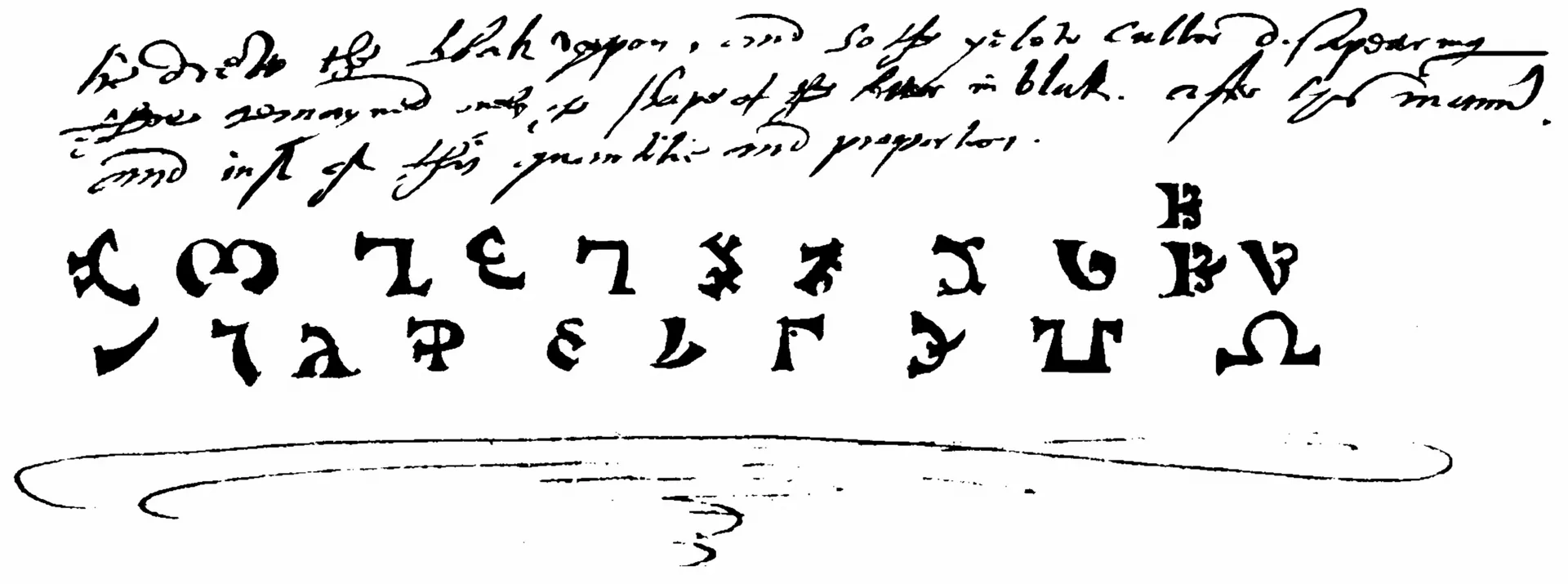
John Dee was one of the most learned men in Elizabethan England: a mathematician, astronomer and adviser on navigation who built one of the largest private libraries in the country at his house in Mortlake, on the Thames west of London. In the early 1580s, convinced that ordinary scholarship would never reveal the deepest truths about creation, he set out to ask the angels directly. The result, recorded in his own hand over several years, includes a complete alphabet and fragments of a language that the angels were said to have spoken, which later writers named Enochian.
The sessions
Dee could not see spirits himself. He needed a scryer, someone who would gaze into a polished stone or crystal and report what appeared. After disappointing results with an earlier scryer, in March 1582 he took on Edward Kelley, a much younger man with a doubtful past. Kelley looked into the stone and described what he saw and heard; Dee wrote it down, sessions he called actions.
On March 26, 1583, by Dee’s record, Kelley saw an alphabet of 21 letters. Soon after came Liber Loagaeth, the “Book of Speech from God”: 49 leaves filled on both sides with great square tables of letters, 49 by 49, which the angels never translated. In 1583 Dee, Kelley and their families left England with the Polish nobleman Albert Łaski and spent the next six years moving among the courts of Poland and Bohemia. At Kraków in 1584 Kelley delivered the core of the language: 48 Calls or Keys, chanted invocations in the angelic tongue, each accompanied by an English translation that Dee recorded alongside it.
Dee called the language Angelical, or Adamical, because his angels told him it was the speech Adam had used in Eden when he gave the creatures their names, lost to humanity except for the patriarch Enoch. The partnership ended in Bohemia; Kelley stayed on in the service of Bohemian patrons, was knighted, and died there in the 1590s, while Dee came home in 1589 to find his library plundered. In 1659 the scholar Meric Casaubon published a large part of the spirit diaries as A True and Faithful Relation, intending to show that a great man had been deceived by evil spirits.
What linguists found
The most thorough study is The Complete Enochian Dictionary by the Australian linguist Donald Laycock, first published in 1978. He counted only about 250 distinct words in the translated material, more than half of them occurring just once. Read according to Dee’s spelling conventions, he found, the sounds are essentially those of English, and the word order follows English closely, though articles and prepositions are mostly missing. Some words echo biblical names, such as babalond, glossed as harlot. The numerals follow no discoverable system. The linguist Mark Newbrook, summarizing Laycock and his later collaborator Stephen Skinner, notes that the Calls look in some ways like a real but unknown language, with oddities such as wildly irregular verb forms, yet map one-for-one onto the English alphabet and English spelling rules in a way no independent language would.
Liber Loagaeth is different. Laycock found that its untranslated text shows the patterns of glossolalia, the fluent but meaningless speech produced in trance, and that its strange consonant clusters are the sort of thing produced by stringing letters together arbitrarily. He suggested readers test this by taking every tenth letter on a printed page and dividing the result into words.
The explanations
Three explanations have been offered. Believers, including later occultists, accept the angels at their word. Skeptics point to Kelley, who had a doubtful reputation and every reason to keep a generous employer impressed. A third view, prompted by Dee’s interest in codes and his service to Elizabeth’s court, reads the angelic manuscripts as disguised intelligence. The cipher idea sits awkwardly with the fact that the Calls come with their English meaning written out beside them. Laycock’s finding that Loagaeth resembles glossolalia also complicates a simple charge of fraud: it raises the possibility that Kelley produced at least some of the material in a trance-like state rather than by cold calculation.
Where it stands
The manuscripts are real and survive, and the language they record is consistent enough to have been studied, taught and used in ritual ever since the Hermetic Order of the Golden Dawn revived it in the late nineteenth century. Its English sound system, English syntax and English alphabet make it very unlikely to be the language of Adam. Who built it, and how deliberately, remains open.