
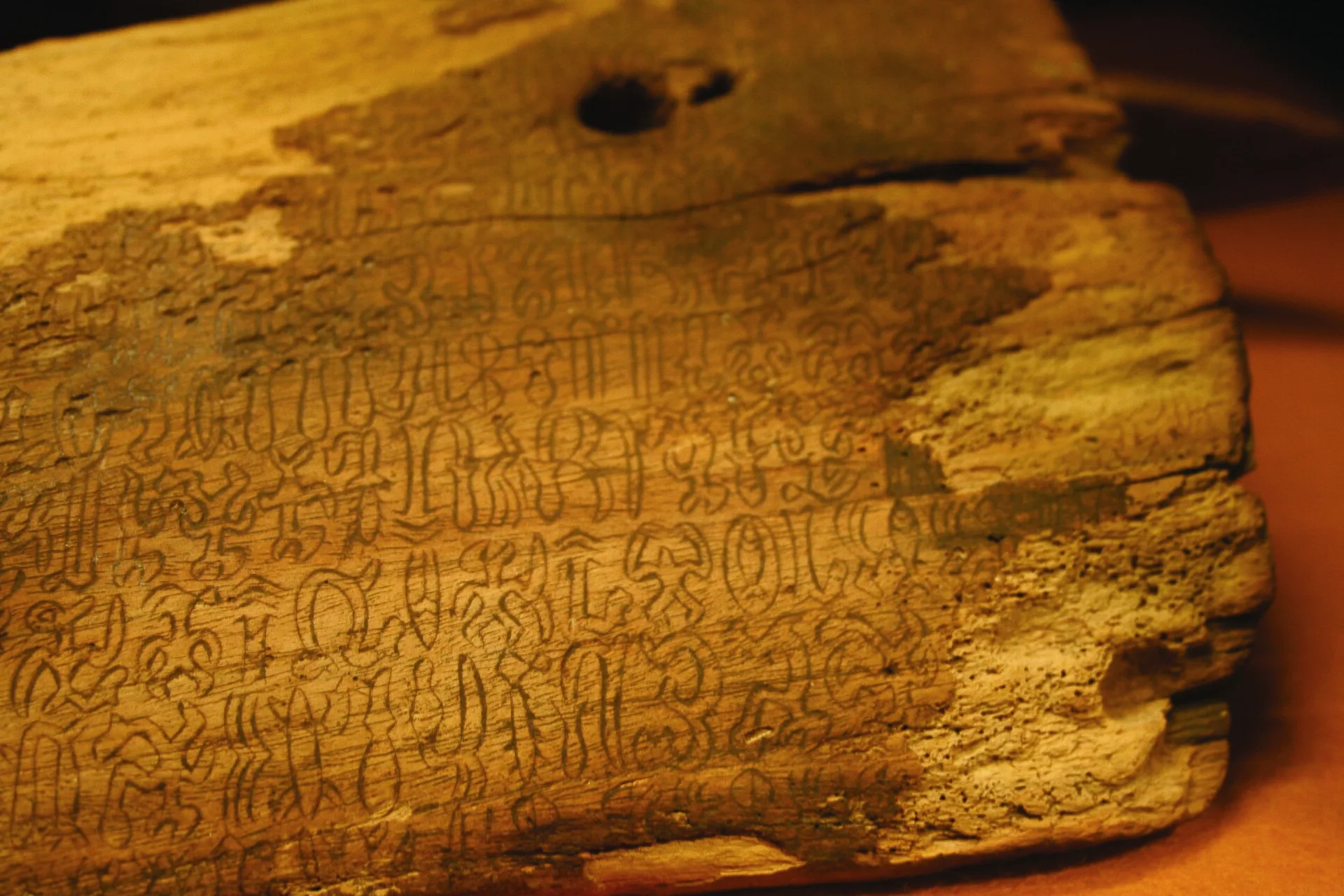
Rapa Nui, the Easter Island of European maps, lies more than two thousand miles off the coast of Chile and is famous for its giant stone heads. It also produced the only script known from Polynesia before the colonial era: rows of small carved figures, birds, fish, human shapes and abstract signs, cut into wooden boards that the islanders called kohau rongorongo. About two dozen inscribed objects survive, scattered among museums from Santiago to St Petersburg. None remains on the island, and no one alive can read them.
What happened
The first outsider to describe the tablets was Eugène Eyraud, a lay brother of the Picpus missionaries, who spent most of 1864 on the island and noticed inscribed boards in many houses. Their owners seemed to set little store by them. That indifference had a cause. In 1862 and 1863 Peruvian slave ships had carried off well over a thousand islanders, and the few who came back brought smallpox. Rapa Nui society, including the specialists who had kept the tablets, was close to destroyed, and by the 1870s barely a hundred people were left.
Bishop Tepano Jaussen of Tahiti became interested after converts sent him a board wound with a cord of human hair, and he gathered several more. A Rapa Nui man named Metoro chanted over the tablets for him, but the recitations did not match the signs in any consistent way. When the American paymaster William J. Thomson visited aboard USS Mohican in 1886, the islanders told him the missionaries had ordered tablets burned; he bought two, now in the Smithsonian, and tried to get an elder, Ure Vaeiko, to read them. Ure Vaeiko first refused, saying the priests had forbidden it, and the chants he eventually gave also failed to fit the glyphs. Thomson’s report preserved the island tradition that the founding chief Hotu Matua had arrived with 67 tablets.
The investigation
Serious study began when the German ethnologist Thomas Barthel published a catalog of the whole corpus in 1958, assigning numbers to roughly six hundred glyph forms that he and later scholars think reduce to perhaps 120 basic signs. The lines run in reverse boustrophedon: the reader goes left to right along one line, then turns the tablet upside down for the next. The objects themselves are a mixed collection, mostly tablets but also a chief’s staff, a pectoral and a birdman figure, and several were carved on European oars or driftwood.
Nearly every possible reading has been proposed. A Hungarian scholar in 1932 claimed a link to the Indus Valley script half a world away; the resemblances turned out to rest on bad copies. Soviet researchers in the 1950s identified what looks like a genealogy on one tablet. The section of the Mamari tablet that seems to track the nights of the lunar month is the one interpretation most specialists accept. In the 1990s the linguist Steven Roger Fischer announced that the long text on the Santiago Staff was a creation chant built on repeated formulas of procreation, an account he gave in his 1997 book Glyph-breaker; other specialists did not find it convincing.
The explanations
The central question is whether rongorongo is old. In 1770 a Spanish expedition had island chiefs mark a document of annexation, and some scholars argue that the script was invented afterward, inspired by the sight of Europeans writing; no visitor between 1722 and 1864 mentioned it. Others see an older, independent invention, which would make Rapa Nui one of very few places on Earth where writing arose from nothing. In February 2024 a team led by Silvia Ferrara of the University of Bologna radiocarbon-dated the four tablets held by the Congregazione dei Sacri Cuori in Rome, which missionaries gathered and sent to Jaussen in 1869. Three came from wood of the eighteenth or nineteenth century. The fourth, known as the Échancrée, was cut from a tree felled between 1493 and 1509, generations before any European ship called.
That tablet is made of a Podocarpus species that never grew on the island and probably arrived as driftwood or salvaged timber, and a board can be carved long after its tree dies. The authors themselves treat the date as an outlier that needs confirming on more tablets.
Where it stands
Rongorongo is an authentic and remarkable script whose meaning has been lost. The texts are too few and too short, and the culture that read them too badly broken, for a confident decipherment. Dating more tablets may settle when it began; reading them may never be possible.