
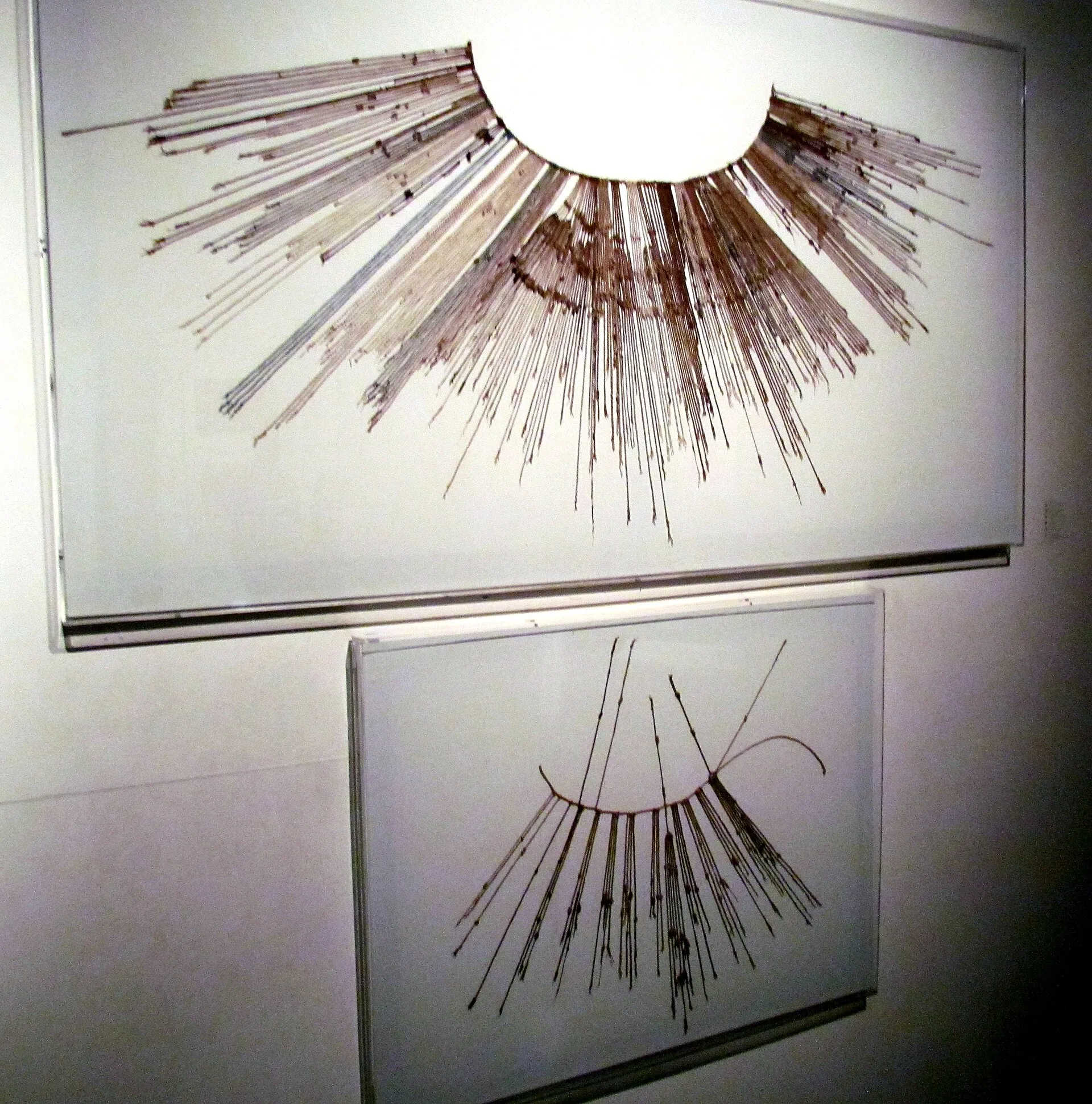
At its height in the early sixteenth century the Inca Empire ran some 4,000 kilometers along the Andes, from what is now Ecuador and Colombia to central Chile and northern Argentina, and governed a population usually estimated at more than ten million. It did so without anything that Spanish observers recognized as writing. Its records were kept on khipus, the Quechua word for knot: bundles of cotton or camelid-fiber cords, dyed in many colors and knotted at intervals, maintained by trained specialists called khipukamayuq. After the conquest of 1532 the Spanish questioned these cord keepers for census and tribute figures, and in some Andean villages khipus remained in use into the twentieth century. Roughly a thousand are known to survive, most of them in museums and private collections with no record of where they were found.
What has been decoded
A standard Inca-style khipu has a thick primary cord from which hang anywhere from one to more than a thousand thinner pendant cords, sometimes with subsidiary cords tied to them. In 1912 Leland Locke, a Brooklyn historian of mathematics working on the collection at the American Museum of Natural History in New York, showed how the knots on those cords encode numbers. Values are arranged in tiers by powers of ten, with the highest place nearest the primary cord. Single overhand knots mark tens, hundreds and thousands; a long knot with two to nine turns gives the units; a figure-eight knot stands for one; an empty position serves as zero. Locke also found a khipu whose top cords carried the totals of the pendant cords beneath them, proof that the cords did arithmetic as well as storage.
That reading has held for more than a century and lets researchers check khipus against one another. A cache found buried in an urn at Puruchuco, an Inca administrative site near Lima, contains sets whose figures roll up through three levels, local tallies summed into larger accounts, much as data might have moved up an imperial chain of command. Storehouse khipus from Inkawasi in the Cañete valley record repeated deductions that look like accounting for goods coming in. The work of Marcia and Robert Ascher and others turned the khipu from a curiosity into a recognized mathematical record.
What has not
Numbers are the only feature that can be read reliably across most khipus. Everything else is still open. Cords vary in color, with more than sixty shades cataloged, and in solid, mottled and striped patterns; in the direction the fibers were spun and plied; in whether each cord is tied to the primary cord from the front or the back; and in the direction of the knots. Colonial accounts describe cord keepers reciting histories and other narratives from their khipus. Whether those non-numerical features encode language or work as memory aids that only their maker could interpret is the central unsolved question.
Two lines of research have produced partial answers. In 2017 Manny Medrano, then a Harvard undergraduate, and the anthropologist Gary Urton matched six colonial khipus from the Santa valley, rediscovered in a Lima museum, to a Spanish census of 1670 that listed 132 tributaries. They proposed that the front or back attachment of each cord recorded a person’s moiety and social standing, and that color tracked first names, describing it as the first information ever read from attachment knots. The same year Sabine Hyland of the University of St Andrews reported on two khipus kept by the village of San Juan de Collata, said by their custodians to be letters sent during an eighteenth-century revolt against Spanish rule. She counted 95 distinct cord types, a number in the range of systems that mix word signs and syllables, and proposed phonetic readings for two lineage names. Neither result has yet been extended into readable text.
Where it stands
Fresh evidence keeps arriving. In August 2025 Hyland and colleagues reported in Science Advances that the primary cord of an Inca khipu radiocarbon-dated to about 1498 was made of human hair, and that the hair’s chemistry pointed to a diet of grains, legumes and tubers rather than the meat and maize beer of the elite. That suggests ordinary people made khipus too. Researchers now share data through open digital databases built on Urton’s work, hoping that matches like the Santa valley census will provide a key. Until then the khipu is an understood number system wrapped in an unread code.