
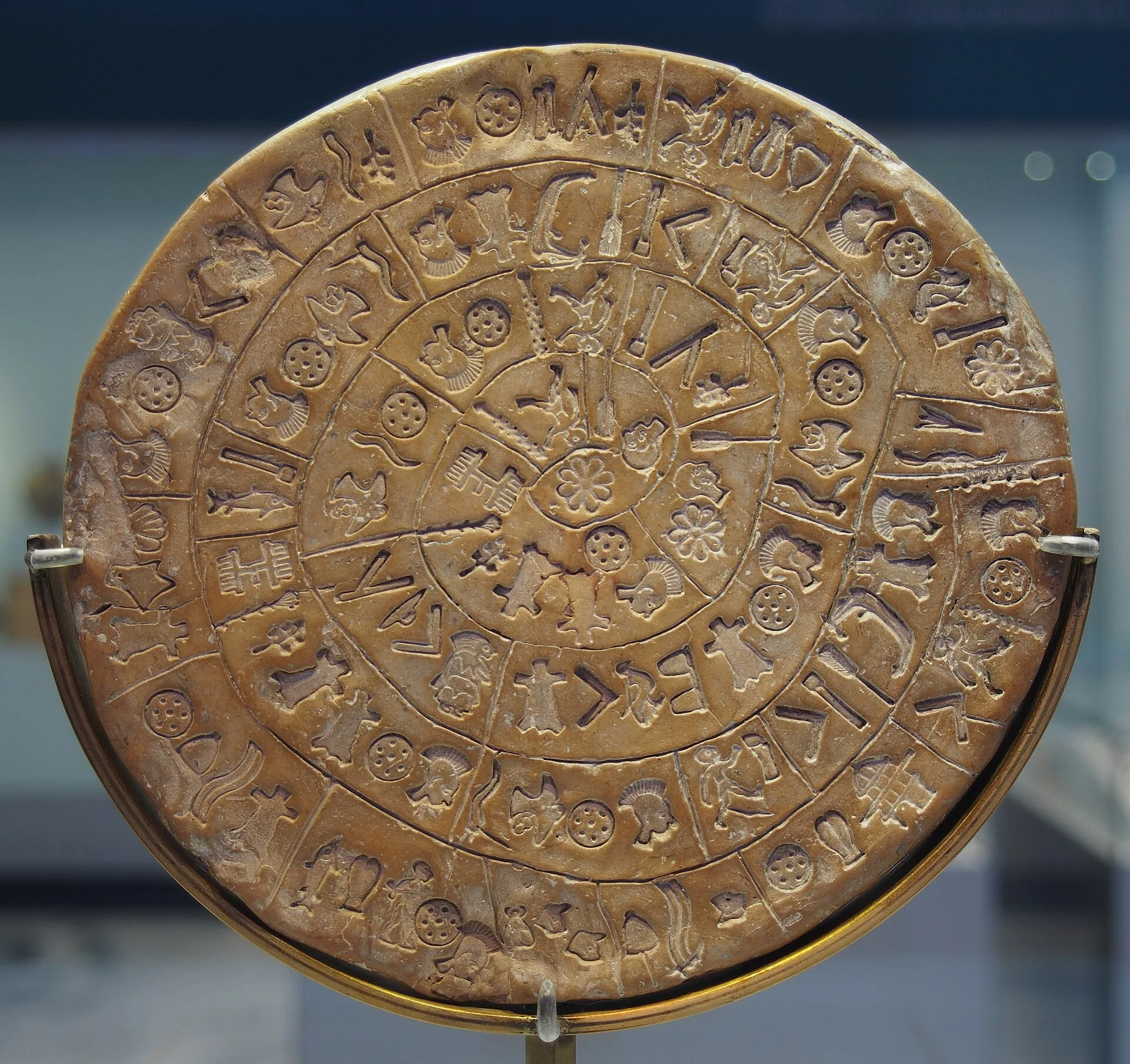
Phaistos was one of the great palace centers of Bronze Age Crete, set on a ridge above the Mesara plain near the island’s south coast. An Italian mission had been excavating there since 1900. On July 3, 1908 its director, Luigi Pernier, recovered from a sealed basement compartment north-east of the main palace a flat, round piece of fired clay a little over six inches across. It has been argued over ever since.
What happened
The object is slightly lopsided, about three-quarters of an inch thick, and covered on both faces by a spiral band of pictures: running men, heads with crested headdresses, a fish, a bird, a ship, a shield, a flower and dozens more. A scratched line divides the spiral into compartments, each holding a short cluster of signs, as if marking off words. Counting both sides there are 242 sign impressions drawn from a repertoire of 45 different signs. What sets the disc apart is how the signs were made. They were not drawn with a stylus but pressed into the wet clay with carved stamps, one for each sign, and the same stamp was used every time a sign recurs. It is, in effect, a page printed with movable type some three and a half thousand years before Gutenberg, and no other object made with those stamps has ever turned up.
Pernier described his find within months in the Italian archaeological journal Ausonia. The deposit around it contained ash, burned animal bone and a tablet in Linear A, the still-unread Minoan script, which pointed to the Middle Minoan period, roughly 1850 to 1600 BCE, though later scholars have questioned how secure that context is. Arthur Evans, excavator of Knossos, devoted a long section of Scripta Minoa in 1909 to the disc. He found its signs unlike other Cretan writing, compared some of them with Lycian and other Anatolian forms, and guessed that the text might be a chant to a mother goddess.
The investigation
Decipherment has become a hobby with no finish line. Proposed readings have treated it as early Greek, as Luwian, as a Semitic tongue and much else, and have made it a hymn, a curse or an almanac. In 2014 the linguist Gareth Owens of the Technological Educational Institute of Crete presented a reading, built with the phonetician John Coleman, that treated the signs as relatives of Linear A and found a prayer to a mother goddess. Thomas Palaima of the University of Texas and Brent Davis of the University of Melbourne gave the standard reply. Linear A is itself unread, so borrowing its sound values is guesswork, and a single text of 242 signs is too small to prove any system of values. Alice Kober had said the same in 1948, and the archaeologist Elizabeth Barber put it most neatly in 1974: there is not enough material to confirm a decipherment, and not enough to refute one either.
The only close relatives are a bronze ceremonial axe found in a cave at Arkalochori in central Crete in 1934, engraved with signs resembling those on the disc, and a clay seal impression from Phaistos with comparable but not identical signs. Neither adds enough text to help.
The explanations
In 2008, the disc’s centenary year, the antiquities dealer and editor Jerome Eisenberg argued in the magazine Minerva that Pernier had faked it. He pointed to the disc’s uniqueness, its crisp edges and even firing, and signs he thought were copied from Egyptian, Hittite and later Greek images, and he suggested motives: rivalry with Evans and the hope of attracting funding. In a follow-up he speculated that the restorer Émile Gilliéron, who made reproductions for Evans, might have helped. The archaeologist Vincenzo La Rosa answered in 2009 from Pernier’s own excavation daybooks, arguing that the timing, the circumstances of the find and Pernier’s first notes rule out a plant.
Where it stands
The disc is displayed in the Heraklion Archaeological Museum, and most Aegean specialists treat it as authentic. A thermoluminescence test, which measures when clay was last heated, could settle the forgery question; it has been proposed repeatedly but not carried out. The text itself is likely to stay unread unless more inscriptions made with the same stamps come out of the ground.