
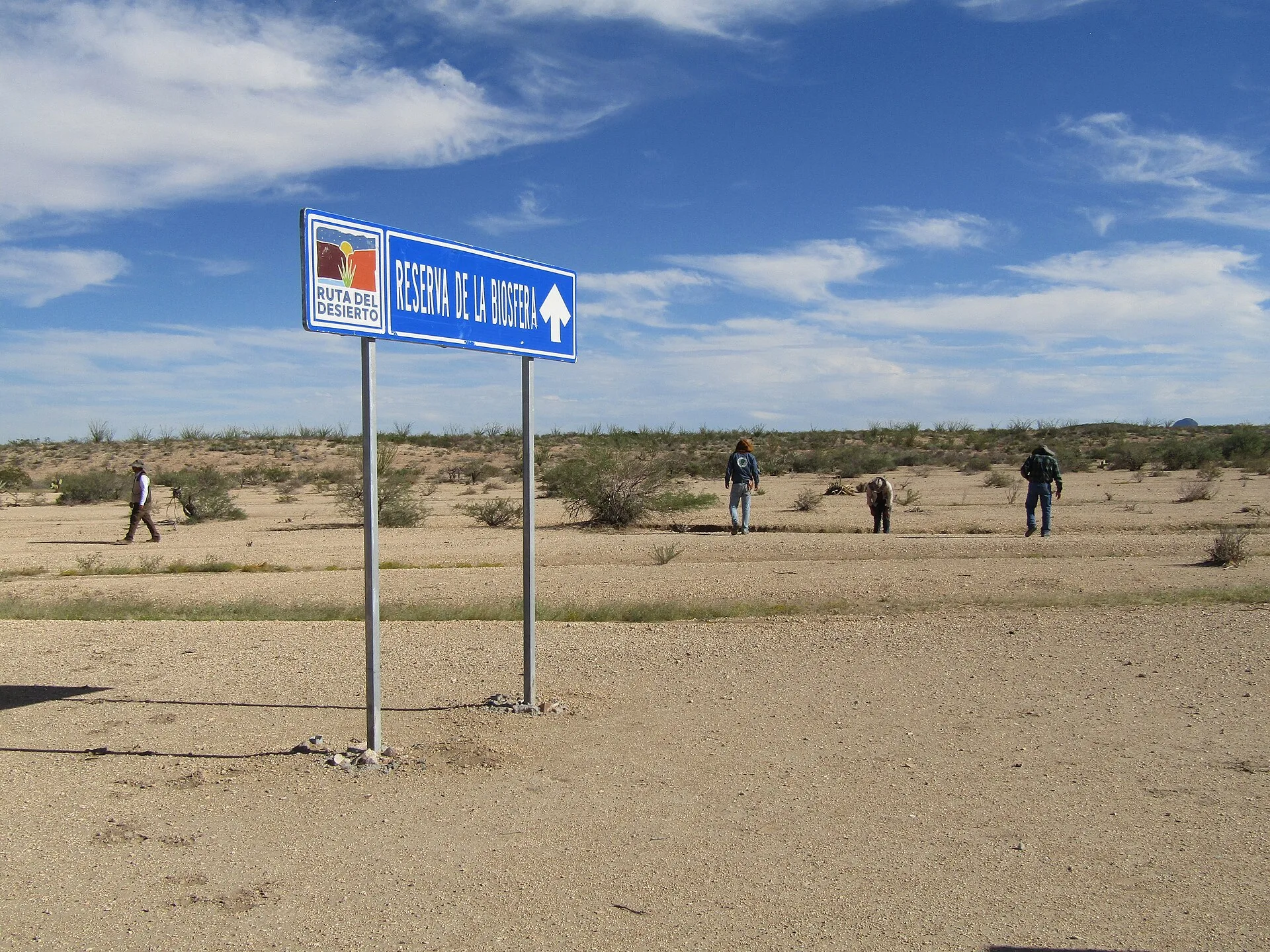
The Bolsón de Mapimí is a vast closed basin in the Chihuahuan Desert of northern Mexico, ranch country of creosote, cactus and salt flats near the point where the states of Durango, Chihuahua and Coahuila touch. Part of it became a UNESCO biosphere reserve a few years after the events below, and is home to a research station and to the rare Bolsón tortoise. Part of it, depending on whom you ask, is La Zona del Silencio: a stretch of ground where radio broadcasts fade to nothing, compass needles wander, meteorites fall unusually often and visitors sometimes meet tall, fair-haired beings from elsewhere.
What happened
The one solid event in the story took place on July 11, 1970. The US Air Force launched an Athena test rocket, flight V-123-D, from its Green River test site in Utah. Athenas were used to fling dummy warheads back into the atmosphere at missile speeds, and they were supposed to come down on the White Sands range in New Mexico. This one went wrong in flight and kept going. A memorandum to President Nixon from Henry Kissinger, later released and published by the National Security Archive, put the impact 180 to 200 miles south of the border in a thinly populated corner of Durango and noted that Mexico had agreed to help with the search.
The re-entry vehicle carried two small containers of cobalt-57, a radioactive isotope used to measure how much of the nose cone’s heat shield burned away. That turned a lost piece of hardware into a contamination problem. According to Andrea Kaus, an anthropologist who lived and worked in the reserve between 1988 and 1990, searchers hired from the nearby city of Gómez Palacio combed the desert while aircraft flew overhead, and the wreck was found after about three weeks, nose down in a sand dune. A local man, Jaime González, led a guard to keep onlookers away. The Americans laid an airstrip and a temporary railroad spur, dug out the dune and shipped the contaminated soil north. Sources differ on small details: Kaus gives the launch date as July 2 and places the crash just inside Chihuahua, while the Air Force documents say July 11 and Durango.
How the legend grew
Kaus, writing in a 1992 dissertation later excerpted online, concluded that the Zone of Silence was invented after the clean-up, when a few local men realized how much attention the empty desert had drawn and began talking about a hotel. Accounts disagree on who added what, but within a few years regional newspapers, then national media, were reporting that magnetic forces in the ground stopped radio transmissions and had pulled the rocket down. The 1969 fall of the Allende meteorite in Chihuahua was folded in as proof that the place attracted objects from space. An American author, Gerry Hunt, sold the zone to English-language readers in a mass-market paperback that promised giant UFOs and grotesque animals.
Visitors, known locally as zoneros, followed. Kaus counted more than 650 people turning up at the research station in 1989 alone asking for directions to the zone, and found that its location kept moving: first the crash site, later a spot where an oil-company engineer said his equipment failed, and eventually wherever a guide chose to take a carload of tourists.
The explanations
The testable part of the legend fails the test. Kaus and the staff of the reserve used radios and compasses without trouble, and researchers there have said the same to journalists since. In a 2019 Skeptoid episode Brian Dunning pointed out that a buried magnetic mass, even if one existed, would not block radio waves at all, and that the Meteoritical Bulletin lists only two small finds near Mapimí. The Allende meteorite came down well to the west and is a stony type that is not magnetic. The mutations visitors describe have ordinary causes: the triangles on tortoise shells are a normal pattern, and a local prickly pear turns purple in dry spells. Compasses that seem to swing on their own are easy to manage with a small hidden magnet.
Where it stands
The rocket crash is documented and the radioactive clean-up was real, if long kept quiet. Everything layered on top of it, from the dead radios to the aliens, has no support beyond the stories themselves. The zone still draws tourists and the occasional film crew, much to the frustration of the ranchers and scientists who share the desert with them.