
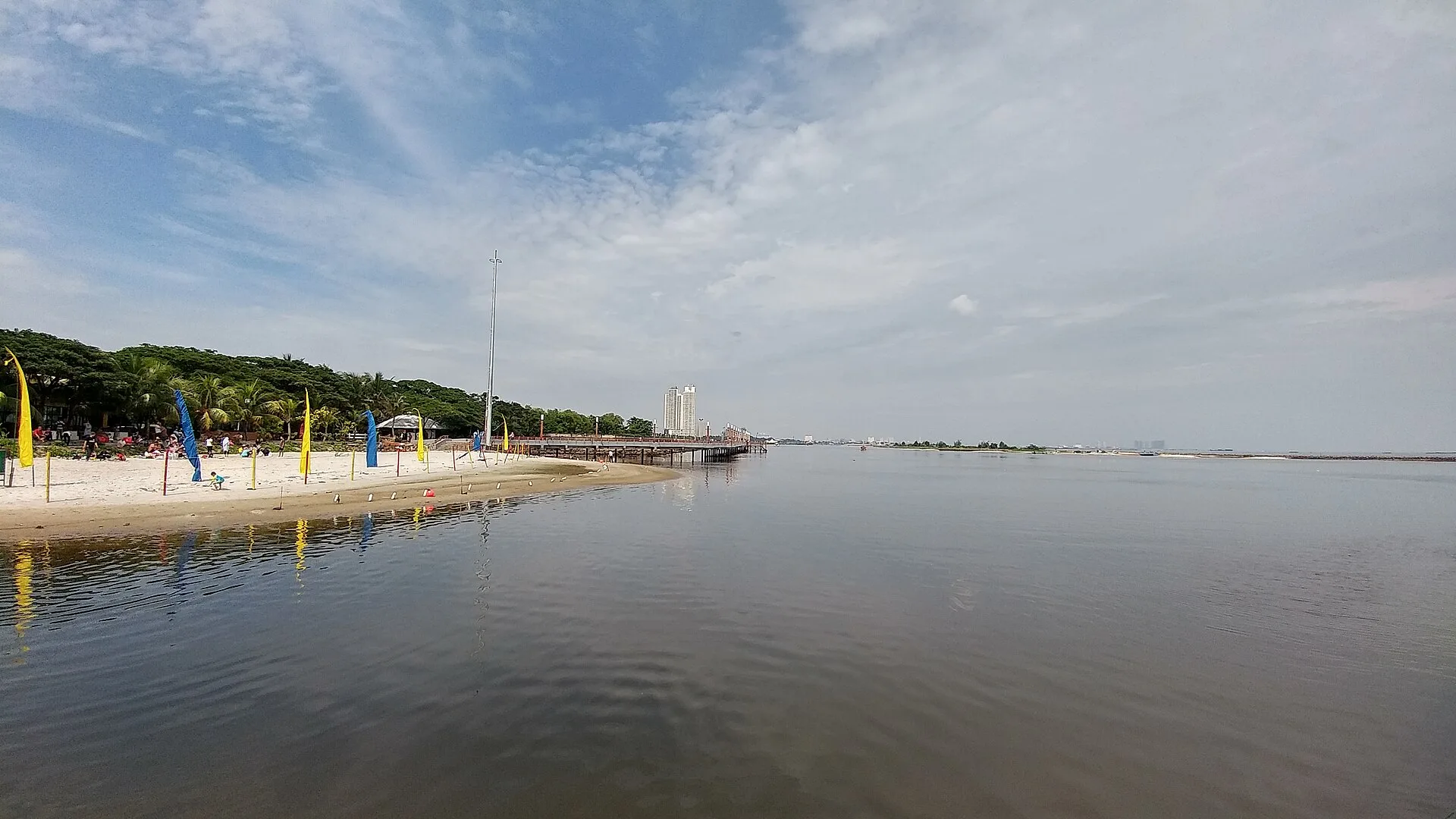
Ancol is the strip of coast on the north side of Jakarta where the city meets the Java Sea. In the days when the city was Batavia, the seat of Dutch colonial government, it was a swampy, outlying place of fishponds and pleasure villas; today it is the Ancol Dreamland resort of beaches, piers and amusement parks, reached across a bridge over the Ancol canal. That bridge belongs to Si Manis Jembatan Ancol, the Sweet One of Ancol Bridge, who has outlasted every other ghost in the capital.
What happened
The story has two heroines. The older one is Ariah, sometimes Siti Ariah, a poor Betawi girl. In the version the Jakarta Post summarized in 2013 she lived in the 1860s; after her father’s death she, her mother and her elder sister worked for a wealthy landowner in Kramat Sentiong in central Jakarta. When she was sixteen the landowner wanted her as a concubine. She fled, and was caught by thugs working for Oey Tambahsia, a rich and notorious young man of Batavia who kept villas at Ancol and was later hanged by the Dutch. She died resisting them. The Betawi cultural writer Ridwan Saidi, who has done most to give Ariah a biography, places her death around 1817, at a dam near Sunter lake, with her body dumped some four hundred meters from the bridge; a Republika nostalgia column dates her disappearance to 1870 or 1871. In a version the Jakarta historian Asep Kambali described to detikNews, she jumped from the bridge to escape a guard sent after her.
The second heroine is Maryam, or Mariam, a village beauty killed resisting rape. This is the name the ghost carries in oral tradition, in the films and on television, and it is her story rather than Ariah’s that most of Jakarta knows.
What the ghost does is more consistent than who she was. She appears at night on or near the bridge as a beautiful young woman with long hair, approaches men, asks for help or teases drivers, and vanishes. A boatman in 1950 is said to have ferried her across and found himself paid in leaves. The same year the newspaper Keng Po linked her to road accidents, and drivers who swerved into trees along the Ancol road blamed a figure that stepped out of the dark; through the 1960s motorists honked or flashed their headlights as they crossed the bridge, a habit the Republika column remembers from its own childhood trips to the beach at Sampur. Talk of Si Manis was at its height from the 1950s to the 1970s, and a painter is said to have lost his sitter mid-portrait in about 1995.
The investigation
There has never been one, because there is nothing to investigate. No colonial register, court record or grave for Ariah or Maryam has been produced; Saidi’s account is a reconstruction by a cultural figure, not a document. Asep Kambali told detikNews in 2012 that stories like this pass from mouth to mouth and cannot be traced to a source, and that their real content is moral: a warning against abuse of power, and against treating the city’s margins as a place where anything goes. A 2023 paper in the journal Historia Vitae reached a similar conclusion, reading Si Manis as a cousin of the Nyai Dasima tragedy, the nineteenth-century tale of a native woman destroyed by concubinage, set against a bridge that stood at the edge of the colonial capital, and finding that her popularity rose not from sightings but from the screen.
The explanations
The screen is where she became a star. Turino Djunaedi directed a film, Si Manis Jembatan Ancol, for the Sarinande company in 1973, with Lenny Marlina, Farouk Afero and Kris Biantoro. In the early 1990s the RCTI network ran a horror-comedy series in which Diah Permatasari played Mariam and Ozy Syahputra her ghostly friend Karina; it was popular enough to produce a 1994 feature from Soraya Intercine Films with the same cast, and later a second television season with Kiki Fatmala in the role. In 2019 Anggy Umbara remade the 1973 film for Multivision Plus with Indah Permatasari as Maryam. Between them, the city government staged Ariah, a dance musical on the Monas square for Jakarta’s 486th anniversary on 29 and June 30, 2013, written and directed by Atilah Soeryadjaya with Jay Subyakto’s staging, an orchestra under Erwin Gutawa and some two hundred dancers. That production dropped the ghost and recast Ariah as a Betawi heroine of the 1869 Tambun farmers’ revolt against Dutch rule.
A ghost whose name, date and manner of death change with each teller is a folktale, and the pattern is a familiar one worldwide: a wronged young woman, a bridge or a road, drivers who see her too late. The 1950s accident reports belong to a period when the Ancol road was dark, unpaved at the edges and lined with trees, and when the city’s newspapers printed what drivers said.
Where it stands
The bridge is now the gateway to a theme park, the canal is lined with concrete, and Si Manis still tops every list of Jakarta’s haunted places. Ariah has become a civic symbol and Maryam a film franchise. Whoever she was, if she was anyone, she is a legend.