
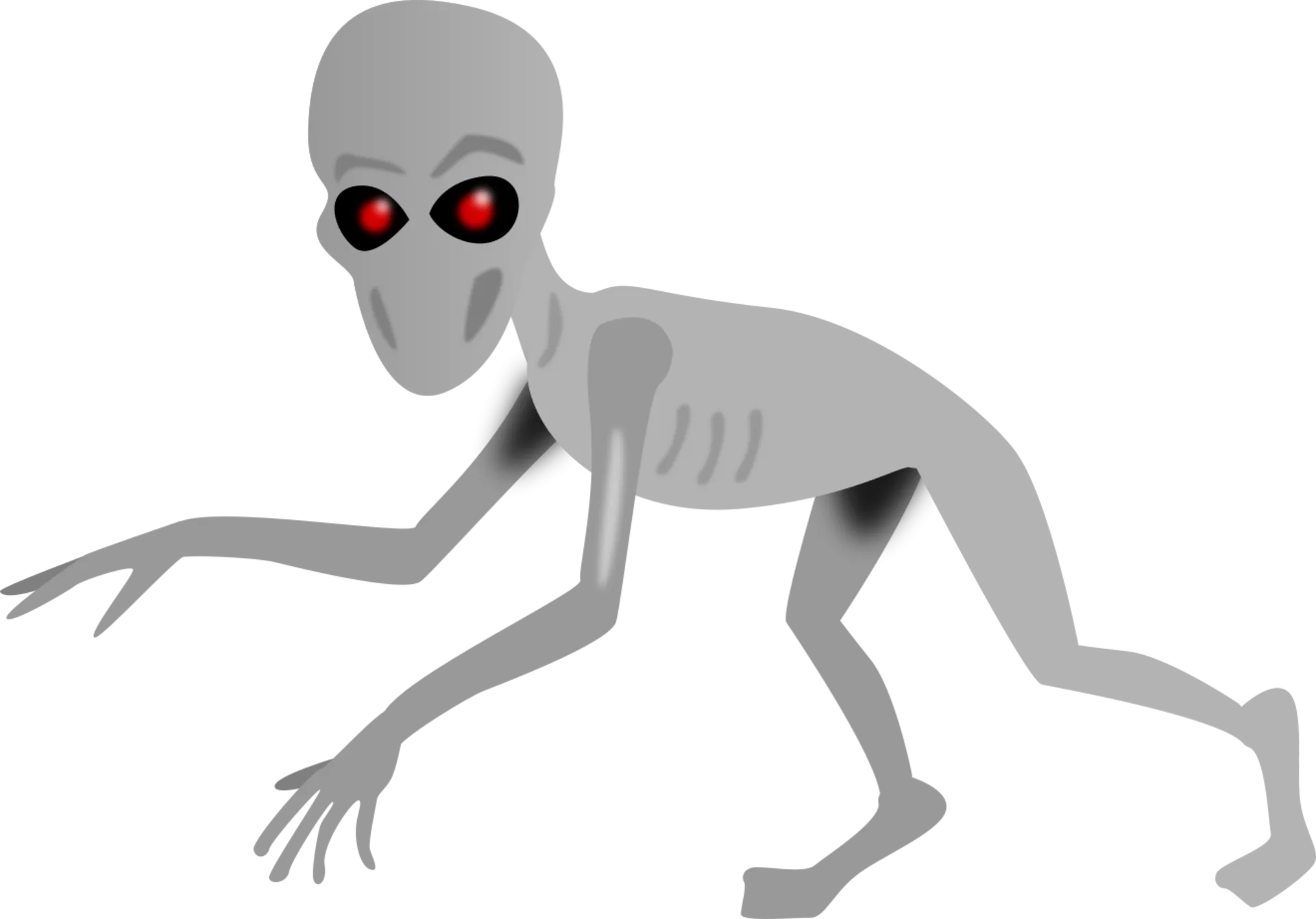
Dover is a quiet, well-off town of wooded lanes and stone walls about fifteen miles southwest of Boston. In 1977 it had around five thousand residents. Over roughly twenty-five hours that April, during the school vacation week, three separate groups of local teenagers reported seeing the same small, strange creature, and the episode has been known ever since as the Dover Demon.
What happened
At about ten on the night of April 21, seventeen-year-old Bill Bartlett was driving along Farm Street with friends when his headlights picked out something on a broken stone wall. By his account it was about four feet tall, with a thin neck and spindly limbs, a large head shaped like a watermelon, and two glowing orange eyes; he saw no nose, mouth or ears. His friends were looking elsewhere and saw nothing. Bartlett went home and drew it.
Around two hours later and roughly a mile away, fifteen-year-old John Baxter was walking home from his girlfriend’s house on Miller Hill Road when he saw a small figure coming toward him that he first took for a neighborhood child. It scrambled off across a gully by a creek, but he came within about fifteen feet of it, close enough to make out a figure-eight-shaped head and spindly limbs. He too made a sketch, and the two drawings were strikingly alike. The next night, around midnight, Abby Brabham, also fifteen, was being driven along Springdale Avenue by Will Taintor, eighteen, when she saw a hairless, monkey-like creature by the road. She said its eyes glowed green. Plotted on a map, the three spots fall in a nearly straight line about two miles long, each near water.
The investigation
The reports reached Loren Coleman, a young cryptozoologist, who interviewed all of the witnesses within a week and gave the creature its name. He concluded that the teenagers had not invented a hoax together, and he ruled out the two animals most often suggested: no horses had been reported missing and it was the wrong season for a foal, while moose were rare in Massachusetts at the time and a yearling calf would have been far too large. When the story spread through the Associated Press in mid-May, police were quoted as suspecting a school-vacation prank, yet the police chief, Carl Sheridan, later told the Boston Globe that he knew the teenagers and considered them reliable.
The explanations
In 2023 the investigator Joe Nickell argued for a snowy owl. A perched owl shows a rounded head with no visible neck, its ear openings and small beak are hidden in feathers, and splayed primary feathers can resemble long fingers. Snowy owls winter in the northeastern United States, favor open ground near water, and their white plumage would look pale or tan in headlights. Nickell also noted that Taintor knew of Bartlett’s sighting before Brabham reported hers, which could have shaped her description.
Benjamin Radford, also writing in the Skeptical Inquirer, stressed that the creature as drawn could not work: a head that size could not sit on so thin a neck. He reported that a timed reconstruction of Brabham’s sighting gave about five seconds, far shorter than her estimate, and judged a hoax and a misperceived ordinary object about equally likely. Brian Dunning of Skeptoid was unconvinced by the owl, since it would require four people to be fooled by the same bird in one day and nobody else ever again, and he dismissed the idea that the film Close Encounters of the Third Kind inspired the story, as it was released months later. He concluded the account was almost certainly untrue while declining to call the teenagers liars.
Where it stands
No one has reported the creature since 1977. Bartlett became a professional painter and has kept to his account for decades, saying he saw something he cannot explain and finding the attention a mixed blessing. The Dover Historical Society has sold T-shirts printed with his drawing. With four witnesses, no physical trace and plausible ordinary explanations that none of them accept, the case remains unproven.